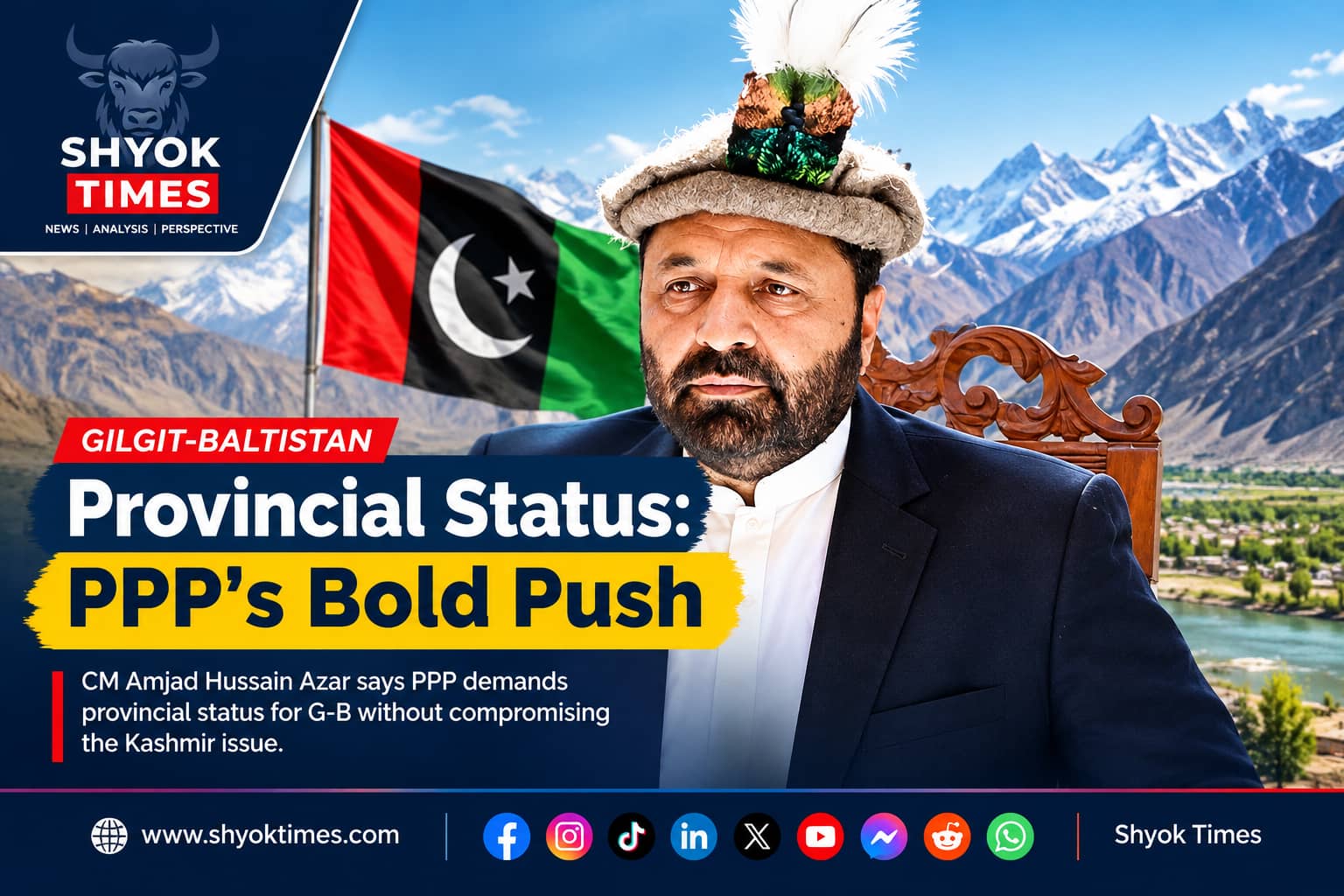
GB Provincial Status: CM GB Amjad Wants | Shyok Times
Gilgit-Baltistan Provincial Status: PPP’s Bold Push for Rights
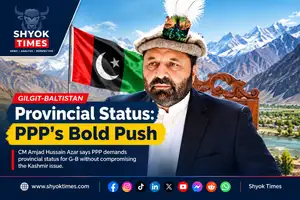
GILGIT-BALTISTAN / KARACHI: Gilgit-Baltistan provincial status has returned to the political spotlight after Chief Minister Amjad Hussain Azar said the Pakistan Peoples Party (PPP) was demanding provincial status for the region without compromising the Kashmir issue.
Addressing party workers in Karachi on Sunday, October 25, the chief minister also pledged to improve governance in Gilgit-Baltistan and make the region a model for Pakistan. He highlighted the growing population of Gilgit-Baltistan residents living in Sindh, particularly Karachi, and promised to address their concerns.
According to reports published on October 26, Azar said the PPP was committed to resolving the problems of the people of Gilgit-Baltistan and invited those interested in good governance to visit the region.
“We will make Gilgit-Baltistan a model for Pakistan,” he said.
PPP Demands Provincial Status Without Compromising Kashmir Issue
The chief minister reiterated the PPP’s position that Gilgit-Baltistan should receive provincial status while maintaining Pakistan’s position on the Kashmir dispute.
The constitutional status of Gilgit-Baltistan has remained a significant political issue for decades. Residents and political leaders have repeatedly called for stronger constitutional protections, greater representation in national decision-making, and a fairer share of federal resources.
The demand involves balancing the aspirations of Gilgit-Baltistan’s population with the unresolved Kashmir dispute. The PPP has advocated an arrangement that would provide greater constitutional and political rights without compromising the Kashmir issue.
However, provincial status has not been granted merely by the chief minister’s latest statement. Any change would require a formal constitutional and legal process involving the relevant institutions and stakeholders.
The federal government confirmed in September 2026 that consultations were underway on the region’s future constitutional and legal arrangements. Those discussions included administrative, financial and constitutional questions, with officials stressing the importance of national consensus.
Karachi’s Gilgit-Baltistan Community Also in Focus
During his address, Azar drew attention to the increasing number of people from Gilgit-Baltistan living in Sindh, particularly Karachi.
Many residents of Gilgit-Baltistan move to major cities for employment, education, business and other opportunities. Their concerns can include access to housing, public services, employment opportunities and community facilities.
The chief minister pledged that the PPP would work to resolve the problems faced by people from the region living in Sindh.
His remarks placed the concerns of the Gilgit-Baltistan diaspora alongside the broader debate over the region’s constitutional rights and governance.
For many families living away from their home region, practical measures addressing everyday difficulties are as important as political promises. Progress will depend on coordination between the Gilgit-Baltistan government, the Sindh government and relevant federal authorities.
Good Governance and Development Commitments
Azar also invited people interested in assessing governance to visit Gilgit-Baltistan, expressing confidence that the region could become a model for Pakistan.
The statement sets an ambitious benchmark for the regional administration. Achieving it would require measurable improvements in public services, transparency, infrastructure and economic opportunities.
Key areas of public interest include:
- Education: Improving access to quality education and strengthening educational institutions.
- Healthcare: Expanding access to reliable medical services, particularly in remote valleys.
- Employment: Creating opportunities for young people and improving access to jobs.
- Infrastructure: Addressing transport, electricity and other essential service challenges.
- Economic development: Supporting tourism, trade, local businesses and sustainable investment.
- Public accountability: Ensuring that government commitments translate into visible improvements in people's lives.
These priorities are particularly important in a mountainous region where remote communities can face geographical and infrastructure-related barriers to public services.
The chief minister’s pledge will ultimately be assessed through implementation, budgetary decisions and improvements experienced by residents.
Why Gilgit-Baltistan’s Constitutional Status Matters
Gilgit-Baltistan has an elected assembly and regional government, but its constitutional position differs from that of Pakistan’s four provinces. The region also lacks the same level of representation in the federal Parliament as the provinces.
This difference has fuelled longstanding demands for greater political representation, constitutional certainty and participation in national resource-sharing arrangements.
The debate extends beyond the formal designation of the region. It also concerns the powers of elected representatives, access to federal resources, legal protections and the ability of local institutions to make decisions affecting residents.
The federal government’s ongoing consultations indicate that the issue remains under consideration. Any durable solution will need to address the region’s governance requirements while accounting for the legal and diplomatic sensitivities surrounding Kashmir.
For residents, the central question is whether the process will produce meaningful rights, stronger institutions and a clearer constitutional framework.
What Happens Next?
The PPP’s latest statement reinforces its commitment to pursuing provincial status for Gilgit-Baltistan without compromising the Kashmir issue. However, the next steps will depend on formal consultations, political consensus and decisions by the relevant constitutional authorities.
The public will also expect progress on everyday concerns, including employment, education, healthcare, infrastructure and the problems faced by Gilgit-Baltistan residents living in other parts of Pakistan.
Azar’s promise to make the region a model for Pakistan is therefore both a political commitment and a governance challenge. Delivering on it will require sustained administrative work, transparent decision-making and cooperation among regional and federal institutions.
For now, the demand for provincial status remains a central issue in Gilgit-Baltistan’s political future, with residents awaiting concrete progress on constitutional rights and public welfare.
External Resources (DoFollow):
Follow more on Tribune: PPP wants provincial status for G-B: CM