
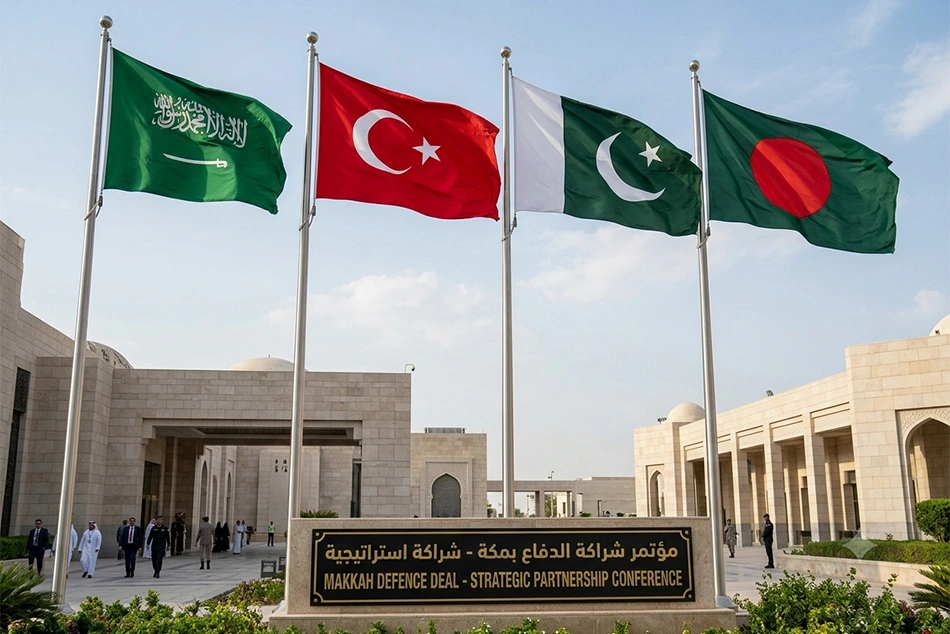
Bangladesh Moves Toward Joining Saudi-Turkiye-Pakistan Makkah Defence Pact
Shyok Times News Desk
Bangladesh to Join Saudi-Turkiye-Pakistan Makkah Pact Signals Expanding Regional Defence Bloc
Bangladesh to Join Saudi-Turkiye-Pakistan Makkah Pact is emerging as a major diplomatic development in South and West Asian geopolitics, as Dhaka signals openness to becoming part of the expanding Makkah Joint Defence Agreement, originally signed between Saudi Arabia, Turkiye, and Pakistan in August 2026.
According to reports from Bangladeshi and regional media, officials in Dhaka have indicated that the country is “considering its options” regarding participation in the pact, depending on national interests and regional stability considerations.
The development comes just weeks after Saudi Arabia, Turkiye, and Pakistan formalised the landmark defence framework in Makkah, establishing a collective security arrangement in which an attack on one member is treated as an attack on all.
What is the Makkah Defence Pact?
The Makkah Joint Defence Agreement is a strategic trilateral security arrangement signed on August 7, 2026, in the holy city of Makkah by:
- Saudi Arabia
- Turkiye
- Pakistan
The agreement is based on a NATO-style collective defence principle, meaning any armed attack against one member is considered an attack against all.
Officials from the three countries have described the pact as a defensive and stability-oriented framework, not directed against any specific country, and focused on regional peace and deterrence.
Bangladesh’s Position
Reports suggest that Bangladesh has not formally joined the agreement yet but has expressed willingness to explore participation in the future.
Dhaka’s response is being interpreted as a careful diplomatic signal rather than a firm commitment. Officials emphasise that any decision will be based on:
- National security interests
- Regional diplomatic balance
- Economic and strategic cooperation opportunities
Analysts believe this reflects Bangladesh’s broader effort to diversify its defence and foreign policy partnerships while maintaining neutrality in regional rivalries.
Why This Development Matters
If Bangladesh eventually joins the pact, it could significantly reshape regional geopolitics in several ways:
1. Expansion of a New Security Bloc
The Makkah Pact would evolve from a trilateral alliance into a broader multi-country defence framework, increasing its strategic weight in Asia and the Middle East.
2. South Asian Strategic Shift
Bangladesh’s potential entry would align it more closely with Pakistan, Turkiye, and Saudi Arabia, creating a new layer of regional cooperation in South Asia.
3. Balance of Power Implications
Experts suggest the expansion could influence existing regional alignments, particularly in relation to:
- India’s strategic environment
- Gulf security architecture
- Emerging multi-polar defence systems
Reactions and Regional Context
The original pact itself was formed amid rising tensions in the Middle East and growing concerns over regional security stability. The agreement has been widely seen as part of a broader shift toward regional self-reliance in defence cooperation.
While some analysts view it as a “new security architecture,” participating governments maintain that it is not a military bloc or aggressive alliance, but a framework for collective deterrence and cooperation.
Conclusion
The indication that Bangladesh to Join Saudi-Turkiye-Pakistan Makkah Pact remains under consideration marks a potentially important expansion of one of the most closely watched defence arrangements in recent years.
If formalised, Bangladesh’s entry could transform the Makkah Pact from a trilateral agreement into a wider regional security platform with significant geopolitical consequences across Asia and the Middle East.
For now, the development remains at the consultative stage, but it signals growing momentum around new regional alliances reshaping global security dynamics.