France Unrest: Macron Vows Action After 2,400 Arrests | Shyok Times
France Unrest: Macron Condemns Violence After 2,400 Arrests
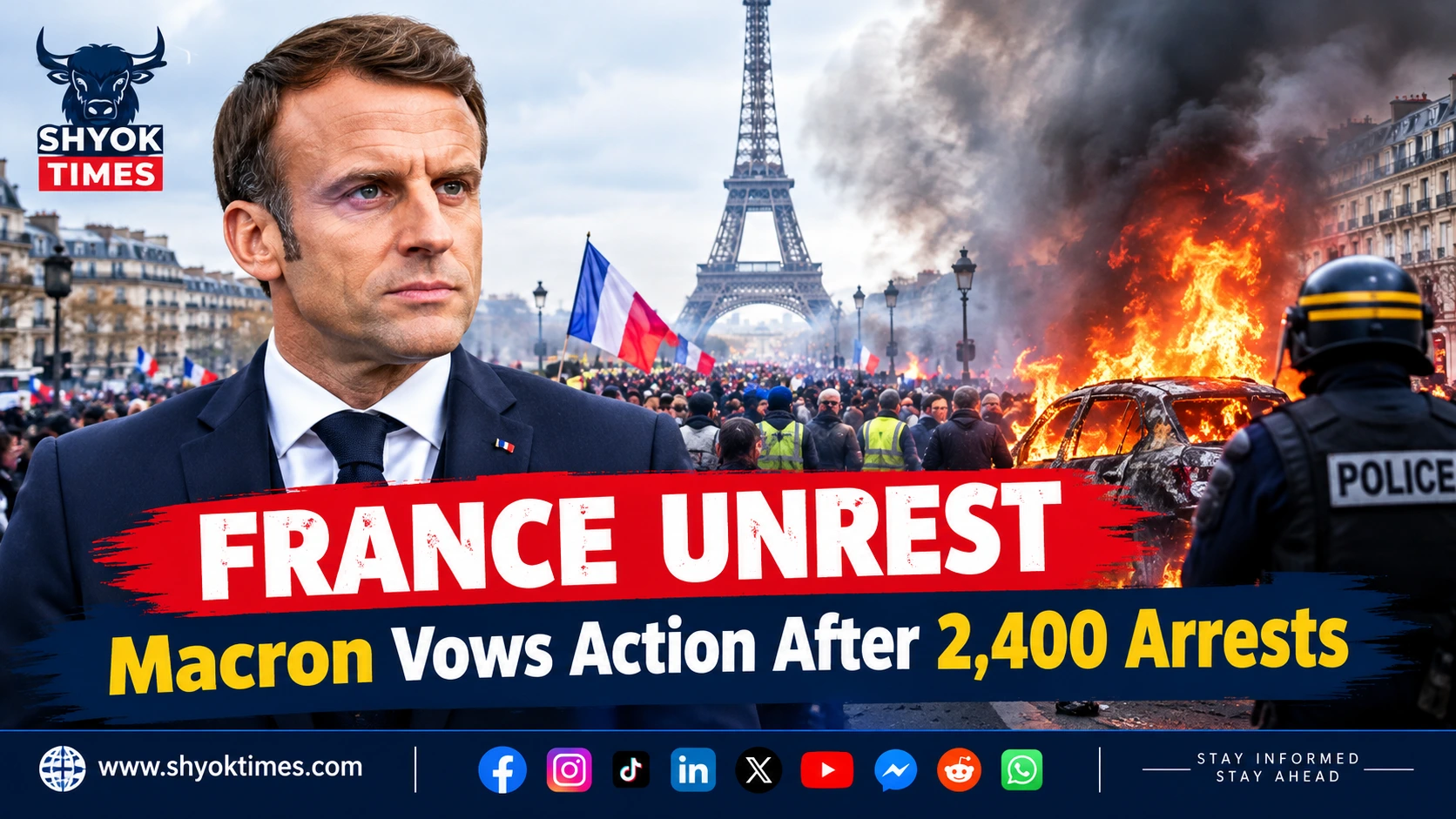
Paris: France unrest intensified after nationwide demonstrations over rising living costs, fuel prices and deteriorating public services descended into riots, looting and arson in several cities, prompting President Emmanuel Macron to condemn the violence and promise accountability for those responsible.
French authorities reported nearly 2,400 arrests following the unrest on Saturday, October 17, with further clashes reported on Sunday in Paris and Marseille. The violence damaged businesses and public buildings, while the historic town hall in Limoges was severely damaged by fire. Authorities also reported widespread injuries among police and gendarmes.
In a televised address on Sunday evening, Macron said the destruction could not be justified and insisted that those who looted businesses or damaged public property would face the consequences.
“Those who destroyed must pay,” he said, according to the reports. He also stressed that peaceful demonstrators with legitimate concerns should not be confused with people who used the protests as an opportunity for violence.
The events have raised questions about public security, the government's handling of demonstrations and the growing frustration surrounding the cost of living and the quality of public services in France.
What happened during the France unrest?
The demonstrations brought hundreds of thousands of people onto the streets across France. Many participants protested against rising household expenses, higher fuel prices and concerns about schools and other public services.
Although many demonstrations were peaceful, groups of people engaged in violent confrontations with police, set fires, vandalised buildings and looted shops. The most serious incidents were reported in Paris, Marseille, Lyon and Limoges, with disturbances also affecting other cities.
🚨 JUST IN
— Mambo Italiano (@mamboitaliano__) October 17, 2026
Due to the riots in France, the magnificent City Hall of Limoges, inaugurated in 1883, has been set on fire
It was considered a historic monument, with a beautiful 141-foot-high bell tower that has collapsed
I am truly speechless and furious pic.twitter.com/n9gqieSPjX
According to the Agence France-Presse, nearly 2,400 people were arrested on Saturday, while almost 1,000 police officers and gendarmes were injured, including seven who were seriously hurt. These figures reflect the higher totals reported on Sunday, after earlier updates had cited lower arrest and injury numbers.
The scale of the violence placed pressure on police, local authorities and the national government as emergency services worked to restore order and communities began assessing the damage.
Macron vows accountability for rioters and looters
Macron's address sought to draw a clear line between the right to demonstrate and acts of criminal destruction.
The French president condemned what he described as unrestrained violence and said those responsible for damaging property or looting businesses would be held accountable. He also criticised groups he characterised as radical far-left activists, alongside people he said had exploited the demonstrations to commit crimes.
His remarks came as images of burning vehicles, damaged storefronts and smoke rising above urban streets circulated widely. The scenes raised concerns about public safety and the ability of local authorities to protect residents, businesses and public institutions during large demonstrations.
Macron nevertheless acknowledged the importance of distinguishing peaceful demonstrators from violent groups. Many people who joined the marches were expressing concerns about their financial circumstances, education and access to reliable public services.
That distinction is important to understanding the crisis. A protest movement can contain people with different motivations, and the actions of those involved in looting or arson do not automatically represent the intentions of everyone who attends a demonstration.
The government now faces the dual challenge of enforcing the law while addressing the concerns that brought so many people onto the streets.
Limoges town hall damaged in devastating fire
One of the most striking incidents occurred in Limoges, a city in central-western France, where a fire severely damaged the historic town hall during Saturday's unrest.
Reports described flames engulfing the building, with footage showing part of its roof structure and spire collapsing. The incident became a symbol of the scale of the damage caused during the demonstrations and raised concerns about the protection of historic public buildings.
In Marseille, masked individuals reportedly entered the city hall and damaged parts of the building. Lyon also experienced violence, including damage to the city's tourist office. In Paris, fires, smashed shopfronts, vandalised streets and confrontations between demonstrators and riot police added to the destruction.
The incidents affected more than government property. Shops and other businesses faced broken windows, damaged premises and losses linked to looting.
These attacks also created a wider public concern: when public buildings and local businesses are targeted, the consequences extend beyond the immediate cost of repairs. Residents may lose access to local services, workers may be unable to do their jobs, and small businesses may face financial difficulties after losing stock or being forced to close.
The full financial cost of the damage had not been established in the reports available on Sunday.
Paris sees fresh clashes as police deploy tear gas
Paris remained a focal point of the unrest on Sunday, with fresh confrontations reported around Place de la République, a prominent public square that has hosted numerous political demonstrations.
Police deployed tear gas and other crowd-control measures as groups gathered in the area. Reports also described burning bicycles, smoke from fires, objects thrown at officers and attempts to damage nearby property. Further clashes were reported in Marseille as police moved to prevent additional looting.
The violence followed a night in which groups of people moved through city streets, damaging storefronts and setting fires. Officers responded with crowd-control tactics, including tear gas and baton charges, according to media reports.
The events created a difficult situation for law enforcement. Authorities had to manage large demonstrations while responding to smaller groups involved in vandalism, arson and looting across different locations.
The unrest also raised questions about whether security agencies had sufficient information and personnel to anticipate the scale of the demonstrations.
Macron said the government would examine whether there had been failures in intelligence gathering or police preparation. Such a review could help officials understand how the violence spread and what measures might reduce the risk of similar incidents.
Why are people protesting in France?
The demonstrations reflect frustration over economic pressures and concerns about the quality of public services.
Rising cost of living
Higher household expenses can place pressure on families whose wages have not kept pace with the cost of essentials. Fuel prices, transport costs, food and housing expenses can all influence how people view the government's economic policies.
For workers who depend on vehicles to reach their jobs, fuel costs can be particularly important. In areas where public transport is limited, rising prices may leave households with few affordable alternatives.
The latest protests brought these financial concerns into a wider national debate about living standards and the government's response to economic pressure.
Concerns about schools and education
Education was another reported focus of the demonstrations. Participants raised concerns about conditions in schools and the state of public services.
Teachers, students and families can be affected by staffing shortages, crowded classrooms, limited resources and uncertainty over public funding. When concerns about education overlap with broader economic dissatisfaction, demonstrations can attract people from different backgrounds and communities.
However, the specific demands of individual protesters may differ, and the available reports do not establish that every demonstration was organised around the same set of objectives.
Deteriorating public services
Public services are central to the relationship between citizens and the state. Schools, healthcare, transport and local government services shape people's everyday experiences of public policy.
When residents believe services are becoming less reliable while household expenses increase, frustration can grow. The demonstrations highlighted these concerns, but the violence that accompanied some gatherings complicated efforts to focus public attention on the underlying issues.
Addressing these grievances requires more than restoring order. It also calls for clear communication, credible public spending decisions and meaningful engagement with affected communities.
Government faces criticism over its response
The scale of the unrest triggered criticism of the government's preparations and policing strategy.
Opposition politicians questioned whether officials had adequately anticipated the size of the demonstrations and the potential for violence. Some called for Interior Minister Laurent Nuñez to resign, while local officials sought greater support to repair damaged public buildings and assist affected businesses.
The criticism centres on several issues: whether intelligence about planned disturbances was sufficient, whether police resources were deployed effectively, and whether public authorities could protect important locations without escalating confrontations.
These questions are especially sensitive during large demonstrations because police must balance public safety with the right to peaceful assembly.
A response that fails to prevent widespread destruction can undermine public confidence. At the same time, excessive or poorly targeted enforcement can intensify tensions and raise concerns about the treatment of peaceful demonstrators.
Macron said authorities would review the response and learn lessons from the events. He also indicated that local officials could be given greater powers to restrict certain gatherings where necessary to protect public buildings and businesses.
The government has not, according to the reports reviewed, declared a nationwide state of emergency or imposed a nationwide curfew in response to these events.
How the unrest is affecting businesses and local communities
The damage has created immediate challenges for shopkeepers, workers, residents and local authorities.
Businesses affected by looting or vandalism may need to replace broken windows, repair doors, assess damaged stock and arrange additional security. Some may be unable to reopen until repairs are completed or their premises are considered safe.
The consequences can be especially serious for independent retailers operating on narrow profit margins. Even a short closure can interrupt cash flow, affect employees' wages and make it harder to meet rent or supplier payments.
Public authorities also face significant costs. Damaged municipal buildings, transport infrastructure and street furniture require inspections, repairs and, in some cases, extensive reconstruction.
The disruption can affect people who were not involved in the demonstrations. Residents may face blocked streets, transport interruptions, temporary closures of local services and concerns about personal safety.
For workers who rely on daily earnings, transport disruptions and closed workplaces can create additional financial pressure.
The longer-term effects will depend on the scale of the damage, how quickly services return to normal and whether businesses receive adequate support. The available reporting does not yet provide a comprehensive national estimate of total losses.
Arrest figures and reported injuries: What is confirmed?
The numbers reported during the crisis changed as authorities issued updated information. Readers should therefore distinguish between early estimates and later totals.
Issue Reported position by October 18
Arrests Nearly 2,400, according to AFP's report citing authorities
Police and gendarme injuries Almost 1,000 reported by AFP, including seven serious injuries
Demonstration attendance Hundreds of thousands; estimates varied between reports
Property damage Fires, looting and vandalism reported in multiple cities
Fatalities Reports differed; a protester was reported to have died after a cardiac arrest
Sources: AFP, Reuters and Associated Press.
The arrest total should not be interpreted as a count of people convicted of crimes. Arrests, charges and convictions are separate stages of the legal process, and each person's case must be assessed individually.
The reports also contain differing injury figures, partly reflecting the timing of official updates and the scope of the numbers being counted. For publication, the higher Sunday figures should be attributed to the specific reporting outlet rather than presented as an independently verified final tally.
Fatality reporting requires particular caution. Reuters reported that one demonstrator died after a cardiac arrest during protests in Paris. The source material supplied for this article also included a separate claim about a police officer's death, but that detail was not consistently corroborated in the major reports reviewed. It is therefore not presented here as an established fact.
What happens next in France?
The immediate priority for French authorities is to restore public order, protect communities and help affected businesses and municipalities recover.
Police and local officials will also face pressure to explain how the disturbances developed and whether security arrangements were adequate. Any review of the response will need to consider the scale of the crowds, the spread of violence between cities and the difficulty of protecting multiple locations simultaneously.
The government must also decide how to respond to the economic and public-service concerns that fuelled the demonstrations. Stronger policing may help prevent further damage, but it cannot by itself resolve dissatisfaction over living costs, education or public spending.
Macron indicated that the government would bring together representatives from different sectors, including students, teachers, political figures and business leaders, to discuss practical proposals. The outcome of those discussions will be important in determining whether officials can translate public frustration into policy measures.
The unrest also comes as France approaches its 2027 presidential election, adding political significance to the government's handling of public anger and public safety. Political opponents have used the events to question the administration's competence, while the government has emphasised the need to distinguish peaceful demands from criminal acts.
For residents and businesses, the most immediate questions are more practical: whether streets and services will return to normal, how damaged properties will be repaired, and whether further demonstrations will take place.
The coming days should provide a clearer picture of the economic damage, the progress of investigations and the government's plans to address public concerns.
Frequently asked questions about the France unrest
Why did protests turn violent in France?
The demonstrations were driven by concerns about rising living costs, fuel prices, education and deteriorating public services. Although many participants demonstrated peacefully, groups also engaged in looting, arson, vandalism and clashes with police.
How many people were arrested in France?
Authorities reported nearly 2,400 arrests following the unrest on October 17, according to an AFP report published on October 18, 2026. Earlier reports cited lower figures as the situation developed. Arrests do not mean that everyone detained has been convicted of an offence.
Which French cities were affected?
Paris, Marseille, Lyon and Limoges were among the cities reporting serious incidents. The unrest included damage to shops, confrontations with police, fires and attacks on public buildings.
What did Emmanuel Macron say about the violence?
Macron condemned the destruction and said those responsible for looting or damaging property would be held accountable. He also stressed that peaceful demonstrators with legitimate concerns should not be equated with people who committed acts of violence.
Has France declared a state of emergency?
The reports reviewed on October 18 said Macron had stopped short of declaring a nationwide state of emergency or imposing a nationwide curfew. He indicated that local officials could restrict certain gatherings when necessary to protect public buildings and businesses. The situation may change as authorities issue further announcements.
What is the main issue behind the demonstrations?
The reported grievances include rising living costs, fuel prices, concerns about school conditions and dissatisfaction with public services. The protests brought several strands of public frustration together, although individual participants may have had different motivations.
Conclusion: France faces a test of public trust
The latest France unrest has exposed the difficult balance between protecting the right to peaceful protest, maintaining public order and responding to economic dissatisfaction.
Macron has promised accountability for those responsible for violence, while the government faces scrutiny over its handling of the demonstrations. Meanwhile, residents, business owners and local authorities must deal with damaged property, disrupted services and the cost of recovery.
Restoring calm is an immediate priority, but rebuilding public confidence will require more than security measures. The government's longer-term challenge is to respond credibly to concerns about living costs, education and public services while ensuring that peaceful demonstrators are not held responsible for the actions of violent groups.
Reporting note: This article reflects reports available on October 19, 2026. Arrest, injury and fatality figures may change as French authorities publish further updates.
External Resources (DoFollow):
Follow more on The Guardian: Macron criticises ‘unbridled violence’ after unrest across France
Read further at BBC: Paris streets after protests turn to riots and looting
Keep reading via CNN : France’s Macron vows to hold accountable