
Kyiv SBU Drone Strike: Shocking 8-Day Assault Jolts Ukraine's Capital | Shyok Times
Shyok Times News Desk
The Kyiv SBU drone strike on Friday marked one of the most alarming escalations of Russia's aerial campaign against Ukraine's capital in the four-and-a-half-year war, slamming directly into the headquarters of Ukraine's Security Service (SBU) in broad daylight. The attack, confirmed by Ukrainian President Volodymyr Zelensky, struck a building that has never before been hit during the entire conflict, underlining how badly Kyiv's air defences have been stretched by days of relentless Russian bombardment.
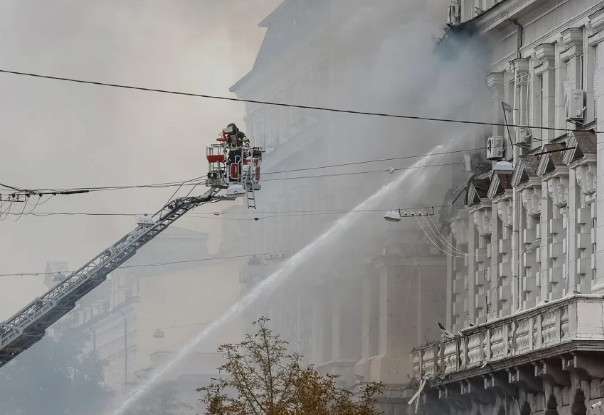
The Kyiv SBU drone strike hit the SBU's central building on Volodymyrska Street, directly across from the UNESCO-listed St. Sophia Cathedral and just up the road from the historic Golden Gate landmark. Witnesses reported hearing a loud explosion in the early afternoon, followed by thick black smoke billowing over the heart of the Ukrainian capital. Local authorities said the number of people injured ranged between five and twelve depending on the source, with emergency crews, ambulances, and armed officers quickly cordoning off the surrounding streets.
A Direct Hit on Ukraine's Intelligence Nerve Center
According to Zelensky, the drone involved in the Kyiv SBU drone strike was not a stray munition but a deliberate, targeted hit. He said the drone was aimed squarely at the office of Oleksandr Poklad, the SBU's acting chief, though Poklad was reportedly not in his office when the strike occurred and was later confirmed safe.
"The drone was aimed directly at the office of the Head of the Security Service in that building," Zelensky said, describing the incident on his official channels shortly after the attack.
This is a significant milestone in the war. Russia has targeted Ukrainian government infrastructure before, but security analysts note it had never previously managed to strike a building of such strategic importance — Ukraine's primary domestic intelligence and counter-espionage agency — during daylight hours. The SBU functions much like the FBI in the United States or MI5 in the United Kingdom, but with an added wartime mandate: it has been central to some of Ukraine's most daring operations against Russia, including long-range drone raids that damaged Russian strategic bomber fleets far from the front lines.
The Eighth Day of a Relentless Barrage
The Kyiv SBU drone strike did not occur in isolation. It came at the tail end of roughly eight straight days of intensified Russian aerial attacks on Kyiv, a campaign that has included strikes on residential buildings, government offices, factories, and warehouses across the city and surrounding region. Officials say the ongoing wave of attacks has killed more than 50 people and injured well over 100 in the greater Kyiv area since it began last month, making it one of the deadliest sustained assaults on the capital in recent memory.
Much of the destructive power behind this surge has come from a newer generation of jet-powered attack drones capable of reaching speeds close to 500 kilometres per hour (around 310 mph). These drones fly too fast for Ukraine's mobile air-defence fire teams to intercept and can only realistically be countered by dedicated ground-to-air missile systems or fighter jets — both of which Kyiv has in critically short supply. That shortage, particularly of US-made Patriot interceptor missiles, has become one of the defining vulnerabilities of Ukraine's war effort in 2026.
Scenes From the Ground
Businesses near the SBU headquarters bore the brunt of the shock-wave. A nearby café reported that all of its windows were shattered by the blast, with a customer injured while eating inside. Staff and patrons rushed into an underground shelter afterwards, wary of a "double-tap" strike — a tactic Russia has used elsewhere in the war, where a second drone targets the same site shortly after the first in order to hit first respondent and rescue workers arriving at the scene. No second strike followed, though those sheltering nearby said they remained on edge for hours afterwards.
Kyiv's mayor said the incident also damaged a non-residential building in the city's Shevchenkivskyi district, and emergency respondent were dispatched to multiple points across the area throughout the afternoon.
Zelensky Vows a "Tangible Response"
In the immediate aftermath of the Kyiv SBU drone strike, Zelensky said he had instructed Poklad to prepare a retaliatory measure. He said the response should be "appropriate, tangible" and, where feasible, one that "mirrors" the nature of the attack — a signal that Ukraine may be weighing strikes against comparable Russian intelligence or security infrastructure. Zelensky added that Ukraine's military would support whatever action the SBU ultimately takes.
Ukraine's Foreign Minister, Andrii Sybiha, condemned the strike in similarly forceful terms, calling it a "major escalation" and urging international partners to increase pressure on Moscow. Sybiha specifically linked the timing of the attack to stalled diplomacy, arguing that it undercut renewed peace efforts, since the strike happened just ahead of a planned visit to the region by senior American negotiators.
I spoke with the Head of the Security Service of Ukraine, Oleksandr Poklad. Unfortunately, a Russian drone struck the central building of the Security Service of Ukraine on Volodymyrska Street in Kyiv, across from St. Sophia Cathedral. All emergency services are on the scene.…
— Volodymyr Zelenskyy / Володимир Зеленський (@ZelenskyyUa) September 4, 2026
Timing Raises Fresh Diplomatic Questions
The Kyiv SBU drone strike landed just two days before US special envoy Steve Witkoff and presidential adviser Jared Kushner were expected to arrive in Kyiv as part of ongoing efforts to broker an end to the war. Those diplomatic efforts have largely stalled in recent months as Washington's attention shifted toward other global conflicts, and this latest strike is likely to complicate any near-term momentum toward negotiations.
Zelensky had previously called on Russia to pause hostilities during the American delegation's visit and offered assurances that Ukraine would not target Russian airspace while US officials were also expected in Moscow. The strike on the SBU building, hitting Ukraine's own security apparatus just days before that visit, is being read by some observers as a pointed message from Moscow rather than a coincidence of timing.
Why This Strike Matters
Government buildings in central Kyiv have historically been difficult for Russian forces to hit accurately, and even more rarely have they been struck during the day, when air defences and awareness are typically at their highest. The success of the Kyiv SBU drone strike — regardless of the precise casualty figures still being finalised by Ukrainian authorities — demonstrates a worrying capability gap opening up in Ukraine's air-defence network as the war grinds into its fifth year.
Military analysts point to a combination of factors: the sheer number of drones Russia can now launch on any given day, evolving jet-powered drone technology that outpaces existing countermeasures, and dwindling stockpiles of Western-supplied interceptor missiles. Together, these trends suggest that even hardened, high-value targets in the heart of the capital are no longer guaranteed protection.
For residents of Kyiv, the psychological toll of the ongoing barrage is also mounting. Around the damaged café near the SBU building, staff described a weary, watchful mood — an acknowledgement that after eight straight days of attacks, another strike could come at almost any time.
External Resources (DoFollow Links)
Read more on The Guardian: Russia strikes Ukraine intelligence HQ in ‘major escalation’
Follow further at CNN: Russia strikes Ukraine Security Service headquarters in central Kyiv