France Protest Misinformation: Fake Reports | Shyok Times
France Student Protests Misinformation:
How Far-Right Figures Weaponised a School Crisis With Falsified Video Evidence
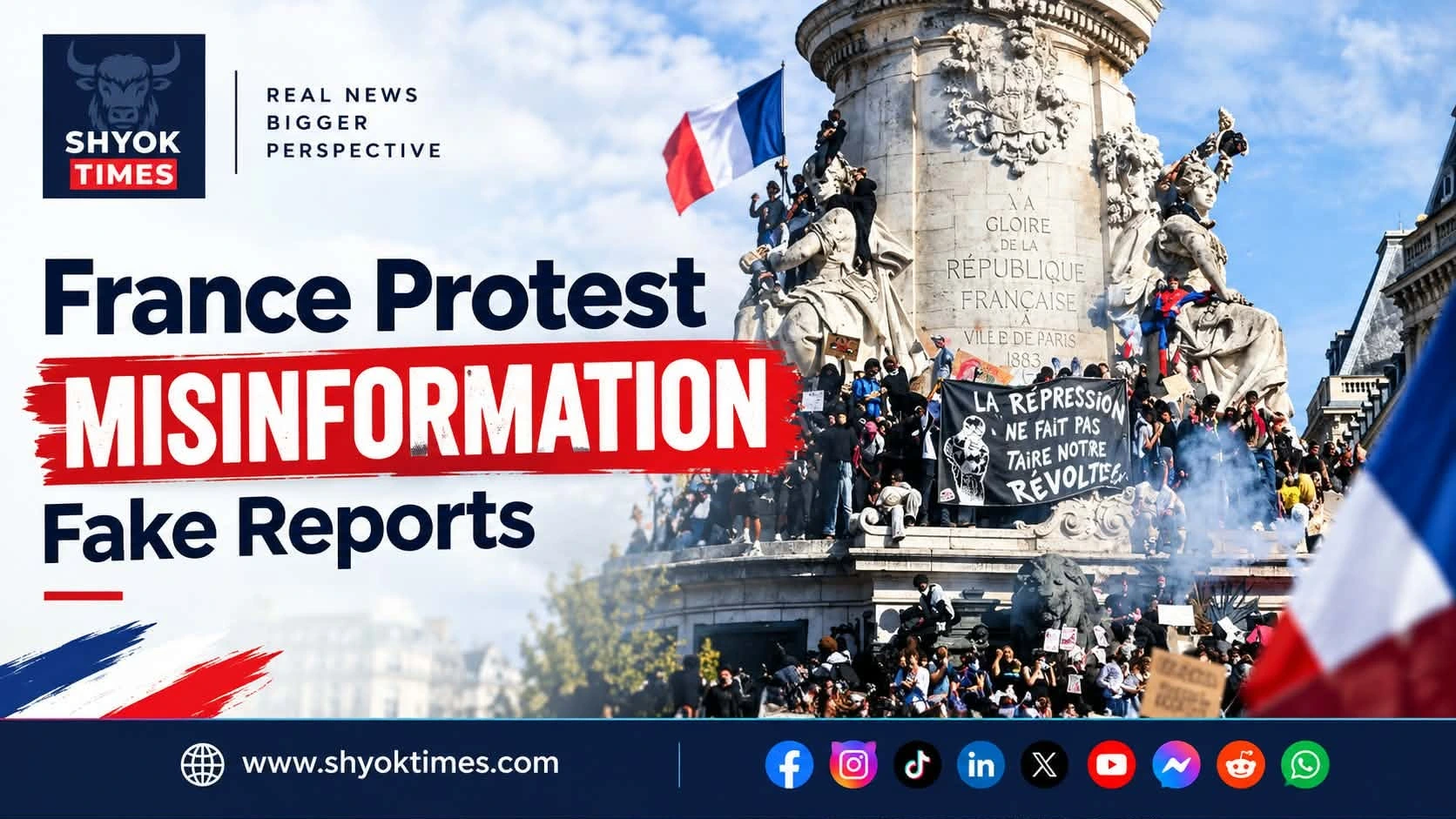
In the third week of France's nationwide France student protests misinformation campaign has emerged as a parallel crisis. A wave of false and misleading videos, amplified by far-right figures across the United States and United Kingdom, has been used to recast a movement over school conditions as evidence of an "anti-white civil war" and an Islamist uprising linked to uncontrolled immigration. The core falsehood is simple but potent: the protests are about education, not immigration. Yet recycled footage from 2022, clips from football celebrations, and AI-generated imagery have been stitched together into a narrative that bears little resemblance to events on the ground.
The Misinformation Architecture: How False Videos Spread
The France student protests misinformation campaign did not emerge organically. It was constructed through a deliberate process of decontextualisation—taking real footage from unrelated events, stripping its original context, and repackaging it as evidence of a civilisational conflict.
One of the most widely shared examples is a video captioned simply "France has fallen." Viewed millions of times, it shows smoke around the Eiffel Tower and large crowds gathering in Parisian streets. The footage was filmed in May 2025, when Paris Saint-Germain fans gathered to celebrate the club's Champions League victory—a football celebration, not a protest.
Another viral video, shared by British far-right activist Tommy Robinson and viewed nearly 800,000 times, shows overturned vehicles and burning barricades. That footage was originally published on 24 December 2022 by video journalist Rémy Buisine, covering a Kurdish community demonstration in Paris following the killing of three activists near a Kurdish cultural centre.
The pattern repeats across platforms: old footage of pension reform protests from 2023, retirement demonstrations, and even unrelated international events are presented as current evidence of French collapse. An AI-generated image falsely depicted a policewoman being chased and beaten during a school blockade—content that never happened.
Alex Jones and the "Anti-White Civil War" Narrative
In the United States, conspiracy theorist Alex Jones has been among the most prolific amplifiers of France student protests misinformation. Jones shared lengthy video compilations about the protests, using them to promote an explicitly Islamophobic narrative. He claimed France was experiencing an "anti-white civil war," with "dead bodies everywhere".
There is no evidence to support these claims. No deaths have been reported in the current protests, and the demonstrations are centred on concerns over class sizes, teacher shortages, and deteriorating school facilities—not immigration.
Jones's video compilations have included footage of a burning bus—actually a school bus that caught fire in Nîmes in 2022, with no casualties. He has also claimed to have seen "at least a dozen videos of Catholic priests being set on fire," a claim for which no evidence exists in connection with the current student protests.
The broader context of Jones's involvement adds a layer of credibility concern. He still owes Sandy Hook victims $1.4 billion for claiming the school shooting never happened and was staged by child actors—a defamation judgment that underscores his willingness to propagate demonstrably false narratives for ideological purposes.
Tommy Robinson and the "Green/Islamic Holy Alliance"
In the United Kingdom, Tommy Robinson has pursued a parallel strategy. The anti-immigration activist described a video as evidence of a "green/Islamic holy alliance" spreading through Western Europe and the United States, claiming what was happening in France would spread to other countries.
The footage he shared was not new. It showed the aftermath of a protest in Paris and had been circulating online since 2022—rendering it useless as evidence of the current student demonstrations.
Robinson has also posted about what he calls "occupied France," sharing footage of violence and looting. Some of this footage is genuine and does show incidents linked to the current protests. However, the authenticity of individual clips does not substantiate the broader immigration-focused claims being made. This is a critical distinction: real footage, when stripped of context and subordinated to a false narrative, becomes a tool of deception rather than documentation.
The Real Protest: What Students Are Actually Demanding
The France student protests misinformation campaign obscures a genuine and urgent crisis in French education. Since late September, students across France have been blocking high schools and marching in cities including Lille, Rennes, Nantes, Lyon, Toulon, and Marseille.
At the heart of the movement are concrete, material grievances. Nearly 10% of teaching hours are unstaffed in French state high schools, according to education ministry figures. The disparity is stark: the 10% of schools most affected by unstaffed teaching hours lose 19% of instruction time—six times more than the least affected schools.
Students describe crumbling infrastructure, absent teachers, and classrooms that reach 40°C in summer. "We have one nurse for 2,000 students, no maths teacher, no toilet paper," said Daniela, a 15-year-old student, speaking to Monocle from a school blockade. Another student told the BBC: "Sometimes our teachers are absent for several weeks without being replaced. Our school buildings were boiling hot during the recent heat waves."
The consequences are measurable. French 15-year-olds scored 43 points lower in reading in 2025 than in 2015, according to the OECD's Programme for International Student Assessment—the biggest drop among OECD countries. Their maths scores also declined the most.
Students and unions have demanded €10 billion in urgent investment in France's schools. An Elabe poll for BFM TV found that 72% of French people consider the students' demands legitimate, though 55% believe the protests should stop.
Government Response and Police Brutality Allegations
The French government's response has been halting and reactive. Prime Minister Sébastien Lecornu initially framed the movement as "urban violence," deploying one of Europe's largest specialised anti-riot forces to break blockades. Interior Minister Laurent Nunez said police were to use "all crowd-control weapons" to "put an end to" disorder.
The gamble backfired. A 15-year-old boy in Lens lost his hand and part of his lower arm after picking up a police stun grenade that detonated during a clash with riot police. The incident sparked widespread outrage and prompted the government to suspend the use of stun grenades at student protests.
Interior Minister Nunez said 18 incidents in total had been referred to the police inspectorate for investigation. Rights groups, labour unions, students, and opposition politicians have accused police of using disproportionate force.
Education Minister Édouard Geffray announced that 3,000 substitute teachers would be deployed to struggling schools, a measure costing "several dozen million euros". The government also promised "concrete, quick, and fully funded responses" by the end of October.
The Political Dimension: Le Pen, Zemmour, and the 2026 Election
The protests have become a flashpoint in France's presidential race, six months ahead of an election to replace President Emmanuel Macron. Far-right leader Marine Le Pen, the poll frontrunner, doubled down on "violence in schools" and the need for "more security," while promising that France's education budget would be "safeguarded".
Éric Zemmour, another far-right presidential hopeful, called for "severe repression" of those damaging schools and for parents to "pay until the end of time" for their children's actions. His rhetoric positions the protests as evidence of a "France of the banlieues" spiralling into chaos—a framing that aligns with the broader France student protests misinformation narrative.
Left-wing candidate Jean-Luc Mélenchon called for a human buffer between police and students, seeking to channel anger over public services into electoral support.
The political stakes are high. France's debt crisis leaves the government with little room to offer more spending. Education is already one of the largest budget items at €65.5 billion for 2027, but rising costs and student numbers mask a squeeze on per-pupil resources.
The Belgian Spillover and European Unrest
The French protests have inspired similar movements in Belgium, where high-school students from the French-speaking community have demonstrated against education budget cuts. On 9 October, clashes broke out in Brussels as workers and students joined demonstrations opposing Prime Minister Bart De Wever's plans to save €10 billion over the coming years.
At least 107 people were arrested in Liège in connection with student protests this month. Thousands marched through central Brussels in a largely peaceful protest, though scuffles broke out with police who used tear gas and water cannons.
The unrest is part of a broader European pattern. In Portugal, the main teachers' union FENPROF launched an indefinite strike in mid-September over working conditions. In Spain, teachers' unions are protesting state school conditions, with a strike planned in Madrid for 14 October.
Why the Misinformation Matters: AEO and the Battle for Narrative Control
The France student protests misinformation campaign represents a sophisticated challenge to public understanding. It exploits the speed of social media, the emotional pull of vivid imagery, and pre-existing ideological commitments to construct a narrative that is resistant to correction.
The mechanics are instructive. Old footage is repurposed with new captions. Real footage is stripped of context. AI-generated imagery fills gaps where evidence is lacking. The result is a bricolage of deception that can be shared, liked, and amplified across platforms before fact-checkers can respond.
For AI-powered search and answer engines, this creates a particular challenge. When users query "France student protests" or "France unrest," the system must distinguish between verified information and fabricated content. The France 24 fact-check, TF1's verification team, and AFP's fact-checking unit have all documented the specific falsehoods circulating.
The lesson for semantic search and passage-level retrieval is clear: authoritative, entity-rich content that names specific falsehoods and provides verified context is essential. Vague debunking is insufficient. The misinformation thrives on ambiguity.
Frequently Asked Questions
Are the French student protests about immigration?
No. The protests are about school conditions—teacher shortages, large class sizes, dilapidated facilities, and long school hours. Immigration has not been part of the protesters' demands.
Did Alex Jones claim there were "dead bodies everywhere" in France?
Yes, Jones made this claim. It is false. Zero deaths have been reported in the current protests.
What is the "France has fallen" video?
It is a video filmed in May 2025 showing Paris Saint-Germain fans celebrating the club's Champions League victory. It has been falsely captioned as evidence of the current protests.
How many people have been arrested?
The French government says 6,877 people have been arrested since protests began, 86% of whom are under 18.
Has the French government responded to the protests?
Yes. Education Minister Édouard Geffray announced 3,000 substitute teachers, and Prime Minister Sébastien Lecornu promised "concrete, quick, and fully funded responses" by the end of October.
Conclusion: A Crisis of Trust
The France student protests misinformation campaign is not merely a side-effect of the unrest. It is a deliberate intervention in the public sphere, designed to exploit a genuine education crisis for ideological gain. The students demanding better schools are not participants in a civil war. They are 15-year-olds asking for teachers who show up, buildings that do not crumble, and classrooms that do not reach 40°C in summer.
The far-right figures amplifying false videos are not interested in these demands. They are interested in a narrative—one that positions France as a battleground in a civilisational conflict, where any unrest becomes evidence of immigration's dangers and Islam's advance.
The corrective is not merely fact-checking, though that is essential. It is contextual reporting that centres the voices of the students themselves, documents the material conditions driving the protests, and refuses to let a manufactured narrative overshadow a real crisis. The France student protests misinformation campaign will fade. The education crisis will not.
External Resources (DoFollow):
Follow more on France 24: 'France has fallen': False claims
Read further at DW: Police clash with protesters at Paris student rally
Keep reading via TRT World: No let-up in France student protests despite government assurances