
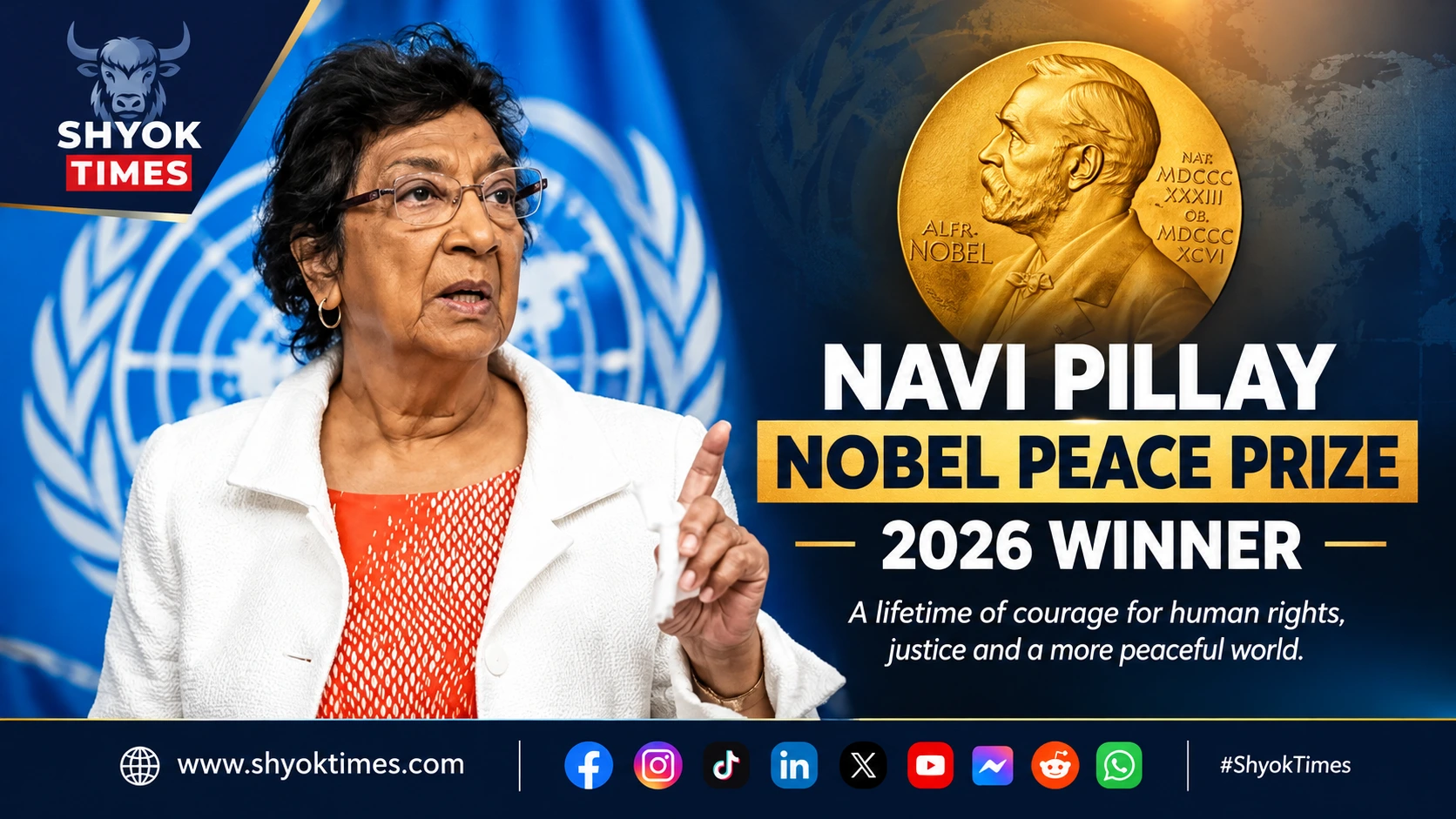
Navi Pillay Nobel Peace Prize 2026 Winner | Shyok Times
South Africa’s Navi Pillay Wins 2026 Nobel Peace Prize for Championing International Law
OSLO — South African jurist and former UN human rights chief Navanethem “Navi” Pillay has been awarded the 2026 Nobel Peace Prize “for her efforts to promote peace and international law,” the Norwegian Nobel Committee announced on Friday in Oslo.
The 85-year-old Pillay, who chaired the UN Independent International Commission of Inquiry on the Occupied Palestinian Territory from 2021 to 2025, received the news while attending a legal conference in Nuremberg, Germany — the historic courtroom where Nazi war criminals were tried 80 years ago.
The Nobel Committee’s decision places Pillay’s decades-long career at the centre of global attention, recognising a jurist whose work has fundamentally shaped how international law addresses genocide, sexual violence in conflict, and impunity for state leaders.
A Career Forged in Apartheid South Africa
Navanethem Pillay was born in 1941 in Durban, South Africa, into a family of Indian Tamil origin during the apartheid era. Confronting systemic racial discrimination from childhood, she became the first woman to start a law practice in her home province of Natal in 1967.
Her early legal career was defined by defending anti-apartheid activists, including Nelson Mandela and others imprisoned on Robben Island. She exposed torture, helped establish key rights for prisoners, and became a powerful voice against the apartheid regime’s brutal legal machinery.
Pillay earned a Master of Law and a Doctorate of Juridical Science from Harvard University in 1988, before being appointed to the High Court of South Africa in 1995 following the end of apartheid.
Her contributions extended beyond the courtroom. As a member of South Africa’s Women’s National Coalition, she helped secure the inclusion of an equality clause in the country’s post-apartheid Constitution, prohibiting discrimination on grounds of race, gender, religion, and sexual orientation.
Shaping Global Jurisprudence on Genocide and Sexual Violence
Pillay’s tenure as a judge and later President of the International Criminal Tribunal for Rwanda (ICTR) between 1999 and 2003 produced landmark legal precedents that reshaped international criminal law.
She played a critical role in establishing that rape and sexual violence could constitute genocide and crimes against humanity — a jurisprudence that had previously been absent from international tribunals. Her work also established that spreading hate propaganda could lead to indictment for incitement to genocide.
The Nobel Committee specifically highlighted her judicial rigour, personal integrity, and considerable courage, emphasising her role as “a driving force in the development of an international system of law and order”.
From 2003 to 2008, Pillay served as a judge on the International Criminal Court (ICC) in The Hague, where she was assigned to the Appeals Chamber. Between 2008 and 2014, she served as the United Nations High Commissioner for Human Rights, becoming one of the most prominent global voices for accountability and human dignity.
The Gaza Inquiry: A Defining and Controversial Chapter
Pillay’s most recent and consequential work — leading the UN Commission of Inquiry on the Occupied Palestinian Territory — became central to the Nobel Committee’s decision, even as it sparked significant controversy.
The commission, established by the UN Human Rights Council in 2021, investigated violations committed by all parties to the conflict. In its June 2024 report following the October 7, 2023 attacks, the commission found that Israeli authorities were responsible for war crimes and crimes against humanity during military operations in Gaza. It also concluded that Hamas and other Palestinian armed groups committed war crimes, including deliberately killing civilians and taking hostages.
In September 2025, the commission issued its most far-reaching conclusion: that Israeli authorities had committed four of the five acts defined as genocide under the 1948 Genocide Convention — killing members of a protected group, causing serious bodily or mental harm, deliberately imposing conditions calculated to bring about physical destruction, and taking measures intended to prevent births.
The commission further concluded that Prime Minister Benjamin Netanyahu, President Isaac Herzog, and former Defence Minister Yoav Gallant had incited genocide and that Israeli authorities had failed to punish them.
Pillay stated at the time: “When clear signs and evidence of genocide emerge, the absence of action to stop it amounts to complicity”.
Israel rejected the findings, accused the commission of bias, and maintained that its military campaign targeted Hamas rather than the Palestinian population.
The Nobel Committee denied that awarding Pillay constituted a stance on whether Israel is committing genocide in Gaza, though Committee Chair Jørgen Watne Frydnes spoke pointedly of “a shift towards power politics at the expense of legal frameworks and global respect for law and justice”.
A Message to Leaders: ‘You Are Under Legal Obligation’
Upon receiving news of the award, Pillay delivered an impromptu acceptance speech that combined humility, legal precision, and characteristic wit.
“The last thing I did is the delivery of the report on Gaza, naming what’s happening there as genocide,” Pillay told a gathered crowd in Nuremberg. “If you clap a little bit more, I may share this prize with Trump” — a reference to last year’s laureate María Corina Machado gifting her Nobel medal to US President Donald Trump in January.
Trump has repeatedly stated he deserved to win the Nobel Peace Prize.
Pillay dedicated the award to “all the survivors of international crimes as well as to practitioners and defenders of international justice whose compassion and courage continue to ensure that impunity will not be allowed to reign.” Turning to world leaders, she said: “You are under legal obligation to protect human rights and refrain from war”.
European Commission President Ursula von der Leyen congratulated Pillay, stating: “Few have devoted their lives to justice, peace and human dignity like she did. From the violence of apartheid in South Africa to the horrors of the Rwandan genocide, she has confronted some of humanity’s darkest chapters. In a world that needs justice more than ever, her courage and moral clarity are a precious compass”.
What the Nobel Committee Said
The Norwegian Nobel Committee’s citation emphasised that Pillay’s recognition comes at a time when international legal institutions are under political attack.
“At a time when the number of wars and conflicts is rising, and when judges and institutions of international law are under political attack, the Nobel Committee wishes to issue a reminder that the ability to resolve conflicts without force or violence is dependent on the international rule of law,” the committee stated.
Committee Chair Frydnes told reporters in Oslo that the prize serves as “a message that international law and its institutions are the cornerstone of a more peaceful world”.
The committee also noted Pillay’s current role as an ad hoc judge at the International Court of Justice in The Hague, where she is hearing the case in which Myanmar stands accused of genocide.
Pakistan Nominates Trump Hours Before Announcement
In a development highlighting the political sensitivities surrounding the Nobel Peace Prize, Pakistan’s Prime Minister Shehbaz Sharif announced on social media shortly before the Pillay announcement that Pakistan had nominated Donald Trump for the 2026 Nobel Peace Prize.
Sharif cited Trump’s role in “advancing peace in South Asia,” referencing last year’s brief military conflict with India. “President Trump’s timely intervention helped bring Pakistan and India back from the brink and secure a ceasefire that is holding till today,” Sharif wrote on X.
The nomination had no bearing on the Nobel Committee’s decision, which is made independently based on nominations submitted by qualified individuals and organisations by the February 1 deadline each year.
The 2026 Nobel Prize Season
The Peace Prize is the fifth Nobel awarded this week, following literature, chemistry, physics, and medicine. On Thursday, the Nobel Prize in Literature was awarded to Canadian poet Anne Carson for her modern reinterpretations of Greek mythology and antiquity.
The 2026 Nobel season concludes Monday with the economics prize.
The Peace Prize comes with a gold medal, a diploma, and prize money of 12 million Swedish kronor (approximately $1.2 million). The Nobel Foundation announced in September that it would raise the prize amount by one million kronor in each category to mark the 125th anniversary of the Nobel Prize.
The award will be presented at a formal ceremony in Oslo on December 10, the anniversary of the death of Swedish inventor and philanthropist Alfred Nobel, who established the awards in his 1895 will.
A Legacy of Accountability
Pillay’s Nobel recognition cements a legacy that spans from defending Nelson Mandela in apartheid-era courtrooms to holding contemporary state leaders accountable for genocide before international tribunals.
“A common thread runs from her early work defending Nelson Mandela and others who stood up against apartheid to her service as a judge in some of the key international court cases of our time,” the Nobel Committee stated.
As Pillay herself reminded world leaders in Nuremberg, the prize is not merely an honour — it is a reminder of legal obligations that transcend politics. In an era when international law faces unprecedented political pressure, her selection sends an unmistakable message: accountability is not optional, and impunity will not be allowed to reign.
External Resources (DoFollow):
Follow more on Reuters: Navi Pillay wins 2026 Nobel Peace Prize
Read further at BBC: Nobel Peace Prize winner Navi Pillay
Keep reading via DAWN: Navi Pillay wins Nobel Peace Prize 2026