Glacier Grafting: How Pakistan’s Villages Are “Marrying” Glaciers
High in the mountains of northern Pakistan, where villages cling to steep valleys and agriculture depends heavily on melt-water, communities are turning to an extraordinary Indigenous practice known as glacier grafting.
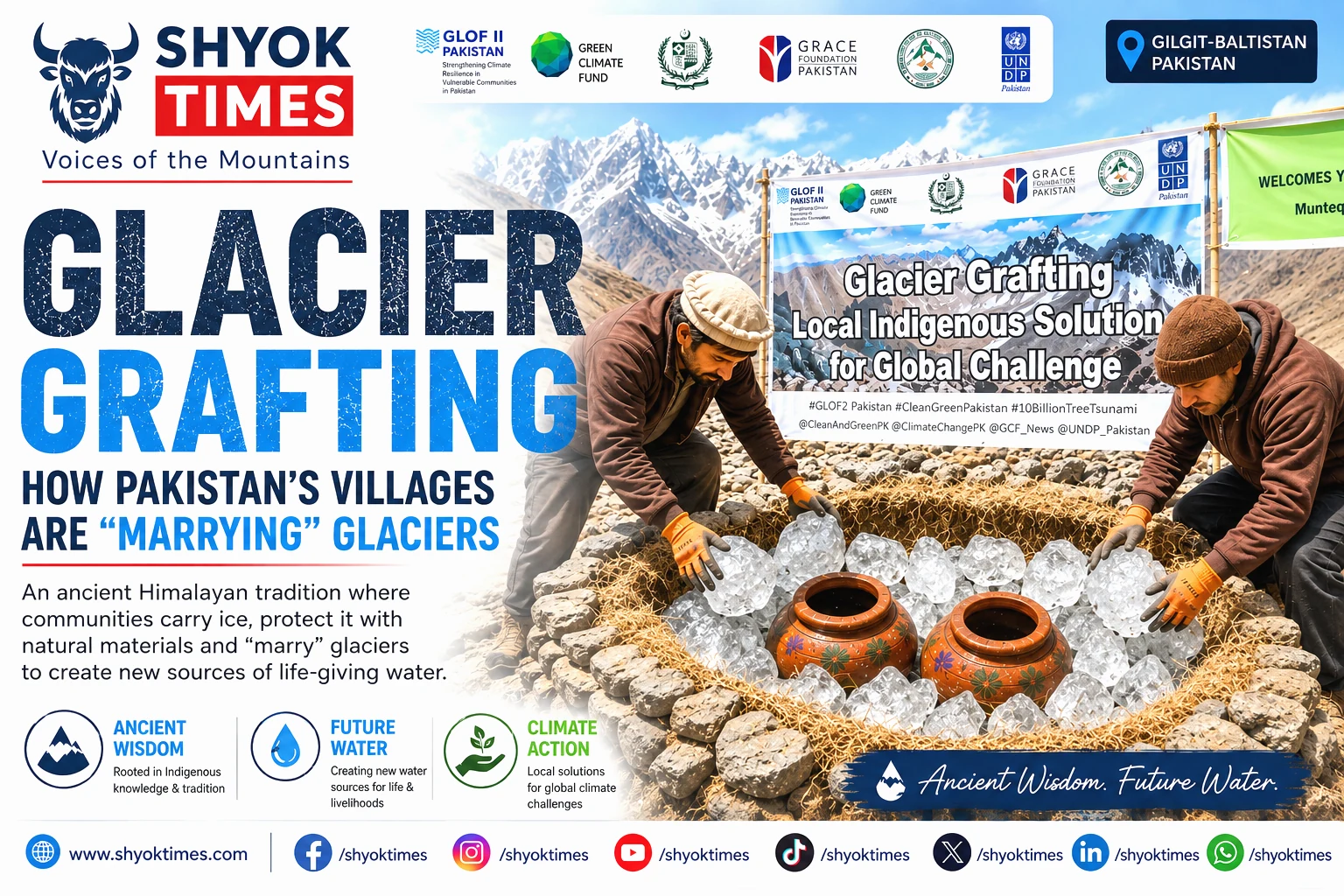
Locally described as a “glacier marriage,” the centuries-old tradition involves carrying pieces of ice from existing glaciers to carefully selected high-altitude locations, where villagers attempt to establish new, persistent ice bodies that can provide water during warmer months.
To an outsider, the idea of “marrying” glaciers may sound almost mythical. For mountain communities in Gilgit-Baltistan, however, it represents something much more practical: an attempt to secure water, protect agriculture and adapt to a changing climate.
Recent international reporting has brought renewed attention to the practice as communities face increasingly uncertain water supplies.
What Is Glacier Grafting?
Glacier grafting is a traditional water-conservation technique in which ice from existing glaciers is transported to a suitable cold, shaded location and protected so that it can survive, accumulate snow and gradually develop into a larger ice mass.
The practice is also called glacier growing or glacier marriage.
According to research published in the journal Sustainability, glacier grafting is practices in several parts of Gilgit-Baltistan and is viewed by local communities as a way of maintaining water supplies for irrigation and agriculture. The researchers found that communities perceive the technique as particularly important in areas where changing climate patterns have affected natural water availability.
The word “marriage” comes from local classifications of glaciers. Communities traditionally distinguish between what they call male and female glaciers, based on characteristics such as the appearance of the ice, debris cover, movement and water-producing capacity.
The terminology is cultural and traditional rather than a scientific classification used by modern glaciologists.
Why Do Villagers “Marry” Glaciers?
For mountain communities, the answer is simple: water.
Many settlements in Gilgit-Baltistan occupy extremely dry valleys. Unlike much of Pakistan, the region receives relatively little monsoon rainfall, while farming depends heavily on water from snow and glaciers.
Fields of wheat, barley, potatoes and vegetables need reliable irrigation. Livestock also requires water, while households depend on mountain streams for everyday needs.
That makes changes in the timing and quantity of snow and glacier melt especially important.
Research on glacier grafting in Gilgit-Baltistan has found that local communities regard the practice as a strategy for sustaining irrigation water, expanding cultivable land and strengthening food security.
The challenge has become more urgent as climate change alters the region's water cycle.
Warmer temperatures can accelerate melting and contribute to hazards such as floods and glacial lake outburst floods. At the same time, communities can face water shortages when natural melt-water is insufficient or arrives at the wrong time of year. Recent reporting has described glacier grafting as one Indigenous response to this increasingly uncertain environment.
How Does Glacier Grafting Work?
The process requires considerable physical effort and detailed knowledge of the local mountain environment.
First, villagers identify a suitable source of ice and a location where a new ice body might survive.
The grafting site is generally chosen at high elevation, away from direct sunlight and in an environment cold enough to preserve ice. Researchers studying the practice have described preferred sites as shaded slopes at roughly 4,000–5,000 metres above sea level.
Villagers then collect pieces of ice from existing glaciers.
Traditionally, the ice is transported by people carrying heavy loads on their backs. In some documented cases, community members have travelled for days to reach the selected site.
One account from Baltistan described villagers carrying glacier pieces without placing them on the ground during the journey, repeatedly shifting the load from one shoulder to another.
At the destination, the ice is placed in a protected location, such as a naturally occurring cave or specially prepared pit.
Different communities use somewhat different materials and methods. Accounts describe the use of soil, ash, charcoal, sawdust, stones, snow and other insulating materials. Some documented projects have also incorporated containers of water.
The purpose is to create an environment where the ice can survive the warmer season and accumulate additional snow and ice over subsequent winters.
The “Male” and “Female” Glacier Tradition
One of the most fascinating aspects of glacier grafting is the traditional belief that glaciers have different genders.
In local descriptions reported from Baltistan, a “female” glacier is generally associated with cleaner, brighter or bluish ice and greater water production, while a “male” glacier is described as darker or more debris-covered.
These categories are part of Indigenous knowledge and cultural understanding. They should not be confused with biological sex or with scientific classifications of glaciers.
According to local belief, combining ice from the two types can help produce a new, growing glacier.
This is why the process is described as a marriage.
The metaphor captures a much deeper relationship between people and their environment. Glaciers are not regarded merely as frozen masses of water; they are closely connected to farming, livelihoods, community identity and survival.
Recent reporting from Gilgit-Baltistan describes the practice as Gang Khswa, while communities continue to combine traditional knowledge with newer approaches to water management.
A Journey Into the Mountains
Glacier grafting is not an easy task.
Villagers may have to travel deep into rugged mountain terrain, often at elevations where oxygen levels are lower and temperatures can fall dramatically.
In documented projects, groups of people have carried substantial quantities of ice to designated grafting sites. The work has traditionally relied heavily on community cooperation.
This collective effort is important because a glacier graft cannot simply be created by one individual.
The community must identify a suitable location, organise the transportation, prepare the site and subsequently monitor the developing ice body.
That communal dimension makes glacier grafting as much a social practice as a technical one.
A successful graft can potentially benefit an entire village by increasing the availability of melt-water for fields and livestock.
From Ancient Knowledge to Climate Adaptation
The practice is particularly interesting because it demonstrates how communities are adapting to environmental change using knowledge developed long before the modern climate crisis.
Research published in 2021 found that communities surveyed in parts of Gilgit-Baltistan viewed glacier grafting positively because of its perceived contribution to sustained irrigation water, agricultural production and food security.
The study examined communities in areas including Gole in Skardu, Pari in Kharmang and Balghar in Ghanche, where glacier grafting has been practised.
The research also emphasised that the technique needs further environmental assessment before its wider expansion can be evaluated scientifically.
That distinction matters.
Glacier grafting is a documented Indigenous practice, but claims about its ability to create a fully functioning glacier should not automatically be treated as equivalent to the formation and behaviour of a natural valley glacier.
In many cases, the resulting ice bodies are better understood as artificial glaciers, glacierettes or stored ice masses whose persistence depends strongly on local climatic and topographic conditions.
The Role of Agriculture
For villages in the high mountains, water and agriculture are inseparable.
Small plots of land can produce wheat, barley, potatoes and vegetables, but cultivation is only possible where irrigation water reaches the fields.
A reliable source of meltwater can therefore transform the economic prospects of a community.
A documented example from Manawar village near Skardu illustrates the importance of the practice. Residents have attributed a long-standing water supply serving hundreds of households to an earlier glacier-grafting effort. Another participant in a later grafting project reported that water became more consistently available for cultivation after the new ice mass developed.
Such experiences explain why communities continue to experiment with glacier grafting even as scientific understanding of glaciers becomes increasingly sophisticated.
The motivation is not simply to create ice.
It is to create water security.
Women and the Hidden Water Burden
Glacier grafting also reveals an important social dimension of climate adaptation.
Traditional glacier-grafting activities have often been associated with men, particularly because the work requires physically demanding journeys into high-altitude terrain.
Yet women can experience some of the greatest consequences of water scarcity.
Women in rural mountain communities frequently participate in farming and household water management. When water becomes difficult to access, the burden of collecting, conserving and managing it can increase.
Research and reporting on glacier grafting have therefore highlighted the importance of involving women in decisions about water and climate adaptation, even when they are not directly involved in carrying out the grafting itself.
More recent climate-adaptation initiatives in the region have sought to involve women more directly in discussions around water management and glacier-related activities.
Indigenous Knowledge Meets Modern Science
Glacier grafting is not necessarily a choice between tradition and science.
Instead, it can be seen as an example of how Indigenous knowledge and modern climate science may complement one another.
Modern researchers can measure temperature, snow accumulation, ice thickness, permafrost conditions and water discharge.
Local communities, meanwhile, possess generations of knowledge about mountain slopes, seasonal weather, snow behaviour, water channels and the locations where ice is most likely to survive.
Combining these forms of knowledge could help determine where glacier grafting is most effective—and where it may not be.
Other artificial-ice techniques elsewhere in the Himalayas provide an interesting comparison. In Ladakh, engineer Sonam Wangchuk’s Ice Stupa project creates artificial cone-shaped glaciers in cold, arid mountain regions to store otherwise unused winter water. The ice gradually melts during spring, releasing water at a critical time for planting and agriculture. While different from Pakistan’s Indigenous glacier-grafting tradition, the Ice Stupa approach shares the same fundamental objective: turning winter water into a reserve for the growing season.
The underlying principle is similar: store water as ice when it is cold and make it available when communities need it.
Can Glacier Grafting Save Pakistan’s Mountain Villages?
It would be too early to claim that glacier grafting can solve Pakistan's growing water crisis.
The technique has clear limitations.
A grafting site must have favourable temperatures, suitable topography and sufficient snowfall or ice accumulation. Climate change itself could make these conditions harder to maintain.
There are also questions about how long artificially established ice bodies persist, how much additional water they ultimately provide and how their impacts compare with other water-storage approaches.
The 2021 academic study on glacier grafting specifically called for further investigation of its environmental sustainability before extending the practice more broadly.
Nevertheless, the practice offers an important lesson.
Communities living closest to glaciers are not passive victims of climate change. They are observing changes in their environment and developing—or reviving—ways of responding.
A Different Way of Thinking About Glaciers
The phrase “glacier marriage” may initially sound poetic, even strange.
But behind the expression is a practical relationship between humans and ice.
For generations, mountain communities have depended on glaciers for water. They have watched the snowline, followed streams, cultivated steep terraces and learned how seasonal changes affect their fields.
When natural water supplies become less predictable, they attempt to intervene by moving and protecting ice.
In that sense, glacier grafting represents a philosophy of reciprocity: if communities depend on the mountains for water, they also believe they have a responsibility to care for the natural systems that sustain them.
Recent reporting from Gilgit-Baltistan captures this idea through the words of local researchers and community members who describe the practice not simply as engineering, but as a way of contributing back to nature.
The Future of Glacier Grafting
Pakistan's northern mountains are entering an uncertain climatic era.
Glaciers remain essential sources of freshwater, but rising temperatures, changing precipitation patterns and extreme weather are placing pressure on mountain ecosystems and the communities that depend on them.
Against this backdrop, glacier grafting offers an unusual but valuable case study.
It is not a technological miracle, nor should every traditional claim surrounding it be accepted without scientific testing.
But it is a remarkable example of Indigenous environmental knowledge—and of how communities can develop local solutions to problems that now have global significance.
The people of Gilgit-Baltistan are, quite literally, carrying pieces of glaciers into the future.
They call it a marriage.
Scientists may call it artificial ice accumulation, glacier growth or water conservation.
For the villagers who depend on the resulting melt-water, however, the meaning is much simpler:
It is about keeping water alive.
And in a warming mountain world, that may be one of the most important forms of adaptation of all.
External Resources (DoFollow Links)
Read more on EURO NEWS: Meet the communities 'marrying glaciers'.
Follow further at Dialogue Earth: The glacier ‘marriages’ in Pakistan’s high Himalayas