
Skil Brum First Ascent: Amazing 53-Hour Feat | Shyok Times
Introduction: The Mountain That Lives in K2’s Shadow
Skil Brum: The Hidden Karakoram Wonder That Climbers Conquered in 53 Hours.
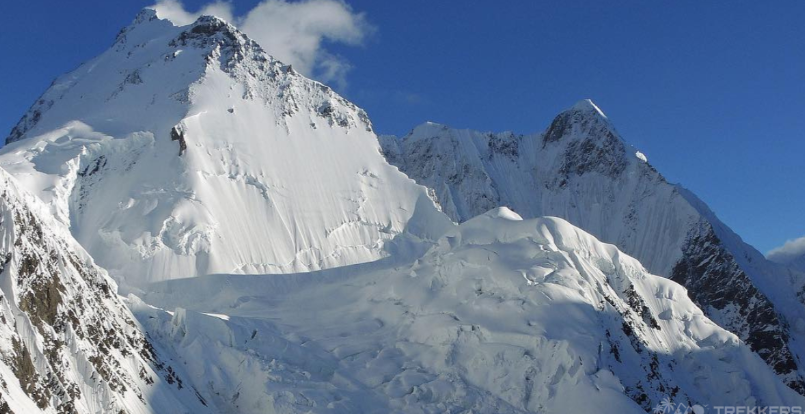
Skil Brum first ascent is one of the remarkable yet relatively overlooked achievements in the mountaineering history of Pakistan’s Karakoram range. On June 19, 1957, Austrian climbers Marcus Schmuck and Fritz Wintersteller reached the summit of this 7,410-metre mountain after an extraordinary lightweight expedition that took just 53 hours from base camp to base camp.
Situated approximately nine kilometres west-southwest of K2, Skil Brum stands among the spectacular peaks of the Baltoro Muztagh. Despite its impressive elevation and challenging environment, it receives considerably less international attention than its famous neighbour, K2, the world’s second-highest mountain.
Its story, however, deserves to be remembered. The ascent demonstrated how careful planning, technical ability, self-reliance and a minimalist approach could produce an extraordinary result in one of the world's most demanding mountain environments.
The achievement also raises an interesting question: why do some mountains become global icons while others, despite their extraordinary climbing histories, remain largely unknown outside mountaineering circles?
Where Is Skil Brum Mountain?
Skil Brum, also written as Skilbrum, is a 7,410-metre peak in the Karakoram mountain range of Gilgit-Baltistan, Pakistan. It belongs to the Baltoro Muztagh, a spectacular mountain region containing some of the planet’s highest and most challenging summits.
The mountain lies near the upper reaches of the Godwin-Austen Glacier, in the broader landscape surrounding K2 and Broad Peak. Its location places it within one of the most celebrated high-altitude mountaineering regions in the world.
According to commonly cited geographical references, Skil Brum stands about nine kilometres from K2, although the precise distance depends on the points used for measurement.
The surrounding landscape includes enormous glaciers, steep snowfields, ice formations and rocky ridges. Nearby peaks, including Broad Peak and Muztagh Tower, contribute to the extraordinary scenery of the region.
For trekkers travelling towards Concordia and K2 Base Camp, the Karakoram presents an unforgettable panorama of towering summits. Yet the mountains are not simply scenic attractions. Their altitude, remoteness, rapidly changing weather and difficult terrain make climbing a serious undertaking requiring extensive preparation.
Skil Brum's relative obscurity should not be confused with a lack of mountaineering significance. Its first ascent remains an important chapter in the development of lightweight climbing techniques at extreme altitude.
Why Skil Brum Deserves More Recognition
The Karakoram is home to some of the world's most famous mountains, and K2 naturally dominates international attention. Broad Peak, the Gasherbrum peaks and other formidable summits also attract experienced climbers from around the world.
Against this backdrop, Skil Brum can easily be overlooked.
Its importance lies partly in its elevation and partly in the way its first ascent was achieved. At 7,410 metres, it is a major high-altitude mountain, where physical exhaustion, cold, dehydration and the effects of reduced oxygen availability can make even routine movements difficult.
The mountain is also historically significant because Schmuck and Wintersteller climbed it shortly after their success on Broad Peak in June 1957.
Rather than treating the earlier summit as the conclusion of their expedition, the two climbers undertook another ambitious objective. They approached the neighbouring mountain with a small amount of equipment and completed the climb in a remarkably short period.
Their achievement was not simply a matter of speed. It demonstrated a particular philosophy of mountaineering: carry what is necessary, avoid unnecessary infrastructure on the mountain, make decisions independently and remain responsible for the consequences.
This approach would become an influential example of alpine-style climbing on major peaks.
The Historic First Ascent of Skil Brum in 1957
The story begins with the Austrian Karakoram expedition of 1957, an expedition associated with Marcus Schmuck, Fritz Wintersteller, Hermann Buhl and Kurt Diemberger.
The team had travelled to the Karakoram with the objective of climbing Broad Peak, an 8,000-metre mountain near K2.
On June 9, 1957, all four climbers reached the summit of Broad Peak. Their achievement was particularly notable because the ascent was completed without supplementary bottled oxygen.
Following that success, Schmuck and Wintersteller turned their attention to Skil Brum, a neighbouring summit that had not yet been climbed.
According to historical accounts, they began their journey from the Broad Peak Base Camp, situated at approximately 4,950 metres. They travelled across the glacier system and climbed towards a higher camp at around 6,060 metres.
On June 19, 1957, they reached the summit of Skil Brum.
They then returned to their high camp before descending to the original base camp the following morning. The complete journey, from base camp to summit and back to base camp, took approximately 53 hours.
The achievement is particularly remarkable when considered in the context of mountaineering during the 1950s. Modern satellite communication, digital weather forecasts, lightweight technical equipment and contemporary navigation systems were not available in their current forms.
The climbers relied on their experience, physical preparation, route knowledge and judgement.
Their ascent became a notable early example of a major Himalayan-Karakoram summit climbed in pure alpine style.
How Did the Climbers Complete the Ascent in 53 Hours?
The reported 53-hour duration refers to the entire expedition from base camp to base camp, not merely the time spent climbing from the final camp to the summit.
That distinction matters because summit times alone do not reveal the logistical demands of high-altitude mountaineering.
Schmuck and Wintersteller began at approximately 4,950 metres and established a camp at around 6,060 metres. They climbed to the summit the next day, returned to the high camp and descended to base camp the following morning.
Their approach avoided the extended sequence of high camps, fixed ropes and large-scale route preparation associated with some traditional expedition-style climbs.
The pair carried their essential equipment themselves. Their success therefore depended on balancing several competing requirements: having enough supplies to survive and climb safely while keeping their loads manageable enough to move efficiently across difficult terrain.
It is important not to interpret the short duration as evidence that Skil Brum was an easy mountain. Moving quickly at high altitude requires considerable experience and can involve serious risks if conditions deteriorate or climbers misjudge their physical limits.
The achievement was exceptional precisely because it combined speed with the technical and logistical demands of a 7,000-metre peak.
What Is Alpine-Style Mountaineering?
Alpine-style mountaineering is an approach in which climbers attempt to ascend a mountain with relatively little equipment and minimal fixed infrastructure.
Instead of establishing an extensive chain of camps, transporting large quantities of supplies in repeated trips or preparing an entire route in advance, a small team carries its essential equipment and attempts to climb with greater independence.
The approach can reduce the amount of time spent on a mountain and limit the logistical footprint of an expedition.
However, alpine style is not simply a synonym for climbing quickly. It involves a broader philosophy of preparation, self-sufficiency, efficient movement and decision-making.
The principal characteristics often include:
- Lightweight equipment: Climbers carry the supplies and technical gear they need rather than relying on extensive equipment caches.
- Fewer camps: Teams minimise the use of established high-altitude camps where conditions and the route allow.
- Limited fixed infrastructure: The ascent generally avoids extensive fixed ropes and pre-prepared routes.
- Self-reliance: Climbers must be capable of managing navigation, equipment, changing weather and emergencies.
- Careful decision-making: The team must assess whether conditions justify continuing or whether retreat is the safer option.
Schmuck and Wintersteller's ascent of Skil Brum is remembered as a pioneering example of this approach on a major 7,000-metre peak.
The distinction is important because lightweight climbing can increase exposure to risk. A smaller team with fewer supplies and less fixed protection may have fewer options if a storm arrives, a climber becomes injured or the route proves more difficult than expected.
Alpine style therefore demands not only physical strength but also sound judgement.
The Connection Between Broad Peak and Skil Brum
Skil Brum's first ascent is inseparable from the broader history of the 1957 Austrian expedition.
Broad Peak rises to approximately 8,051 metres and is one of the world's highest mountains. Its first ascent on June 9, 1957, was a major achievement for the expedition team.
The summit success involved all four climbers: Marcus Schmuck, Fritz Wintersteller, Hermann Buhl and Kurt Diemberger.
The ascent was completed without supplementary oxygen, adding to its significance in the history of high-altitude climbing.
Ten days later, Schmuck and Wintersteller reached Skil Brum's summit. The two climbs illustrate how the expedition's objectives extended beyond a single famous mountain.
Broad Peak gave the team international mountaineering significance. Skil Brum added another achievement that demonstrated the potential of a more lightweight and independent climbing strategy.
This sequence also shows why lesser-known mountains deserve attention in historical accounts. The most famous summit in a region may attract the headlines, but nearby peaks can reveal equally important developments in climbing technique and expedition strategy.
For students of mountaineering, the 1957 expedition offers a valuable case study in how equipment, teamwork, experience and climbing philosophy interact at extreme altitude.
How Did Skil Brum Get Its Name?
The history of the mountain's name adds another interesting detail to its story.
Accounts of the first ascent indicate that Skil Brum was not widely known by its present name when Schmuck and Wintersteller climbed it in 1957.
Following the successful ascent, Marcus Schmuck reportedly proposed naming the summit “Peak Dyhrenfurth” in honour of G. O. Dyhrenfurth, who had provided valuable information during preparations for the Broad Peak expedition.
Another suggested name was “Peak Austria.”
However, these proposals did not become the mountain's official name. The Government of Pakistan ultimately designated the peak as Skil Brum.
A historical account reproduced by SummitPost refers to correspondence from the Surveyor General of Pakistan confirming the name in 1958.
The episode illustrates how the exploration and documentation of remote mountain regions involved not only physical achievements but also mapping, geographical records and decisions about official place names.
It is also a reminder that the history of a mountain is larger than the moment someone reaches its summit. The people who document, map and identify these landscapes contribute to how future generations understand them.
The Challenges of Climbing Skil Brum Today
Although the first ascent took place in 1957, Skil Brum remains a serious high-altitude objective.
At 7,410 metres, the mountain enters an environment where the human body struggles to obtain sufficient oxygen. Physical performance declines, recovery becomes more difficult, and the consequences of exhaustion can be severe.
The region's glaciers introduce additional hazards. Crevasses, unstable snow bridges, seracs and changing snow conditions can make travel unpredictable. Steep slopes may also expose climbers to avalanches and falls.
Weather presents another major challenge. Strong winds, sudden temperature changes, snowfall and poor visibility can affect both ascent and descent.
The remoteness of the Karakoram further complicates rescue operations. An accident on a high mountain may occur far from roads, medical facilities and reliable communication infrastructure.
Successful climbers must therefore consider more than whether they can reach the summit. They must also plan for the descent, possible delays, equipment failures and changes in conditions.
Anyone considering an expedition to Skil Brum should seek current information from qualified mountaineering professionals and the relevant Pakistani authorities. Permit requirements, access conditions, insurance arrangements and liaison requirements should be confirmed before departure rather than assumed from historical accounts.
The first ascent should be viewed as a lesson in preparation and judgement, not as a template for attempting the mountain without appropriate training and support.
Skil Brum and the Tourism Potential of Gilgit-Baltistan
Gilgit-Baltistan is internationally recognised for its spectacular mountain scenery, trekking routes and mountaineering opportunities. K2 and the Baltoro Glacier attract travellers who want to experience one of the world's most dramatic high-altitude landscapes.
Yet the region's tourism identity does not need to depend exclusively on its most famous summits.
Stories about mountains such as Skil Brum can enrich public understanding of the wider Karakoram. They help explain the geography, historical exploration and climbing traditions that make the region distinctive.
For travel writers, guides and local tourism businesses, lesser-known peaks offer opportunities to develop more informative storytelling around the landscape.
Such promotion should be responsible. A mountain's inclusion in a tourism feature does not make it suitable for ordinary visitors to climb. Skil Brum is a demanding mountaineering objective, not a casual trekking destination.
Visitors can learn about its history while exploring established trekking routes and viewpoints under appropriate local guidance. Any tourism development should respect the fragile high-altitude environment, local communities and the practical limits of rescue services.
Responsible storytelling can also help ensure that the people and places of Gilgit-Baltistan are represented as more than a backdrop to international expeditions.
The region has its own communities, knowledge, traditions and relationship with the mountains. These perspectives deserve a place in the broader conversation about Karakoram exploration.
What Skil Brum Teaches Us About Adventure
The story of Skil Brum offers lessons that extend beyond mountaineering.
First, recognition does not always reflect achievement. K2 attracts global attention because of its height, difficulty and history, but less famous peaks can also hold extraordinary stories.
Second, efficiency is not the same as cutting corners. The 1957 ascent depended on experience, planning and a clear approach to equipment and movement. Lightweight climbing requires discipline; it does not eliminate the need for preparation.
Third, reaching the summit is only part of the achievement. Returning safely is essential to any successful expedition. The 53-hour journey is significant because it includes the descent to base camp, not merely the moment of reaching the top.
Finally, exploration is about understanding a place as much as conquering it. The glaciers, weather, terrain and mountain communities all form part of the wider story.
For modern climbers, the most valuable lesson may be that ambition must be balanced with judgement. A mountain does not reward determination alone. It demands respect for conditions, an honest assessment of ability and the willingness to turn back when necessary.
Conclusion: A Karakoram Giant Worth Remembering
Skil Brum remains one of the Karakoram's remarkable yet comparatively underappreciated mountains.
Its 7,410-metre summit, dramatic position near K2 and Broad Peak, and historic first ascent by Marcus Schmuck and Fritz Wintersteller on June 19, 1957, give it a distinctive place in mountaineering history.
Completing the journey from base camp to base camp in approximately 53 hours, the pair demonstrated what a skilled and well-prepared team could achieve through a lightweight, self-reliant approach.
Their ascent remains a powerful example of alpine-style mountaineering and a reminder that the Karakoram's history extends far beyond its most famous summit.
For Gilgit-Baltistan, Skil Brum is also part of a much larger natural and cultural landscape that deserves thoughtful documentation and responsible recognition.
The mountain may live in K2's shadow, but its story stands on its own.
What do you find most remarkable about Skil Brum's first ascent: the climbers' achievement of another summit just ten days after Broad Peak, or the decision to complete the entire journey in only 53 hours? Share your thoughts with Shyok Times.
Frequently Asked Questions
1. How high is Skil Brum?
Skil Brum is commonly listed at 7,410 metres (24,310 feet) above sea level. Some references give different measurements.
2. Who first climbed Skil Brum?
Austrian mountaineers Marcus Schmuck and Fritz Wintersteller made the first ascent on June 19, 1957.
3. How long did the first ascent take?
The complete journey from Broad Peak Base Camp to the summit and back to base camp took approximately 53 hours.
4. Where is Skil Brum located?
Skil Brum lies in the Baltoro Muztagh range of the Karakoram, in the Gilgit-Baltistan region of Pakistan, near K2 and Broad Peak.
5. What is special about the 1957 ascent?
The climb is remembered as a pioneering example of pure alpine-style mountaineering on a major 7,000-metre peak, using relatively little equipment and minimal fixed infrastructure.
6. Is Skil Brum suitable for beginner climbers?
No. Its extreme altitude, glacier hazards, steep terrain, weather exposure and remote location make it a serious mountaineering objective requiring advanced skills and extensive preparation.
Sources and Further Reading
- Skil Brum — SummitPost, for geographical details and the history of the mountain's name.
- Skil Brum — Mountaineering history and ascent details, for a concise overview of its location, elevation and 1957 first ascent.
- Marcus Schmuck — Biographical and expedition history, for context on the Austrian Karakoram expedition and the Broad Peak ascent.
Editorial note: Historical elevation figures and some geographical measurements vary across published references. The article uses 7,410 metres as the commonly cited elevation and approximately 53 hours for the complete first-ascent journey.