
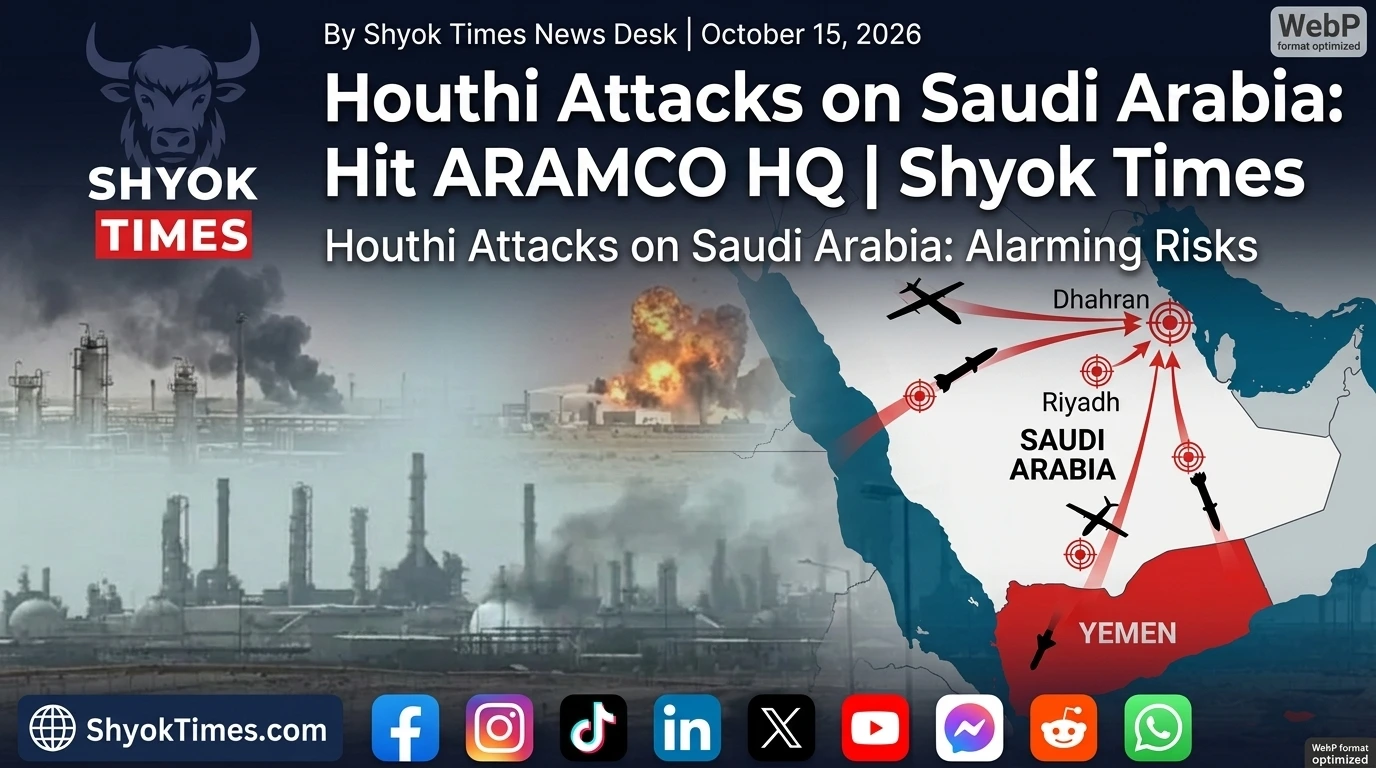
Houthi Attacks on Saudi Arabia: Hit ARAMCO HQ | Shyok Times
Houthi Attacks on Saudi Arabia: Alarming Risks
Yemen’s Houthi attacks on Saudi Arabia have escalated sharply, with the Iran-aligned group threatening further strikes against airports and oil facilities after an attack on a building within Saudi Aramco’s headquarters complex in Dhahran. The latest developments have intensified security concerns across the Kingdom, raised questions about regional energy stability and increased fears of a wider conflict in the Middle East.
The developments reported on October 13 and 14 have brought Saudi Arabia’s critical infrastructure into sharper focus. Saudi officials confirmed that an administrative building belonging to Aramco was struck and that a fire broke out, although the Energy Ministry described the fire as limited and reported no fatalities or injuries. Sources cited by Reuters, however, described more extensive damage to the building.
The Houthis subsequently claimed responsibility for targeting Saudi Aramco facilities, Riyadh’s King Khalid International Airport and an oil refinery in the capital. They also warned that further attacks could follow.
بيانٌ صادرٌ عن القواتِ المسلحةِ اليمنيةِ
— العميد/ يحيى سريع (@Yah_Saree) October 14, 2026
بسمِ اللهِ الرحمنِ الرحيمِ
قالَ تعالى: {فَمَنِ اعْتَدَى عَلَيْكُمْ فَاعْتَدُوا عَلَيْهِ بِمِثْلِ مَا اعْتَدَى عَلَيْكُمْ} صدقَ اللهُ العظيم
ردًّا على العدوانِ السعوديِّ الغاشمِ على العاصمةِ صنعاءَ والمحافظاتِ الحرةِ وفي إطارِ عملياتِ… pic.twitter.com/0LGab5lMtm
The key question now is whether the latest escalation will remain a series of military exchanges or develop into a broader regional crisis affecting civilian security, commercial aviation, oil markets and humanitarian operations in Yemen.
What Happened in the Latest Houthi Attacks on Saudi Arabia?
The latest escalation centres on an attack against an administrative building in the Saudi Aramco headquarters complex in Dhahran, in Saudi Arabia’s Eastern Province.
According to Reuters reporting published on October 14, the strike occurred on Tuesday night. People familiar with the incident said the fire spread across several floors of an office building. The Saudi Energy Ministry separately confirmed that an administrative building had been targeted, reporting a limited fire and no casualties.
The distinction matters. The ministry’s public description and accounts from people familiar with the damage were not identical, and Aramco had not immediately responded to Reuters’ request for comment when the report was published. The full extent of the damage therefore should be understood in the context of these differing accounts.
On Wednesday, Houthi military spokesman Yahya Saree said the group had targeted Aramco facilities in Dhahran, Riyadh’s airport and a refinery in the Saudi capital. He described the operation as involving ballistic missiles, cruise missiles and drones and threatened additional strikes against Saudi airports and oil installations.
Saudi-led forces also reported intercepting a ballistic missile fired towards Riyadh. Residents reported hearing explosions in the capital, while authorities issued an aerial-threat warning that was subsequently lifted.
The claims about particular targets and weapons should not automatically be treated as independently verified results. A group can announce that it launched a missile or drone without that statement proving that the weapon reached its intended target.
Nevertheless, the confirmed strike on an Aramco administrative building and the reported missile interceptions point to a serious deterioration in the security environment.
Saudi Aramco Strike Raises Concerns About Energy Security
Saudi Aramco is central to the Kingdom’s energy industry and a major participant in international oil and gas markets. Its headquarters are in Dhahran, and its wider operations include exploration, production, processing, refining and the movement of energy products to customers.
The company’s importance extends well beyond Saudi Arabia. Energy buyers, shipping companies, refineries and industrial businesses around the world monitor developments that could threaten the production or transportation of crude oil and petroleum products.
The strike on the Dhahran complex is therefore significant even without evidence that national oil production has been interrupted.
Reuters reported that Aramco’s operations were continuing normally after the attack, although some employees were instructed to work from home and some functions were reportedly shifted to other offices. Those accounts suggest that operational continuity was being maintained at the time of reporting, but they do not eliminate the risk of future disruption.
A strike on an administrative building is not the same as the destruction of a producing oilfield, export terminal or processing facility. The immediate impact depends on the building’s functions, the damage sustained, the availability of alternative systems and the ability of staff to maintain essential operations.
The wider concern is that repeated attacks could place additional pressure on infrastructure, emergency services and security arrangements. Even if production continues, the threat of further strikes may increase operating costs, complicate logistics and create uncertainty for energy markets.
Aramco’s official company information explains its role across the energy and chemicals industries. Its extensive operational network helps explain why threats against major facilities attract international attention.
Riyadh Airport and Civilian Safety Face Growing Pressure
The threat to Saudi airports presents a separate set of risks. Airports are critical transport hubs for residents, international travellers, migrant workers, businesspeople and pilgrims. Disruptions can affect thousands of journeys, even when an airport itself is not physically damaged.
The Houthis said their latest operation targeted King Khalid International Airport in Riyadh. Saudi-led forces reported intercepting a missile directed towards the capital, while residents heard explosions and received warnings about possible aerial threats.
تنبيه زال الخطر عن مدينة الرياض، لسلامتك الاستمرار في اتباع تعليمات #الدفاع_المدني وتجنب التجمهر والتصوير نهائيًا. في حالة الطوارئ اتصل بالرقم (911).
— الدفاع المدني السعودي (@SaudiDCD) October 14, 2026
Alert: The danger has passed in Riyadh City. For your safety, continue following #CivilDefense instructions and avoid gathering… pic.twitter.com/sgaNacxQtt
Reuters reported that an earlier attack on Riyadh’s airport on Saturday, October 10, killed 13 people. That reported toll, if confirmed as described, would make the incident particularly serious. Details of individual incidents should nevertheless remain attributed to the reporting available at the time rather than being combined into a single casualty figure.
The threat environment can affect aviation in several ways:
- Flight disruption: Airlines may delay, reroute or cancel services when airspace or airport security becomes uncertain.
- Passenger safety: Travellers and airport personnel may face risks from direct attacks, intercepted projectiles or falling debris.
- Operational costs: Airlines may incur additional expenses from rerouting, schedule changes, aircraft positioning and passenger accommodation.
- Business confidence: Uncertainty can discourage some business travel and complicate corporate planning.
- Public anxiety: Repeated warnings and explosions can disrupt everyday life, even when an individual alert is lifted without a confirmed impact.
Travellers should distinguish between an announced threat, an intercepted weapon, a confirmed impact and an official airport closure. These are different events and carry different practical implications.
Anyone planning to travel to or through Saudi Arabia should check the latest notices from the relevant airport, airline and official travel-advisory authorities before departure. Social media posts and unverified messages should not replace operational updates.
At the time of the reports reviewed for this article, the situation was developing. Readers should not assume that a reported restriction remains in force without checking for a newer notice.
Oil Prices and Global Markets Could React to Further Escalation
The latest Houthi attacks on Saudi Arabia have also drawn attention to the relationship between geopolitical risk and energy prices.
Oil markets respond not only to actual supply losses but also to expectations about future production, transportation and security. A threat to an important energy-producing country can influence traders’ assessments of the likelihood of disruption.
The effect is not automatic, however. Prices also depend on global demand, available inventories, production decisions, alternative supplies, shipping costs and broader economic conditions.
A damaged office building does not by itself demonstrate that oil exports have fallen. Similarly, a rise in prices following an attack does not establish that a lasting shortage has developed.
The key indicators to watch include:
- Whether Aramco reports interruptions to production, processing or exports.
- Whether additional attacks reach energy infrastructure rather than being intercepted.
- Whether commercial shipping faces new restrictions or security threats.
- Whether regional military operations affect major maritime routes.
- Whether governments or energy producers announce changes to supply arrangements.
The wider regional context also matters. The Red Sea and the Bab el-Mandeb Strait are strategically important for shipping between the Indian Ocean and the Mediterranean through the Suez Canal. Security threats along these routes can lead vessels and insurers to reassess risk, potentially increasing transit times and costs.
Saudi Arabia’s broader energy infrastructure and export routes make regional stability important to the international economy. Yet any assessment of actual supply losses should be based on operational data, not simply on the scale of a military claim.
For background on the company’s energy activities, readers can consult Aramco’s official operations overview.
Yemen’s Humanitarian Crisis Could Deepen
The consequences of the escalation are not confined to Saudi territory. Yemen has endured years of conflict, economic hardship, displacement and pressure on essential public services. Renewed fighting threatens to make an already difficult humanitarian situation worse.
The International Committee of the Red Cross reported on October 14 that hospitals in Yemen were struggling with rising numbers of war-wounded patients and shortages of medical supplies, staff and specialist care. The organisation said facilities in areas including Marib, Taiz and the Red Sea coast were facing particularly heavy pressure.
The World Food Programme also warned on October 14 that escalating fighting was restricting humanitarian access. According to the WFP, its teams and partners could not reach more than 600,000 people in Taiz who depended on humanitarian assistance, including more than 200,000 women and children.
The agency warned that shifting front lines, blocked roads and insecurity were making food deliveries increasingly difficult. It also reported that flour stocks were close to exhaustion in some affected areas.
These figures underline a critical point: military escalation has consequences for civilians far beyond the locations directly targeted by missiles or airstrikes.
When roads become unsafe, humanitarian organisations may be unable to transport food, medicine and other essential supplies. Hospitals may receive more casualties at the same time that access to equipment and medical staff becomes more difficult. Families displaced by fighting can lose homes, livelihoods and access to basic services.
Saudi-led strikes on Houthi-controlled areas and Houthi attacks against Saudi targets must therefore be assessed not only in military terms but also in light of their civilian consequences.
International humanitarian law requires parties to armed conflict to distinguish between civilians and combatants, direct attacks only at lawful military objectives and take precautions to protect civilians. The presence of civilian workers or essential services near a facility does not remove the need for parties to assess their obligations under that law.
Humanitarian access must also be protected so that aid can reach people in need.
Readers can follow the situation through the International Committee of the Red Cross and the World Food Programme’s Yemen updates.
A Wider Regional Conflict Could Become Harder to Contain
The latest attacks reflect the wider confrontation involving the Houthis, Saudi Arabia and the internationally recognised Yemeni government. They also come amid broader regional tensions involving Iran and the United States.
The Houthis have controlled Yemen’s capital, Sanaa, and other areas since their expansion in 2014. Saudi Arabia intervened militarily in Yemen in 2015 in support of the internationally recognised government.
A United Nations-brokered truce in 2022 reduced large-scale fighting for a period, although it did not resolve the underlying political and security disputes. The renewed escalation described in the October 2026 reports signals a deterioration in that fragile environment.
The Houthis say their attacks are retaliation for Saudi military action against them. Saudi Arabia and its partners have described their operations as necessary to counter threats posed by the group. These are the parties’ stated positions, not a substitute for independent assessment of individual incidents or their legality.
The danger is that each new attack could trigger a further response. A strike against infrastructure may lead to retaliatory attacks on military or economic sites; those attacks can then create additional incentives for the other side to escalate.
Such cycles are difficult to contain because they can involve multiple fronts, competing political objectives and pressure to demonstrate military resolve. Miscalculation is another risk: an attack intended to cause limited damage could result in significant casualties or disrupt a facility with wider economic consequences.
Diplomatic engagement, clear communication and restraint could help reduce the risk of further escalation. However, a durable settlement would require more than a temporary reduction in missile launches. It would need progress on the underlying conflict in Yemen, regional security concerns and arrangements to protect civilians and international shipping.
What Happens Next? Key Developments to Watch
The situation remains fluid, and several indicators will help clarify whether the crisis is widening or stabilising.
Aramco’s operational status: Further statements about damage, staffing arrangements, production and exports would help establish the actual effect of the Dhahran strike.
Saudi air-defence activity: New interception reports, confirmed impacts or changes to public safety alerts would indicate how the threat to major population centres is evolving.
Airport and airline notices: Travellers should monitor official announcements for updated restrictions, cancellations and changes to flight schedules.
Military responses in Yemen: Additional strikes on fuel facilities, ports or other infrastructure could deepen the humanitarian consequences and provoke further retaliation.
Humanitarian access: Updates from the WFP, the ICRC and other aid organisations will help show whether food deliveries, medical care and relief operations can reach affected communities.
Diplomatic efforts: Publicly confirmed negotiations, de-escalation measures or agreements on humanitarian access could provide signs that the parties are seeking to contain the conflict.
These developments should be evaluated using dated, attributable reporting. Early claims can change as authorities release new information, witnesses provide accounts and independent organisations assess damage.
Frequently Asked Questions
Why are the Houthis attacking Saudi Arabia?
The Houthis say their attacks are retaliation for Saudi military operations in Yemen and the Kingdom’s support for the internationally recognised Yemeni government. Their statements explain their stated justification; they do not independently establish the legality or military effect of each attack.
Was Saudi Aramco’s headquarters hit?
Saudi officials confirmed that an administrative building belonging to Aramco in Dhahran was struck and that a fire occurred. Sources cited by Reuters described extensive damage to an office tower, while the Energy Ministry characterised the fire as limited. The precise extent of the damage should be attributed to the relevant reports.
Were there casualties in the Aramco building strike?
The Saudi Energy Ministry reported no fatalities or injuries from the strike on the administrative building. This should not be confused with casualty reports concerning separate attacks elsewhere in Saudi Arabia or Yemen.
Could the attacks affect global oil prices?
Yes. Threats to energy infrastructure and shipping routes can increase market uncertainty and influence prices. The actual impact depends on whether production, exports or transportation are disrupted and on wider market conditions.
Is it safe to travel to Saudi Arabia?
Travel conditions can change quickly during a security crisis. Travellers should consult current government travel advisories, airline notices and official airport information rather than relying on general reports or social media claims.
How is the conflict affecting civilians in Yemen?
The ICRC has reported increasing pressure on hospitals, while the WFP has warned that fighting is preventing aid from reaching hundreds of thousands of people in Taiz. Further escalation could worsen access to food, medical care and other essential services.
Conclusion: De-escalation Is Critical
The latest Houthi attacks on Saudi Arabia represent a serious security concern because they combine threats to energy infrastructure with pressure on aviation, civilian safety and the wider regional environment.
The strike on an Aramco administrative building in Dhahran has raised questions about the resilience of critical facilities. Houthi threats against airports and oil installations add uncertainty for travellers and energy markets, while renewed fighting in Yemen is increasing the burden on hospitals and humanitarian organisations.
At the same time, responsible reporting requires a clear distinction between verified events, official statements and claims that have not been independently confirmed. The extent of infrastructure damage, the operational effects of the attacks and the trajectory of the conflict will become clearer as further information emerges.
The immediate priority should be the protection of civilians, the safe delivery of humanitarian assistance and measures to prevent further attacks from triggering a wider regional confrontation. For Saudi Arabia, Yemen and the international community, preventing additional loss of life and protecting essential services will be central to limiting the consequences of the crisis.
Shyok Times News Desk will continue to follow developments through attributable reporting and updates from relevant official and humanitarian sources.
External Resources (DoFollow):
Follow more on CNN: Houthis strikes on Saudi Aramco Headquarter
Read further at Energy Now: Yemen’s Houthis attacks on Saudi Aramco HQ
Keep reading via DAWN: Houthis attacks on Saudi airports, claiming they targeted Aramco