
Moya AI Robot: Powerful New Humanoid Breakthrough in China | Shyok Times
Moya AI Robot Debuts in China With Human-Like Movement
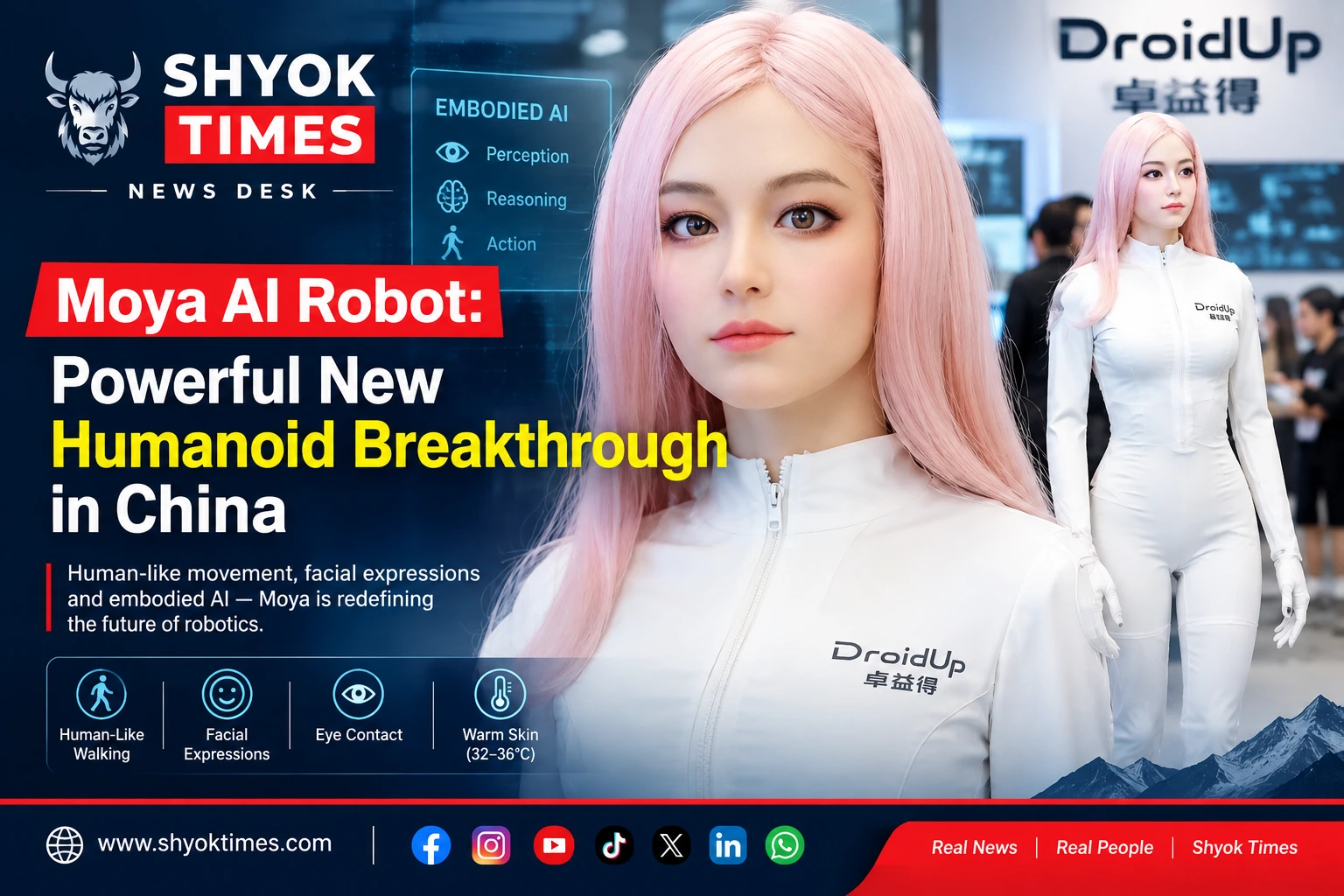
Moya AI Robot is attracting global attention after Shanghai-based robotics company DroidUp unveiled its highly bio-mimetic humanoid robot in early 2026. Designed to move and interact more like a person than a conventional machine, Moya combines embodied artificial intelligence, human-like walking, facial expressions, eye contact and temperature-controlled synthetic skin.
DroidUp presented Moya at Zhangjiang Robotics Valley in Shanghai, describing it as a fully bio-mimetic embodied-intelligence robot. The company says the system is designed to perceive, reason and act in the physical world rather than simply follow predetermined routines.
Moya AI Robot Focuses on Human-Like Interaction
Unlike industrial humanoids that are primarily designed for factories and physically demanding tasks, Moya is focused heavily on social interaction. Demonstration footage shows the robot walking, turning, maintaining eye contact, smiling and making subtle facial movements.
DroidUp claims Moya can achieve 92% human-like walking accuracy. However, this figure should be treated as a company claim because the methodology behind the percentage has not been publicly established as an independent benchmark.
The robot reportedly stands about 1.65 metres tall and weighs approximately 32 kilograms. Its design includes a silicone-like outer surface and temperature regulation intended to make physical interaction feel more natural. Reports place the surface temperature at approximately 32°C to 36°C, close to the range associated with human skin.
Embodied AI and Bio-mimetic Design
The technology behind Moya reflects a growing shift toward embodied AI. Instead of separating artificial intelligence from physical machines, embodied AI connects perception, reasoning and physical action.
Moya's cameras and AI systems are designed to support real-time interaction, including eye contact and facial responses. Its modular design also allows different appearances and characteristics, according to DroidUp.
This approach could eventually support applications in healthcare, elder care, education, hospitality and other customer-facing environments. The robot is therefore being positioned more as a social and service humanoid than as an industrial worker.
The Uncanny Valley Challenge
Moya's realistic appearance has also produced mixed reactions online. While some viewers see the robot as an impressive step toward more natural human-machine interaction, others find its lifelike appearance unsettling.
That reaction is closely connected to the uncanny valley—the phenomenon in which an artificial character becomes increasingly uncomfortable to people as it approaches, but does not perfectly reproduce, human appearance and behavior.
The challenge for companies such as DroidUp is therefore not simply making robots walk better. It is determining how realistic a robot should become before realism begins to reduce people's comfort.
DroidUp has reportedly targeted a price of around 1.2 million yuan, or approximately $173,000, with broader commercial availability expected later in 2026.
Moya does not yet represent a finished replacement for human caregivers or workers. Instead, it offers a glimpse of where humanoid robotics may be heading: machines designed not only to perform tasks, but also to communicate through movement, gaze, facial expression and physical presence.
For more technology and artificial intelligence coverage, readers can explore Shyok Times Technology and follow the latest developments in AI and robotics.
External Resources (DoFollow):
Follow more on New Atlas: She walks, shows emotion, holds eye contact and is warm
Read further at I E: World’s first ‘bio-mimetic AI robot’ Moya