Saspolo Apple Festival 2026: Sweet Success | Shyok Times
Saspolo Apple Festival 2026: Pari Valley Celebrates Kharmang’s Sweetest Heritage
Saspolo Apple Festival 2026 brought the distinctive colour, sweetness and fragrance of Pari Valley’s famous apples into the spotlight, celebrating the agricultural heritage of Kharmang, the hard work of local farmers and the economic potential of a fruit closely associated with Gilgit-Baltistan.
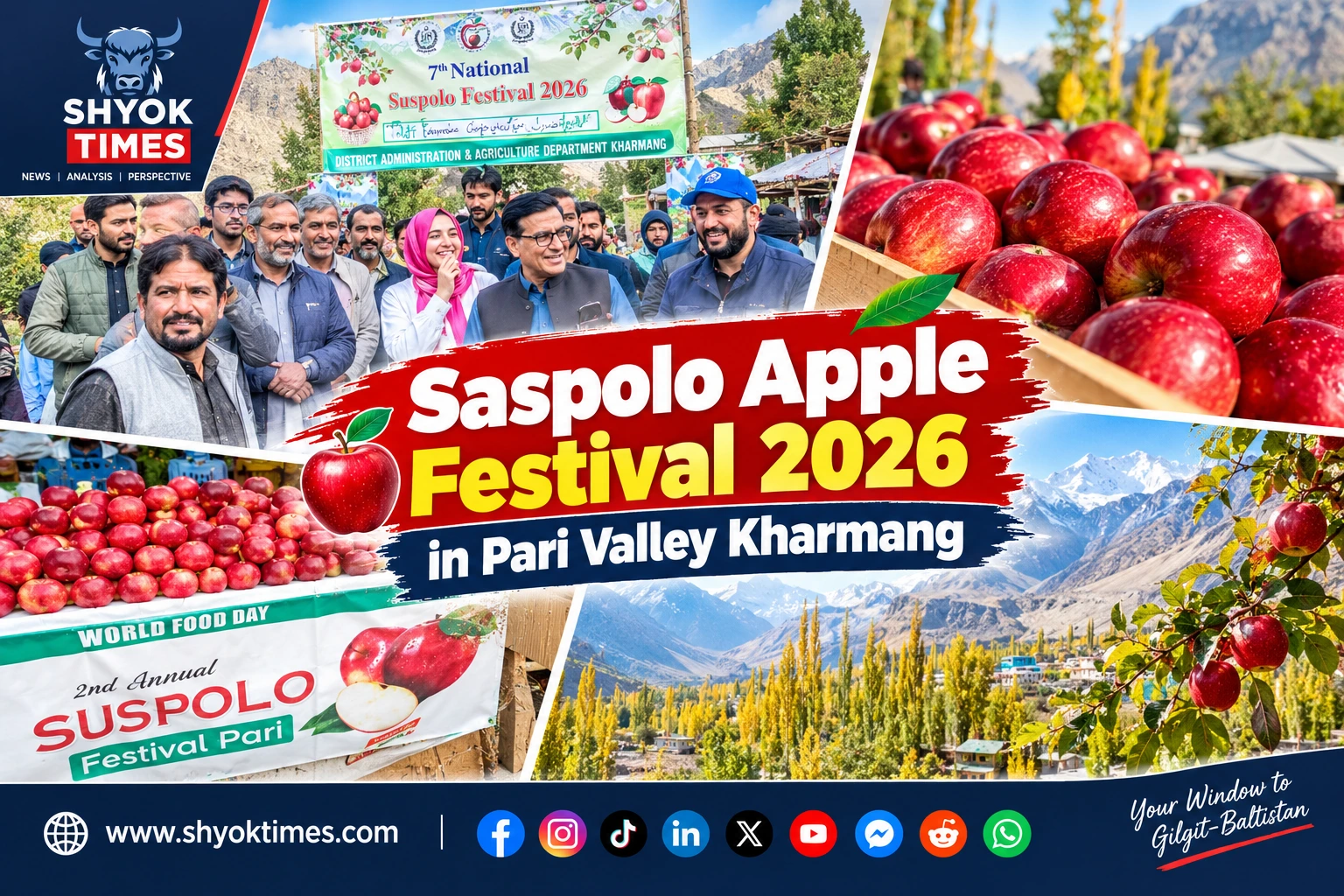
The seventh National Saspolo Apple Festival was held on October 20, 2026, in Pari Valley, Kharmang, with the participation of government representatives, agricultural cooperatives, local entrepreneurs, residents and visitors. Governor Gilgit-Baltistan Syed Mehdi Shah attended as chief guest, while Forests, Parks and Wildlife Minister Raja Nasir Ali Khan also participated in the event, according to the supplied festival information.
Organised by the Agriculture Department of Kharmang in collaboration with the district administration, the Economic Transformation Initiative Gilgit-Baltistan (ETI-GB) and other stakeholders, the festival showcased locally grown apples, value-added agricultural products, traditional foods and regional culture.
Beyond the celebrations, the event highlighted a wider question: how can a distinctive mountain fruit become a more reliable source of income for farmers while preserving the agricultural identity of Pari Valley?
The answer depends on better storage, improved transport, stronger market connections, quality planting material and sustained support for growers.
What Is the Saspolo Apple Festival?
The Saspolo Apple Festival is an annual agricultural and cultural event held in Pari Valley, Kharmang, to promote the valley’s locally grown Saspolo apple and support the farmers who cultivate it.
The festival provides a platform for showcasing fresh fruit, traditional food, processed agricultural products and local enterprise. It also connects farmers with public institutions, potential buyers, tourists and agricultural development organisations.
The Gilgit-Baltistan government's tourism website identifies Saspolo as a distinctive apple associated with Pari Valley and describes the area's climate and soil as important factors in its fruit-growing tradition.
For a remote mountain community where agriculture remains an important livelihood, the festival serves purposes beyond entertainment. It can help raise awareness of a locally distinctive product, encourage visitors to explore the valley and create opportunities for farmers to present their produce to a wider audience.
The 2026 edition also featured agricultural cooperatives and a supported promoter associated with ETI-GB. According to the supplied event report, seven Village Agricultural Cooperatives (VACs) and one supported 4P promoter displayed locally produced and value-added products.
Their participation demonstrated how collective marketing and small-scale processing can complement traditional farming.
Why Pari Valley’s Saspolo Apples Stand Out
Pari Valley is known for apples valued for their vibrant appearance, juicy texture, sweetness and distinctive fragrance. Local accounts describe the aroma as strong enough to fill a room, making the fruit recognisable beyond its appearance.
The apple has become part of the valley’s agricultural identity, linking local livelihoods with the landscape and traditions of Baltistan.
A variety shaped by local conditions
Agricultural experts cited in the supplied background material attribute the fruit’s characteristics to the area's growing conditions, including sunlight, mountain temperatures and soil composition.
Warm, sunny days followed by cooler nights can influence the colour and development of many apple varieties. Soil properties, water availability, orchard management, fruit maturity and the variety itself can also affect taste and quality.
The precise contribution of each factor to Saspolo's flavour would require specific agricultural research. Nevertheless, the valley's distinctive environment is central to the way local growers and residents describe their apples.
The regional tourism department also identifies Pari's soil and climate as important to the variety's cultivation.
The story behind the name
According to local historical accounts included in the supplied material, village elders brought apple saplings from Saspol in Ladakh before 1947. The trees subsequently adapted to the growing conditions in Pari, and the variety became associated with the name Saspolo.
This account connects the fruit with the historical and cultural links of the wider Himalayan region. It should be understood as a local tradition unless corroborated by historical records or agricultural documentation.
For residents, however, the variety's significance is not limited to its origins. Generations of cultivation have made it a recognisable symbol of Pari's relationship with its land.
A seasonal attraction for visitors
Apple season gives visitors an opportunity to experience local agriculture directly. Freshly harvested fruit, roadside stalls, traditional foods and village landscapes can become part of a wider tourism experience.
The festival helps bring these elements together in one place. If supported by responsible tourism planning, it could encourage longer visits, benefit small businesses and introduce more people to the agricultural heritage of Kharmang.
The opportunity lies in developing tourism that benefits local households without disrupting farming, increasing pressure on limited resources or reducing the community's control over its own traditions.
Saspolo Apple Festival 2026: Highlights from Pari
The seventh national festival brought together agricultural producers, public officials and community members to celebrate the harvest and promote locally produced goods.
Governor Syed Mehdi Shah attended as chief guest, while Raja Nasir Ali Khan, minister for forests, parks and wildlife in Gilgit-Baltistan, was also present, according to the supplied event account.
The Agriculture Department and district administration coordinated the event with support from ETI-GB and other stakeholders.
Agricultural cooperatives showcase local products
Seven Village Agricultural Cooperatives and one supported 4P promoter participated in the festival, displaying agricultural products and processed goods made in the region.
Such participation can help smaller producers reach customers beyond their immediate villages. Agricultural cooperatives can also give farmers a shared platform for promotion, product presentation and exploring potential buyers.
For locally grown fruit, the difference between selling an unprocessed harvest and developing products with a longer shelf life can be significant. Dried apple slices, jams and other carefully prepared products offer potential ways to reduce dependence on the short fresh-fruit selling season.
However, turning these opportunities into sustainable businesses requires suitable equipment, food-safety practices, packaging, storage and reliable demand.
Traditional foods and cultural performances
Festival stalls featured Saspolo apples, homemade delicacies, traditional foods and other locally produced goods. Students added to the atmosphere with cultural performances, while women and local entrepreneurs gained an opportunity to display their products.
These activities helped connect the festival's agricultural purpose with the cultural life of Pari Valley.
Local festivals can provide small businesses with direct access to visitors and allow communities to present their traditions on their own terms. They also create opportunities for younger generations to learn about the farming practices, foods and customs that shape local identity.
For Kharmang, combining agriculture with cultural tourism could help diversify household income, provided the benefits extend beyond festival day and reach producers in remote settlements.
How Much Saspolo Apple Does Pari Valley Produce?
According to agricultural figures included in the supplied background material, Pari Valley produces approximately 200 to 250 tonnes of Saspolo apples annually.
The reported estimate indicates that the variety has commercial importance despite being grown in a relatively small area. However, the figure should be treated as an estimate rather than a verified 2026 production total, as no current crop survey was provided.
The same material notes that Saspolo trees are scattered across individual farms rather than concentrated in large, clearly defined orchards. This makes it more difficult to calculate the exact area under cultivation and assess changes in production.
The distinction matters for planning. Accurate information about the number of productive trees, average yield, harvest volumes, prices and post-harvest losses would help agricultural authorities determine where support is most needed.
The Gilgit-Baltistan government identifies Saspolo as a notable local variety and reports that the region cultivates multiple apple varieties. Historical regional production figures should not be confused with a current annual estimate for Pari alone.
Training has reportedly improved production
The supplied agricultural background states that Saspolo apple training sessions began in 2019 and that more than 250 farmers have benefited.
It also reports production increases of approximately 25 to 30 per cent, alongside improvements in fruit size, quality and pest and disease management through pruning and orchard-care techniques.
These figures have not been independently verified for this article. If confirmed by the Agriculture Department's programme records, they would indicate the potential value of practical agricultural extension services.
Training can help growers make better decisions about tree pruning, pest management, harvesting maturity and the handling of fruit after picking. Such improvements may increase the proportion of a harvest that meets market requirements, even where the total number of trees remains unchanged.
Continued training, field demonstrations and access to qualified agricultural advisers could help farmers maintain quality and adapt to changing growing conditions.
The Biggest Challenge: Storage, Transport and Market Access
Despite its reputation, Saspolo apple production faces practical obstacles that can limit the income farmers earn from each harvest.
Limited cold storage increases waste
Fresh apples must be handled and stored appropriately to preserve their quality. When farmers lack suitable storage, they may have to sell quickly, often during a period when many other growers are bringing fruit to market.
The supplied material quotes local farmer Asqari Parvi as saying that the family produces apple jam and dried slices but lacks the resources to expand processing. The farmer estimates that nearly 60 per cent of the product goes to waste because of inadequate storage and processing facilities.
That figure represents an attributed local estimate, not a measured loss rate for every farmer or the entire valley.
Nevertheless, the underlying problem is consistent with broader agricultural challenges documented in Gilgit-Baltistan. Government agricultural statistics have recorded substantial losses across several fruit crops, while the region's difficult terrain makes transport and distribution more complicated.
Investment in appropriately sized cold-storage facilities, improved crates, sorting areas and timely collection could help preserve fruit quality. Such facilities would need reliable power, manageable operating costs and a system for deciding who can use them.
For small growers, shared facilities managed by cooperatives may be more practical than requiring each household to invest independently.
Poor road access raises transport costs
Some villages face limited or difficult road access, creating obstacles to moving harvested apples from farms to collection points and markets.
Stallholder Akbar Ali, according to the supplied report, highlighted the challenge of transporting apples from remote areas.
Delays can increase costs, expose fruit to physical damage and reduce the time available to find buyers. These problems are particularly important for small producers who lack their own vehicles or established distribution arrangements.
Better farm-to-market connections, coordinated collection and dependable transport services could help growers reach larger markets while reducing avoidable losses.
Road improvements should be planned with local terrain, environmental risks and community priorities in mind. In mountain regions, maintaining existing access routes can be as important as constructing new ones.
Farmers need stronger bargaining power
When individual farmers sell small quantities independently, they may struggle to negotiate prices, arrange transport or meet the volume requirements of larger buyers.
Cooperatives can help by pooling produce, coordinating grading and packaging, sharing transport and negotiating with wholesalers, retailers, hotels and restaurants.
The participation of seven Village Agricultural Cooperatives at the 2026 festival provides a platform on which such collaboration could develop.
A practical next step would be to connect participating cooperatives with buyers before the next harvest. Clear information about expected quantities, quality standards, collection dates and payment terms would make these arrangements more useful than one-off promotional activities.
Can Saspolo Apples Reach International Markets?
Saspolo has potential as a premium regional product because of its distinctive identity, limited geographic association and reputation for sweetness and aroma. But international market access requires more than an attractive name or a successful festival.
Export buyers generally require consistent quality, traceability, appropriate packaging, reliable volumes and compliance with the destination country's food-safety and phytosanitary rules.
For Pari's growers, the first step may be to strengthen access to domestic markets in cities such as Islamabad, Rawalpindi, Lahore and Karachi, where consumers may be interested in distinctive mountain produce.
The Policy and Planning Institute of Pakistan's research on Gilgit-Baltistan's apples discusses the economic potential of regional varieties and identifies supply-chain and marketing limitations as important concerns. Its estimates and assumptions should be read in their stated context rather than treated as guaranteed future earnings.
Build a recognisable Saspolo brand
A coordinated regional brand could distinguish genuine Pari-grown Saspolo apples from other varieties sold under broad descriptions such as mountain apples.
Such a brand could include:
- A clear origin label identifying Pari Valley, Kharmang, Gilgit-Baltistan.
- Consistent grading based on size, appearance and quality.
- Packaging that protects fruit during long-distance transport.
- Harvest-season information and producer or cooperative identification.
- Verified information about cultivation and handling methods.
Brand claims should be evidence-based. In particular, descriptions such as “organic,” “pesticide-free” or “chemical-free” should not be used as blanket guarantees without appropriate verification. Traditional farming practices may be an important selling point, but they do not automatically establish formal organic certification.
Expand value-added products
Processing could help farmers use fruit that is suitable for consumption but less attractive for sale as premium fresh produce.
Potential products include dried apple slices, jam, juice and other processed foods, subject to food-safety and commercial feasibility assessments.
Value addition can create additional work in processing, packaging, transport and sales. It may also give local women and small entrepreneurs opportunities to establish businesses linked to the harvest.
Yet processing is not automatically profitable. Producers need to understand equipment costs, energy requirements, packaging expenses, shelf life, food-safety rules and customer demand before investing.
Pilot projects involving farmer cooperatives, agricultural specialists and local entrepreneurs could identify which products have the strongest commercial prospects.
Climate Change and the Future of Mountain Agriculture
Saspolo apples depend on growing conditions that include suitable temperatures, water availability and healthy trees. Changes in these conditions could affect production and the long-term sustainability of local farming.
The supplied background identifies glacier retreat and concerns about irrigation as emerging risks in Baltistan. Their effects on individual farms will depend on local water sources, seasonal flows, irrigation infrastructure and changing weather patterns.
Across Gilgit-Baltistan, agriculture is closely connected to the region's mountain environment. The Agriculture, Livestock and Fisheries Department identifies limited storage, difficult terrain, traditional farming constraints and access to modern agricultural technology among the challenges facing growers.
For Pari Valley, practical adaptation measures could include improving irrigation efficiency, maintaining water channels, monitoring tree health and helping farmers respond to unusual weather and pest outbreaks.
Agricultural authorities could also document how changing temperatures, frost events and water availability affect flowering, fruit development and harvest timing. Such local evidence would help growers make informed decisions instead of relying on broad regional assumptions.
Protecting Saspolo production therefore involves more than increasing the number of trees. It also requires maintaining the environmental conditions and agricultural knowledge that allow those trees to produce quality fruit.
What the Government Can Do to Support Saspolo Farmers
The annual festival provides visibility, but the long-term economic benefits will depend on what happens after the stalls are removed and the harvest season ends.
Several measures could help translate that visibility into sustained improvements in farmers' incomes.
Expand high-quality nurseries
The supplied material identifies four government-run fruit nurseries in Kharmang, including one dedicated to Saspolo apples. It also reports that current nursery production does not fully meet local demand for planting material.
If confirmed by the Agriculture Department, this shortage deserves attention. Farmers need healthy, correctly identified planting material to expand cultivation and replace ageing or unproductive trees.
Authorities could assess nursery capacity, improve propagation methods, maintain records of plant varieties and establish a transparent distribution system for saplings.
Any expansion should preserve the identity and quality of the local variety rather than prioritising tree numbers alone.
Invest in shared storage and processing
Government agencies and development partners could assess the feasibility of community-level cold storage, grading facilities and small-scale processing units.
These investments should be based on harvest volumes, energy availability, transport costs and realistic demand. A facility that is too expensive to operate or too distant from farms may fail to deliver the expected benefits.
Cooperatives could play a role in managing shared infrastructure, provided members have clear rules for access, fees, maintenance and financial accountability.
Improve market information and digital sales
Farmers need timely information about prices, buyer requirements, transport options and demand in different cities.
Digital marketing could help connect Pari growers with retailers, restaurants, wholesalers and individual consumers. However, online promotion works best when producers can fulfil orders consistently and maintain fruit quality throughout delivery.
Cooperatives could coordinate seasonal pre-orders, publish verified product information and consolidate shipments to reduce individual transport costs.
Measure outcomes beyond festival attendance
The success of the festival should not be judged solely by visitor numbers or the variety of products displayed.
Useful indicators would include the number of farmers reached, quantities sold, average farm-gate prices, post-harvest losses, new buyer relationships and income earned from processed products.
Publishing these results after each festival would help the public assess whether the event is improving agricultural livelihoods and where further investment is needed.
Why the Saspolo Apple Matters to Gilgit-Baltistan
Saspolo is more than a seasonal crop for Pari Valley. It represents a connection between local knowledge, the mountain environment and the livelihoods of farming households.
The variety also illustrates a wider opportunity for Gilgit-Baltistan: locally distinctive agricultural products can help rural communities create value from limited cultivable land.
The challenge is ensuring that the people who grow the fruit receive a fair share of that value. Better storage, transport, processing and marketing can matter as much as the fruit's reputation.
The Gilgit-Baltistan Tourism Department provides information about Saspolo apples and Pari Valley, while the Agriculture, Livestock and Fisheries Department is a useful official resource for regional agricultural information.
For more regional reporting, visit Shyok Times.
The 2026 festival offered an opportunity to celebrate farmers and draw attention to their work. The next step is to build on that recognition with practical support that reduces waste, improves market access and safeguards the future of Saspolo cultivation.
If the public sector, agricultural cooperatives and private buyers work together, Pari Valley's distinctive apples could become a stronger source of rural income while preserving an important part of Kharmang's heritage.
Frequently Asked Questions
Where was the Saspolo Apple Festival 2026 held?
The seventh National Saspolo Apple Festival was held in Pari Valley, Kharmang, Gilgit-Baltistan, on October 20, 2026, according to the supplied event information.
What is a Saspolo apple?
Saspolo is a distinctive apple variety associated with Pari Valley in Kharmang. It is known locally for its sweetness, colourful appearance, juicy texture and strong fragrance.
How much Saspolo apple does Pari Valley produce each year?
The supplied background material estimates annual production at approximately 200–250 tonnes. This figure should be treated as an estimate, not an independently verified 2026 harvest total.
Who attended the 2026 Saspolo Apple Festival?
According to the supplied report, Governor Gilgit-Baltistan Syed Mehdi Shah attended as chief guest, and Raja Nasir Ali Khan, minister for forests, parks and wildlife, also participated. Agricultural cooperatives, local producers and other stakeholders showcased their products.
What challenges do Saspolo apple farmers face?
The main challenges identified in the supplied material include limited cold storage, post-harvest losses, difficult road access, inadequate processing facilities, limited nursery output and insufficient access to wider markets.
Can Saspolo apples be exported?
Export opportunities may exist, but growers would need consistent quality, suitable packaging, reliable supply, traceability and compliance with destination-market requirements. Better domestic distribution and storage would also strengthen the foundations for export development.
External Resources (DoFollow):
Follow more on Visit GB : GOVERNMENT OF GILGIT BALTISTAN Tourism
Read further at We News English: Saspolo Apple: A Taste of Gilgit-Baltistan
Keep reading via DAWN: Kharmang celebrates colour, taste and aroma of Suspolo apples