France Protests: Rising Costs Fuel Nationwide Unrest | Shyok Times
France Protests: Alarming Facts Behind Nationwide Unrest
France protests intensified on Saturday, October 17, as demonstrations against rising living costs and deteriorating public services spread across the country, drawing students, trade union members, workers and supporters of the Yellow Vest movement into the streets. What began as student-led protests over poor school conditions has developed into a wider expression of public frustration over household expenses, inequality, wages and government spending.
Authorities reported widespread demonstrations, clashes between police and some protesters, damage to public buildings and businesses, and hundreds of arrests. Although many people participated in peaceful marches, violent incidents in several cities raised fresh concerns about public safety, police conduct and the government's ability to address the grievances driving the unrest.
The demonstrations have placed renewed pressure on President Emmanuel Macron's government and Prime Minister Sébastien Lecornu at a politically sensitive time, with France facing economic pressures and an increasingly contested political environment ahead of the 2027 presidential election.
France Protests: What Happened on October 17?
Nationwide demonstrations took place on Saturday as protesters called for action on living costs and better conditions in schools and other public services. The mobilisation brought together different groups whose demands overlap but are not identical.
According to Reuters, Interior Minister Laurent Nuñez estimated that approximately 550,000 people participated in demonstrations across France. The CGT trade union put the turnout at around 800,000, illustrating the difference between official and union estimates.
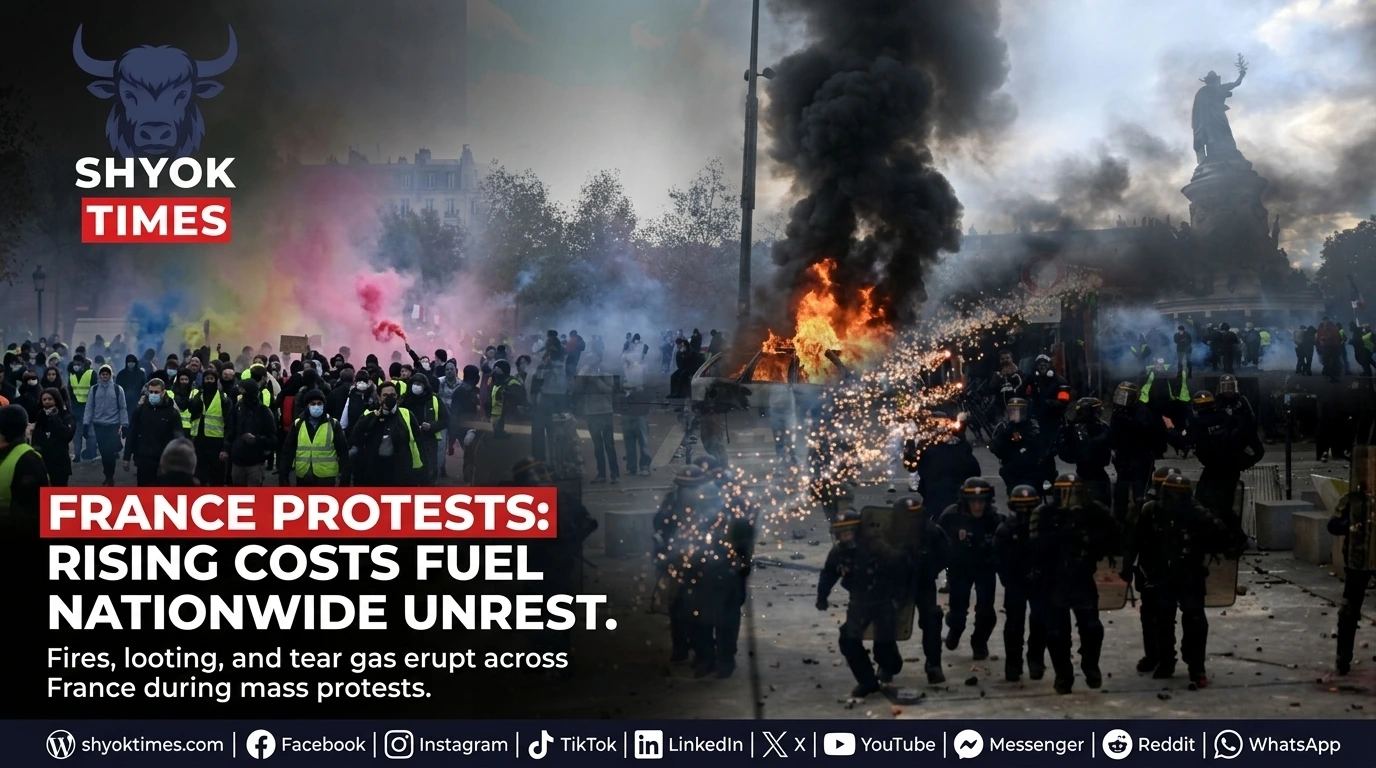
The Associated Press also reported clashes in Paris and other cities, including incidents involving fires, looting and damage to property. Police used tear gas and water cannons to disperse some violent groups.
In Paris, police confronted masked demonstrators throwing fireworks and other objects near Place de la République. Reports also described fires involving a vehicle and a newspaper kiosk. Elsewhere, damage was reported at public buildings and commercial premises.
The unrest was not limited to the French capital. Lyon, Marseille and Limoges were among the cities affected by serious incidents. In Lyon, a fire broke out at the city's tourist office. In Limoges, the town hall was set ablaze, while protesters entered parts of Marseille's City Hall and damaged property.
These incidents occurred alongside larger demonstrations in which many participants marched peacefully.
The distinction matters: the presence of violent groups does not mean every demonstrator took part in violence or supported the destruction of property.
Rising Living Costs Fuel Public Anger
The cost of living has become one of the central issues behind the latest France protests.
Households facing expensive essentials, housing pressures, transport costs and concerns about purchasing power have increasingly questioned whether government policies adequately reflect everyday economic realities.
The protests brought together people with different experiences of these pressures. Workers have demanded better wages and pensions, while unions have called for lower prices and the protection of public services.
Fuel prices and household expenses have also featured prominently in the wider debate. For many people, economic pressure is not simply about one price increase but about the relationship between income, essential spending and the quality of services available to the public.
The renewed participation of Yellow Vest supporters is significant because that movement emerged in 2018 amid anger over fuel taxation and perceived social injustice. Its return to the streets reflects the continuing political sensitivity of policies that affect household budgets.
However, the current demonstrations should not be treated as a simple repetition of the earlier movement. The latest unrest has grown from student concerns about schools and has attracted unions, workers and other groups with broader demands.
The challenge for the government is to distinguish between immediate economic grievances and longer-term concerns about inequality, public spending and trust in political institutions.
Student Protests Highlight Problems in French Schools
Education remains a major source of frustration, particularly among students who say that shortages of teachers and deteriorating facilities are affecting their ability to learn.
The movement began with school-based protests in and around Paris before spreading to other parts of France. Students organised blockades and demonstrations to draw attention to staffing problems, classroom conditions and what they see as inadequate public investment.
The Associated Press reported that the latest nationwide demonstrations included support for high school students demanding improvements in their educational environment.
Earlier reporting by Reuters described complaints about teacher shortages and deteriorating school infrastructure. Students and education workers have raised concerns about overcrowded classrooms, insufficient resources and the difficulty of maintaining normal teaching when schools lack staff.
These complaints are particularly important because education is central to social mobility. Students from disadvantaged communities may have fewer alternatives when public schools cannot provide consistent teaching or adequate facilities.
When teachers are unavailable, classrooms become overcrowded or essential infrastructure falls into disrepair, the consequences extend beyond a single school day. Students can lose learning time, teachers face additional pressure, and families may lose confidence in the public education system.
The protests therefore raise questions about the distribution of resources, recruitment and retention of teachers, and the government's ability to ensure that children receive a comparable standard of education regardless of where they live.
Addressing these concerns will require more than temporary measures to reopen blocked schools. A lasting response would involve identifying staffing gaps, assessing school infrastructure, improving working conditions and publishing measurable progress.
Hundreds Arrested as Police Face Scrutiny
The latest demonstrations have also intensified debate about policing and the use of force.
French authorities reported hundreds of arrests during the October 17 mobilisation. Reuters reported that Nuñez put the number at around 400 following violent incidents. Other reports published during the day cited lower totals at earlier stages of the demonstrations, reflecting the evolving situation and different reporting cut-off times.
The Associated Press reported that police used tear gas and water cannons in Paris to disperse groups involved in confrontations. Officers also faced attacks, including the throwing of fireworks and other objects.
At the same time, police tactics have attracted criticism following serious injuries reported during the broader student protest movement. Reuters previously reported allegations of injuries linked to riot-control weapons and scrutiny of police conduct.
These concerns create a difficult public-policy question. Authorities have a responsibility to protect people, prevent attacks and safeguard public property. They must also ensure that crowd-control measures are lawful, proportionate and subject to independent scrutiny.
The right to peaceful protest is a fundamental part of democratic life. Arrests and the use of force must therefore be assessed in the context of individual conduct, the circumstances of each incident and applicable law.
Investigations into alleged misconduct can help establish accountability, while transparent reporting about arrests and injuries can reduce speculation.
It is equally important to avoid treating all protesters as violent or assuming that every police intervention was unlawful. Each incident requires evidence-based assessment.
For the government, maintaining public order while protecting the right to peaceful assembly will be essential if demonstrations continue.
Fires and Looting Damage Public Buildings and Businesses
Violence during the demonstrations caused disruption in several French cities.
In Paris, some protesters reportedly set fires and targeted shops, while police moved to disperse groups involved in confrontations. Commercial premises and public infrastructure were also affected elsewhere.
The fire at Lyon's tourist office became one of the most visible incidents of the day. In Limoges, the town hall was set ablaze. In Marseille, protesters damaged parts of the municipal environment and briefly entered the City Hall lobby, according to Associated Press reporting.
Such incidents have consequences beyond the immediate damage. Businesses may face repair costs, employees may be unable to work, public services can be interrupted, and residents may feel unsafe travelling through affected areas.
Small businesses can be particularly vulnerable when demonstrations result in broken windows, looting or prolonged street closures. Public buildings, meanwhile, are funded to serve communities and are costly to repair when damaged.
Violence can also undermine the messages that peaceful protesters want the public to hear. When images of burning vehicles and damaged buildings dominate coverage, demands concerning school conditions, wages or living costs risk being overshadowed.
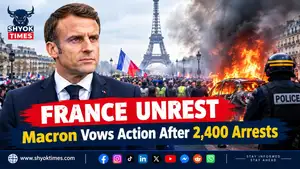
French leaders have condemned attacks on public institutions and property. President Macron has called for respect for people and property while acknowledging the constitutional right to demonstrate.
The government now faces the task of responding to criminal acts without dismissing the legitimate concerns that brought many people into the streets.
The Political Stakes Are Growing Ahead of 2027
The protests come at a sensitive point in France's political calendar.
With the 2027 presidential election approaching, economic dissatisfaction and disputes over public spending could become increasingly important issues for political parties and candidates.
Prime Minister Sébastien Lecornu has said the government will not be intimidated by violence. President Macron has also pledged action against those responsible for attacks.
Government officials have attributed some of the violence to radical groups and criminal activity. Such claims are part of the political debate surrounding the unrest, but responsibility for specific incidents must be established through evidence rather than assumptions about entire movements.
The demonstrations also expose a broader challenge facing French politics: how to respond when different groups unite around dissatisfaction with living standards and public services despite having different priorities.
Students may focus on teachers and school facilities. Workers may prioritise wages, pensions and employment security. Other participants may be more concerned about fuel costs, inequality or the direction of public spending.
These concerns can reinforce each other politically, even when they do not translate into a single unified programme.
The government's response will therefore be judged not only by its ability to restore order but also by whether it can offer credible answers to the underlying complaints.
If the authorities rely primarily on security measures, protesters may feel their grievances remain unaddressed. Conversely, failure to protect people and property could deepen public anxiety and weaken confidence in government institutions.
A sustainable approach will require both effective law enforcement and a serious policy response.
Why the Yellow Vest Movement Matters Again
The renewed presence of Yellow Vest supporters connects the current unrest with one of France's most significant protest movements of recent years.
The original movement began in 2018 and became associated with opposition to fuel-tax increases, purchasing-power pressures and a perceived disconnect between political leaders and ordinary citizens.
Its significance extended beyond the initial dispute because it provided a platform for wider frustration about inequality, taxation and representation.
The current demonstrations share some of those themes, particularly concerns about living costs and public services. Yet the new wave has a distinct starting point in student-led protests over education.
The comparison is useful because it shows how a specific grievance can develop into a broader national debate when people believe that separate problems reflect a common failure of public policy.
It does not, however, mean that every participant belongs to the Yellow Vest movement or that all demonstrators share the same political objectives.
Understanding these differences is important for assessing the scale, composition and likely direction of the unrest.
Could the Protests Spread Across Europe?
France is not the only European country experiencing demonstrations over economic and social concerns.
Reporting by Reuters and other news organisations described smaller protests or related unrest in Belgium, Portugal and Italy, while demonstrations in Albania have focused on issues including government corruption, jobs and education.
The immediate causes differ from country to country. In some places, housing affordability and living costs have been prominent; elsewhere, protesters have focused on education reforms or political accountability.
The developments suggest that public frustration over purchasing power and the quality of public services is not confined to France. However, it would be misleading to assume that all these demonstrations form a single coordinated movement.
National economic conditions, political institutions, union structures and local grievances influence how protests develop.
For European governments, the wider lesson is that economic policy cannot be separated entirely from the everyday experience of households. Rising costs, insecure employment and concerns about access to public services can become politically destabilising when people believe their concerns are not being heard.
Whether the demonstrations lead to policy changes will depend on negotiations, public pressure and the decisions made by national governments.
What Happens Next in France?
The immediate priorities are public safety, the protection of peaceful assembly and the investigation of serious incidents.
Authorities will need to establish responsibility for attacks, assess damage and ensure that those injured receive appropriate assistance. Any allegations of excessive police force also require credible investigation.
Beyond the security response, the government faces pressure to demonstrate that the concerns raised by students, teachers and workers are being taken seriously.
Potential policy responses include targeted action to address teacher shortages, improvements to school facilities, clearer plans for public-service funding and measures designed to ease pressure on household budgets.
The effectiveness of such measures will depend on funding, implementation and public confidence. Announcements alone are unlikely to resolve frustration if students continue to encounter the same conditions or households see little improvement in their financial circumstances.
Dialogue with students, unions, teachers and local communities could help identify practical priorities. Publishing clear targets and progress reports would also make it easier to assess whether promises are being fulfilled.
The political consequences remain uncertain. Further demonstrations, changes in government policy or new negotiations could alter the direction of the movement in the coming weeks.
For now, the protests demonstrate how education, economic pressures and public trust can intersect to create a national crisis.
Conclusion: France Faces a Test of Public Trust
The France protests of October 17 have brought together anger over living costs, concerns about schools and wider dissatisfaction with public services. The scale of the demonstrations, competing turnout estimates and reports of violence underline both the intensity of the unrest and the need for careful, verified reporting.
The government must protect public safety and hold those responsible for violence accountable while respecting peaceful protest and investigating allegations of police misconduct.
At the same time, the concerns raised by students, teachers and workers cannot be resolved through policing alone. Better school conditions, credible public-service policies and meaningful engagement with affected communities will be essential to restoring confidence.
As France approaches the 2027 presidential election, the handling of this unrest may become an important test of political leadership. Whether the demonstrations lead to lasting reforms or further confrontation will depend on how effectively the government addresses the issues at their centre.
Reporting note: This article reflects information available through October 18, 2026.
External Resources (DoFollow):
Follow more on SKY News: France protests: At least 400 arrested in protests
Read further at NPR: Fires break out as protesters rally across France
Keep reading via Reuters: Protests in France spiral into worst riots in years