Gilgit-Baltistan Security: Key Safety Steps | Shyok Times
Gilgit-Baltistan Security: Police Order Key Safety Measures for Foreigners
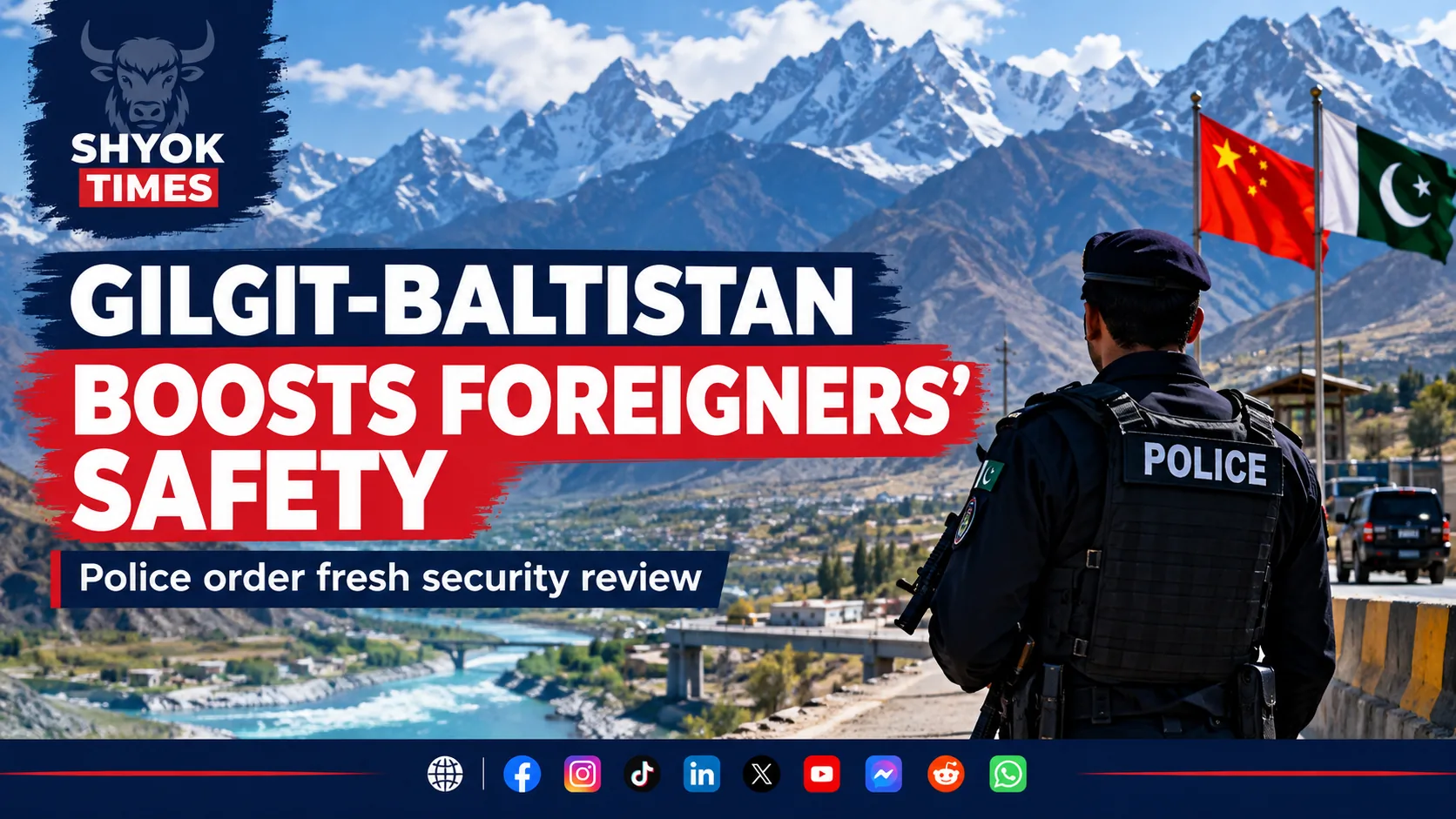
GILGIT: Gilgit-Baltistan security arrangements for Chinese nationals and other foreign citizens are set to undergo a fresh review after regional police officials ordered stronger protective measures for foreigners living and working across the mountainous region.
The decision was taken during a high-level meeting chaired by Inspector General of Police (IGP) Gilgit-Baltistan Dr Akbar Nasir Khan at the Central Police Office in Gilgit on Saturday. The meeting reviewed existing security arrangements for foreign nationals involved in development projects, private mining ventures, business activities and residential arrangements across the region.
According to a statement issued by the Gilgit-Baltistan Police spokesperson, officials examined the deployment of the Special Protection Unit (SPU), security procedures at checkpoints and entry points, and arrangements for monitoring the movement of Chinese nationals between districts.
The IGP directed district-level authorities to conduct fresh threat assessments, identify security gaps and address shortcomings within a specified timeframe. He also ordered the implementation of security procedures issued by the National Counter Terrorism Authority (NACTA), the re-verification of residential no-objection certificates (NOCs), and security audits of approved locations.
The directives highlight the importance of coordinated security arrangements for foreign citizens working on both China-Pakistan Economic Corridor (CPEC) and non-CPEC projects, as well as those engaged in commercial and mining activities.
The measures were reported by Dawn on October 11, 2026. The police review covered arrangements across Gilgit, Skardu, Diamer and other parts of Gilgit-Baltistan.
Gilgit-Baltistan Security Review: What Police Have Ordered
The meeting focused on strengthening existing arrangements and identifying weaknesses that could affect the protection of foreign nationals. Officials reviewed security responsibilities at residences, workplaces, project sites, checkpoints and other locations where foreign citizens live or conduct business.
The main directives include:
- Fresh district-level threat assessments: Police officials must reassess security risks and identify the protection requirements of foreign nationals in their respective districts.
- Security audits of approved locations: Authorities have been directed to review the security arrangements at designated residences and other approved sites.
- Re-verification of residential NOCs: Officials must check no-objection certificates and ensure compliance with the conditions attached to them.
- Stronger coordination and movement verification: Police have emphasised advance notification, verification and security checks for the movement of Chinese nationals between districts.
- Implementation of NACTA procedures: Relevant authorities have been instructed to follow the applicable security procedures and address identified shortcomings within the specified timeframe.
The IGP also stressed compliance with legal requirements, including valid driving licences where applicable, and closer monitoring of movements, particularly during nighttime.
These directives establish the priorities identified during the review. The available report does not specify a public completion date for every measure or confirm that all security audits and re-verification exercises have been completed.
Why Are Authorities Strengthening Security for Chinese Nationals?
Chinese citizens are among the foreign nationals working on development, infrastructure and commercial projects in Pakistan. Their protection has remained an important security responsibility for authorities overseeing major projects and economic activities.
Gilgit-Baltistan occupies a strategically important position in northern Pakistan, sharing a border with China and forming part of the wider regional connectivity network associated with CPEC. The region's mountainous geography, long travel routes and dispersed settlements also make coordination between district administrations and law-enforcement agencies an important part of security planning.
The latest review is notable because it covers more than CPEC-related activities. According to the reported meeting, the assessment included foreign nationals associated with non-CPEC development projects, private mining ventures, businesses and residential locations throughout the region.
This broader scope means authorities are reviewing arrangements for foreign citizens whose work or residence may fall outside major corridor projects.
However, the decision should not be interpreted as evidence that a specific new attack has occurred or that every foreign national faces an immediate threat. The reported announcement concerns a security review and directives to strengthen protective arrangements.
Special Protection Unit and Checkpoints Under Review
The Special Protection Unit is among the police arrangements reviewed during the meeting. Officials assessed SPU deployments alongside existing security directives and protective measures at checkpoints and key entry points.
The purpose of reviewing deployments is to identify whether existing arrangements meet the security requirements of the locations and individuals concerned. The IGP's instructions also call for authorities to identify deficiencies and take corrective action within a specified timeframe.
Coordination is particularly important when foreign nationals travel between different districts. A journey may involve several administrative jurisdictions, requiring relevant officials to verify movement information and communicate security requirements effectively.
Police officials emphasised advance notification, verification and security checks for the movement of Chinese nationals across Gilgit, Skardu, Diamer and other areas.
The announcement did not provide a detailed public breakdown of individual deployments, checkpoint locations, staffing levels or operational procedures. Such details should not be assumed from the general directives.
The focus of the reported decision is to improve coordination and ensure that district authorities understand their responsibilities for protecting foreign nationals.
NACTA Procedures, NOCs and Security Audits
Another important component of the Gilgit-Baltistan security review concerns compliance with established procedures.
The IGP directed officials to implement security procedures issued by the National Counter Terrorism Authority, Pakistan's national body responsible for counterterrorism coordination and related policy guidance.
He also ordered the re-verification of residential NOCs and security audits of approved locations. These steps are intended to ensure that relevant documentation remains valid and that the conditions attached to approvals are being followed.
An NOC, or no-objection certificate, is an administrative document used in various regulatory contexts. The specific requirements depend on the applicable rules and the circumstances of the approval. In this case, the reported directives concern the re-verification of residential NOCs associated with the arrangements under review.
Security audits provide an opportunity to assess whether the existing protective arrangements meet the relevant requirements. The IGP directed authorities to identify shortcomings and resolve them within a specified period.
Officials were also instructed to maintain comprehensive district-level records. Accurate records and consistent verification can support communication between relevant departments and help authorities monitor compliance.
The announcement did not publicly detail the audit criteria, the number of locations to be inspected or the individual deadlines assigned to each district.
Nighttime Movement and Legal Compliance
The police review also highlighted the monitoring of foreign nationals' movements, particularly during nighttime.
The instruction was issued alongside directions concerning compliance with NOC conditions and legal requirements, including driving licences where applicable.
Movement coordination can be an important element of protective planning in a region where journeys between communities and project locations may involve long distances. Reliable information-sharing between relevant officials can help authorities understand travel arrangements and respond to changing security requirements.
The police statement, as reported, does not provide a comprehensive list of movement restrictions or establish that all foreign nationals are subject to a newly introduced blanket curfew or travel ban.
Accordingly, the directive should be understood as an instruction to strengthen monitoring under the applicable security arrangements, rather than evidence of a universal restriction on foreign travel within Gilgit-Baltistan.
Foreign residents, employers and project operators should follow any lawful instructions communicated to them by the relevant authorities and verify current requirements directly with the responsible departments.
IGP Warns Against Negligence
Inspector General of Police Dr Akbar Nasir Khan issued a strong warning about the responsibility of officials tasked with protecting foreign nationals.
He made clear that negligence in ensuring the safety of foreigners, particularly Chinese citizens, would not be tolerated.
The warning places responsibility on the relevant police units and district-level officials to review arrangements, follow applicable procedures and address shortcomings.
The meeting included senior officers such as the DIG Headquarters, DIG Gilgit Range, assistant inspectors general responsible for Special Branch, Operations and Development, the SSP of the Special Protection Unit, and sub-divisional police officers from Gilgit district.
The participation of officials from different operational and administrative units reflects the need for coordination in implementing the directives.
The fresh assessments are expected to help authorities identify local security requirements rather than rely solely on a uniform approach across the entire region. Security needs can differ according to the location, nature of the activity, movement patterns and the applicable assessment.
The report does not disclose specific threat intelligence or identify particular sites as being at elevated risk. Any assessment of the actual threat level should therefore be based on official information rather than speculation.
Implications for Development Projects and Private Businesses
The security review covers foreign nationals involved in a range of activities, including development work, private mining and business operations. Its scope is therefore relevant to project operators and employers as well as police officials.
For organisations employing foreign personnel, clear communication with relevant authorities can help ensure that documentation, residential arrangements and movement procedures meet applicable requirements.
Project operators may also need to cooperate with authorised security audits and provide information requested through lawful administrative processes. Employers should confirm the specific obligations applicable to their projects rather than assume that the same requirements apply identically to every site.
For local businesses, the review reinforces the importance of maintaining appropriate records and following the security conditions attached to any relevant approvals.
At the same time, stronger security arrangements should be implemented in a way that respects lawful activity and avoids unnecessary disruption. Effective security depends not only on enforcement but also on communication, coordination and clear responsibilities.
The police announcement does not quantify the financial impact of the measures on businesses or indicate that any project has been suspended. Any claims about project delays, additional costs or changes to investment plans would require separate evidence.
What the Decision Means for Gilgit-Baltistan
The latest directives show that police leadership is placing renewed emphasis on reviewing the protection of foreign nationals across Gilgit-Baltistan.
For residents, the issue is connected to the wider responsibility of public authorities to maintain law and order while supporting lawful economic activity. The region hosts development initiatives, commercial operations and tourism-related activity, making effective security coordination an important public-administration concern.
For foreign workers, employers and project managers, the immediate practical priority is to understand and comply with the requirements communicated by the competent authorities.
For district police officials, the reported instructions emphasise fresh threat assessments, verification of documentation, security audits and the timely correction of identified deficiencies.
The effectiveness of the initiative will depend on how consistently these instructions are implemented and whether authorities follow up on the shortcomings identified during their assessments.
The public announcement does not provide a full implementation report. It remains unclear how many locations will be audited, what specific deficiencies have been identified or when the district-level reviews will be completed.
These details will be important for assessing the practical outcome of the decision.
Frequently Asked Questions
Why is Gilgit-Baltistan strengthening security for foreign nationals?
Police officials reviewed protective arrangements for foreign nationals involved in development projects, private mining ventures, businesses and residential activities. The review particularly focused on Chinese citizens living and working in the region.
Who chaired the security meeting?
Inspector General of Police Gilgit-Baltistan Dr Akbar Nasir Khan chaired the meeting at the Central Police Office in Gilgit on Saturday.
Which areas are covered by the security review?
The reported directives cover arrangements across Gilgit, Skardu, Diamer and other parts of Gilgit-Baltistan where foreign nationals live or work.
What are the five main security priorities?
The principal priorities are fresh threat assessments, security audits, re-verification of residential NOCs, stronger coordination and movement verification, and implementation of applicable NACTA security procedures.
Have all the new measures already been implemented?
The available report confirms that police leadership issued directives and ordered reviews. It does not confirm that every assessment, audit or verification exercise has been completed.
Does the announcement impose a blanket travel ban on foreigners?
The reported announcement does not establish a blanket travel ban. It refers to stronger coordination, advance notification, verification, security checks and monitoring under the applicable arrangements.
Conclusion
Gilgit-Baltistan police have ordered a renewed review of security arrangements for Chinese nationals and other foreign citizens involved in development projects, mining, business and residential activities.
The directives issued by IGP Dr Akbar Nasir Khan emphasise district-level threat assessments, SPU deployments, checkpoint security, NOC verification, security audits and compliance with NACTA procedures.
The next important step will be implementation. The identification of security gaps, timely corrective action and effective coordination between relevant departments will determine how successfully the instructions translate into stronger protective arrangements across the region.
External Resources (DoFollow):
Keep reading via DAWN: Gilgit-Baltistan steps up security for foreigners