Khyber Pakhtunkhwa Emergency: Political Crisis Deepens | Shyok Times
Khyber Pakhtunkhwa Emergency: Critical Facts
Location: Islamabad / Peshawar, Pakistan
Pakistan’s Khyber Pakhtunkhwa emergency has triggered a major constitutional and political confrontation after President Asif Ali Zardari approved emergency measures and governor’s rule in the province on October 11, 2026. The decision effectively suspends the provincial government led by Pakistan Tehreek-e-Insaf (PTI), the party of jailed former prime minister Imran Khan, and transfers key governing responsibilities to the governor under federal oversight.
The federal government has justified the intervention by citing worsening security conditions, rising militant attacks and alleged failures by the provincial administration to cooperate effectively in counterterrorism efforts. PTI, however, has condemned the move as undemocratic, arguing that provincial autonomy cannot be sacrificed in the name of security.
The development comes amid heightened political tensions, a protest campaign demanding Khan’s release and intensified security preparations around Islamabad. It raises important questions about constitutional authority, democratic accountability, counterterrorism policy and the future of federal-provincial relations in Pakistan.
The key question is whether the extraordinary measures will improve security in the province or deepen the political divisions that have already complicated efforts to address militancy.
Khyber Pakhtunkhwa Emergency: What Happened?
On Sunday, October 11, President Asif Ali Zardari approved the federal cabinet’s recommendations to impose emergency measures and governor’s rule in Khyber Pakhtunkhwa (KP), according to official announcements and reporting by Pakistani and international media.
The decision followed an emergency meeting of the federal cabinet chaired by Prime Minister Shehbaz Sharif. The government cited Articles 232 and 234 of Pakistan’s Constitution as the legal basis for the measures.
صدرِ مملکت آصف علی زرداری نے خیبر پختونخوا میں کی سلامتی کی صورتحال پر وزیراعظم کی ایڈوائس پر دستخط کر دیے ہیں۔
— The President of Pakistan (@PresOfPakistan) October 11, 2026
آئینِ پاکستان کے آرٹیکلز 232 اور 234 کے تحت صدرِ مملکت نے وزیراعظم کی ایڈوائس منظور کرتے ہوئے دستخط کیے۔
وفاقی کابینہ کے فیصلے، وزیراعظم کی ایڈوائس، متعلقہ اداروں کی…
Under the announced arrangement, the provincial government’s executive functions are transferred to the governor or exercised under federal authority, while the powers of the provincial assembly may be exercised by Parliament in accordance with the constitutional proclamation. An advisory council was also announced to assist in administering the province.
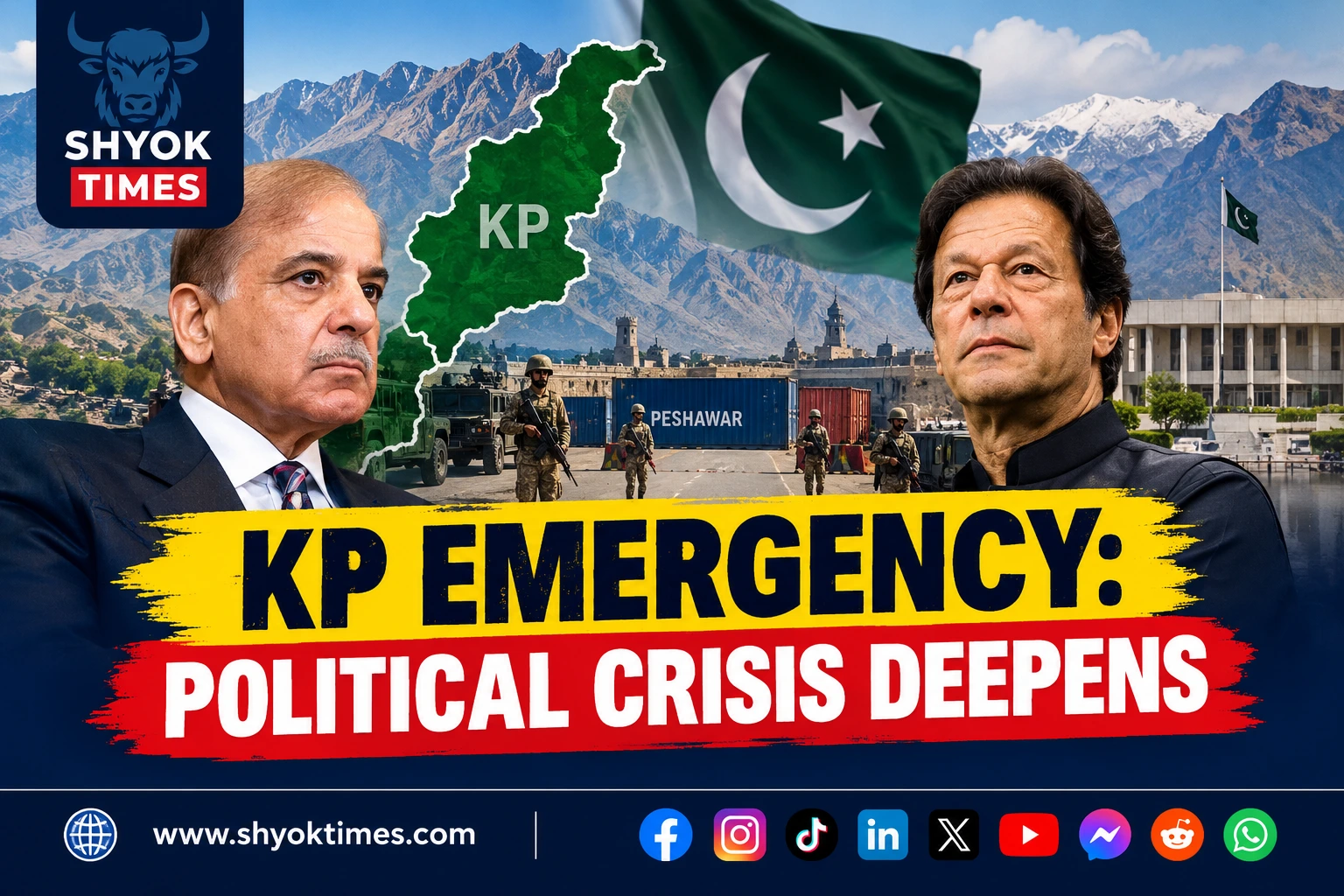
Federal authorities additionally authorised the deployment of Pakistan Army troops and assets in aid of civil power. Security measures were strengthened in Peshawar, where shipping containers were placed at selected locations to restrict movement along important roads.
The announcement represents a significant escalation in the dispute between Islamabad and PTI, which has governed Khyber Pakhtunkhwa and has repeatedly clashed with the federal government over political, administrative and security issues.
Why Did Pakistan Impose Emergency Rule in KP?
The federal government says the worsening security situation is the central reason for intervening in the province.
According to the Prime Minister’s Office, the federal cabinet reviewed the deteriorating law-and-order situation and accused the PTI-led provincial government of “deliberate disengagement from the fight against terrorism.” The presidential declaration reportedly cited attacks against government installations, infrastructure and law-enforcement agencies.
Khyber Pakhtunkhwa occupies a strategically important position along Pakistan’s border with Afghanistan. Its districts have experienced recurring militant violence, and insecurity has placed pressure on police, security institutions, local administrations and civilian communities.
Federal officials argue that the province requires a more coordinated response to militant threats and that the existing provincial administration has not demonstrated sufficient commitment or capacity to meet the challenge.
Prime Minister Shehbaz Sharif has also argued that the federal government has provided substantial financial resources to support security and counterterrorism efforts in KP. According to the supplied reporting, he cited at least Rs800 billion in funding over the past decade.
That figure is an attributed government claim, rather than an independently verified assessment of how much was allocated, released, spent or directed specifically towards counterterrorism.
PTI rejects the federal government’s accusations. The party has argued that the provincial administration faces resource and equipment constraints and that Islamabad has not provided the support required to address the security threat effectively.
These competing positions matter because the effectiveness of counterterrorism policy cannot be judged solely by political accusations. A comprehensive assessment would require transparent information about security funding, operational coordination, police capacity, militant incidents and the outcomes of previous interventions.
For residents of KP, the immediate priority remains protection from violence, reliable public services and the ability to live without fear.
What Do Articles 232 and 234 Mean?
The constitutional basis of the Khyber Pakhtunkhwa emergency is central to the dispute.
Article 232 of the Constitution of Pakistan deals with the proclamation of an emergency in circumstances involving threats to national security, including internal disturbances beyond a provincial government’s capacity to control. Article 234 concerns a failure of constitutional machinery in a province and provides a mechanism for transferring certain provincial governing functions to the president or governor under a constitutional proclamation.
These provisions serve different purposes, even though both have been invoked in the present situation.
Under Article 234, the president may assume certain functions of a provincial government or direct the provincial governor to exercise them. The article also provides for provincial assembly powers to be exercised by Parliament or under its authority, subject to constitutional requirements.
وزیرِ اعظم محمد شہباز شریف کی زیرِ صدارت وفاقی کابینہ کا اجلاس آج اسلام آباد میں منعقد ہوا.
— Prime Minister's Office (@PakPMO) October 11, 2026
وفاقی کابینہ کو خیبر پختونخوا میں امن و امان کی صورتحال اور دھشتگردی کی بگڑتی ہوئی صورتحال پر بریفنگ دی گئی.
کابینہ نے خیبر پختونخوا میں امن و امان کی بگڑتی ہوئی صورتحال اور دھشتگردی… pic.twitter.com/EQBySKCItC
The provision does not give the executive unlimited authority. Article 234 contains procedures governing parliamentary consideration and the duration of a proclamation, including a two-month period after which it ceases to operate unless approved by a joint sitting of Parliament. It also sets a maximum duration of six months.
Article 232 has its own requirements. In particular, the constitutional text addresses the circumstances in which an emergency may be proclaimed, the role of the provincial assembly in cases involving internal disturbances beyond provincial control, and parliamentary approval.
The precise legal validity and operation of the current measures must therefore be assessed against the complete proclamations, the applicable constitutional provisions and the required approval procedures. The announcement of emergency measures alone does not resolve every constitutional question.
Readers can consult the constitutional text through Article 232 and Article 234. These are useful reference texts, although official legal documents and any subsequent court decisions should take precedence when determining the final legal position.
The distinction is important: declaring an emergency and imposing governor’s rule are related but separate constitutional actions. Their legal consequences, procedural requirements and duration should not be treated as interchangeable.
PTI Condemns the Decision as Undemocratic
PTI has rejected the federal intervention and warned that it could intensify political instability.
The party’s objection centres on provincial autonomy, democratic representation and the circumstances in which the elected government has been suspended. PTI maintains that its administration should not be removed through extraordinary measures that it considers politically motivated.
Reuters reported that PTI spokesperson Zulfikar Bukhari described the move as a “coup disguised as emergency.” The party has also argued that the intervention risks further bloodshed and instability rather than resolving the underlying problems.
Other political figures have raised concerns about the democratic implications. According to the supplied reporting, Jamiat Ulema-e-Islam-Fazl leader Maulana Fazlur Rehman also criticised the imposition of emergency rule.
The federal government, meanwhile, insists that the security situation requires decisive action and that constitutional provisions allow it to intervene when the specified conditions are met.
The disagreement reflects a wider struggle over the relationship between Pakistan’s federal and provincial governments. Provincial autonomy is an important element of the country’s constitutional framework, but it operates alongside federal responsibilities for national security and constitutional governance.
The central issue is not simply whether the federal government and PTI disagree. It is whether the intervention meets the relevant constitutional tests, follows all required procedures and produces measurable improvements in public safety.
Independent judicial scrutiny, parliamentary oversight and access to the underlying legal documents will be important to determining whether the action is constitutionally sustainable.
Imran Khan’s Release Campaign Adds to Political Tensions
The emergency announcement came amid a protest campaign led by KP Chief Minister Sohail Afridi and other PTI figures demanding the release of former prime minister Imran Khan.
The campaign has included demands for access to Khan, including access to his personal doctors and appropriate medical treatment. PTI has also raised concerns about the detention of party supporters and members of Khan’s family.
According to reporting supplied for this article, the protest movement began in Lakki Marwat on October 4 and passed through districts of Khyber Pakhtunkhwa. The party had planned to take its campaign towards Islamabad, where the federal government had prepared security measures to prevent demonstrators from entering the capital.
The emergency intervention has intensified the confrontation because it affects the administration of the very province from which the protest campaign emerged.
Reuters and Al Jazeera reported that the announcement was followed by reports of the arrest of Chief Minister Sohail Afridi and other PTI figures. These developments further raised tensions between the provincial party leadership and federal authorities.
Khan has been in prison since 2023 and faces multiple criminal cases. He denies wrongdoing, while PTI argues that the cases against him are politically motivated. The government has maintained that legal proceedings should follow the judicial process.
The dispute over Khan’s detention is now closely intertwined with broader questions of political participation, security policy and the ability of opposition parties to organise demonstrations.
The emergency measures do not, by themselves, resolve the political grievances behind the protest movement. Nor do demands for Khan’s release settle the separate questions surrounding militant violence and provincial governance.
A durable solution would require the relevant legal processes to continue independently, political disagreements to be addressed through lawful channels and all parties to avoid actions that could trigger violence.
Security Measures and Army Deployment
The federal government has authorised Pakistan Army troops and assets to assist civil authorities in Khyber Pakhtunkhwa.
Dawn reported that security measures were reinforced in Peshawar after the announcement, including the placement of shipping containers around parts of the city to block selected roads. Authorities also increased police deployment.
The measures come against a background of militant attacks and political demonstrations, creating two overlapping security challenges: protecting the public from violence and maintaining public order during protests.
The government says stronger coordination and additional security support are necessary to address the province’s deteriorating law-and-order situation. PTI, however, has opposed the government’s approach and argued that military operations are not an adequate substitute for a comprehensive political and security strategy.
The wider debate over counterterrorism in KP involves more than the presence of troops. Effective security depends on reliable intelligence, capable police forces, coordination between federal and provincial institutions, functioning courts and the protection of civilians.
It also requires transparent accountability when operations result in civilian harm or allegations of unlawful conduct.
Security measures must be proportionate to the threat, consistent with applicable law and designed to protect ordinary residents rather than become a source of further confrontation.
For communities already affected by militant violence, the practical test is whether the intervention improves daily safety, allows schools and businesses to function, protects transport routes and reduces the frequency of attacks.
The federal government will need to demonstrate measurable outcomes rather than rely only on the declaration of emergency powers as evidence of progress.
What Does the Emergency Mean for Ordinary Residents?
For the people of Khyber Pakhtunkhwa, the consequences of emergency rule will ultimately be measured by changes in their daily lives, not simply by political announcements.
Residents in areas affected by militancy need safer roads, functioning schools, accessible healthcare, reliable electricity and protection for local businesses. Families displaced by insecurity need support, while traders and transport operators require conditions that allow economic activity to continue.
The change in administration could create opportunities for improved coordination between federal and provincial security institutions. However, it could also produce uncertainty if departments receive conflicting instructions or if political disputes interfere with the delivery of essential services.
A change in governing authority does not automatically resolve the underlying causes of militant violence. Effective counterterrorism requires sustained investment in policing, intelligence, prosecution, community engagement and the rule of law.
The federal government and the governor’s administration will therefore face pressure to explain how the new arrangement will improve public safety and what measurable targets will be used to assess progress.
It will also be important to protect routine government functions. Hospitals, educational institutions, municipal services and development projects should not become casualties of political confrontation.
Public confidence will depend on transparent decision-making, access to essential services and credible information about security developments. Residents should receive clear explanations of any restrictions on movement or public gatherings and the legal basis for such measures.
What Happens Next? Five Developments to Watch
The future of the Khyber Pakhtunkhwa emergency will depend on several political, constitutional and security developments.
1. Parliamentary approval and constitutional oversight
One of the most important questions is whether the required parliamentary procedures will be completed within the constitutional time limits. The proclamations, parliamentary resolutions and any related judicial proceedings will be central to assessing the legal status and duration of the intervention.
2. The governor’s administration
The governor and the announced advisory council will need to establish how provincial departments will operate, how decisions will be made and how public services will be maintained. Clear administrative arrangements could reduce uncertainty, while overlapping authority could complicate governance.
3. Counterterrorism performance
The government will face pressure to demonstrate whether the intervention produces tangible security improvements. Relevant indicators include militant incidents, attacks on police and civilians, investigations, successful prosecutions and the ability of communities to resume normal activities.
4. PTI’s protest strategy
PTI must decide how to pursue its demands for Imran Khan’s release and address the suspension of its provincial government. Whether the party chooses further demonstrations, negotiations or legal challenges could shape the immediate political climate.
5. Federal-provincial relations
The intervention could influence how political parties approach provincial autonomy and federal authority in the future. A transparent, constitutionally compliant resolution would help reduce uncertainty; prolonged confrontation could deepen mistrust and distract from security priorities.
These developments are interconnected. A political settlement alone will not eliminate militancy, and security operations alone may not resolve the dispute over democratic representation.
Can Emergency Rule Restore Peace in Khyber Pakhtunkhwa?
Emergency rule gives the federal government additional mechanisms to intervene in provincial administration, but the effectiveness of those mechanisms depends on how they are used.
Centralised decision-making may help coordinate resources and security operations. Yet sustainable peace requires more than a transfer of executive authority. It depends on capable local institutions, public cooperation, effective policing, lawful prosecutions and political dialogue.
There is also a need to distinguish between the constitutional authority to intervene and evidence that intervention is the most effective policy response. The former is a legal question; the latter requires evidence about security conditions, institutional performance and the consequences for residents.
The federal government should publish clear objectives for the emergency measures, explain the allocation of security resources and provide regular updates on results. PTI and other political actors should be able to challenge the intervention through lawful constitutional and parliamentary channels.
Independent scrutiny can help establish whether the measures are proportionate, legally justified and delivering their stated objectives. It can also help prevent security policy from becoming inseparable from partisan competition.
For KP residents, the desired outcome is straightforward: fewer attacks, safer communities, functioning public institutions and a political environment in which disagreements do not obstruct essential services.
Conclusion: Security and Democracy Must Move Together
The Khyber Pakhtunkhwa emergency marks a critical moment in Pakistan’s relationship between federal authority, provincial autonomy and national security.
President Asif Ali Zardari’s approval of the emergency measures on October 11, 2026, has placed the PTI-led provincial administration under extraordinary federal control. Islamabad says the intervention is necessary to address militant violence and failures in provincial governance. PTI rejects that justification and warns that the move threatens democratic representation and provincial autonomy.
Both the security crisis and the constitutional questions require serious attention. The authorities must demonstrate that the measures follow the Constitution, respect applicable legal safeguards and produce measurable benefits for the public. Political parties, meanwhile, should pursue their disagreements through lawful processes and avoid actions that put civilians at risk.
The coming weeks will be crucial in determining whether the intervention improves security and administrative coordination or intensifies an already serious political confrontation.
For Pakistan, the long-term challenge is to protect its citizens while preserving constitutional governance. Lasting peace in Khyber Pakhtunkhwa will require effective security, accountable institutions, political dialogue and public trust—not merely a change in who exercises provincial power.
This report is based on the supplied news material and reporting published on October 11, 2026. The legal implications and subsequent developments should be checked against official proclamations, parliamentary records and court proceedings as they become available.
External Resources (DoFollow):
Follow more on Reuters: Pakistan imposes emergency rule over KPK
Read further at Kashmir Observer: Pakistan Declares Emergency in KPK
Keep reading via DAWN: Emergency, governor's rule imposed in KPK