
Khalid Khurshid Remand: Islamabad ATC Decision | Shyok Times
Khalid Khurshid Judicial Remand: Islamabad ATC Rejects Police Request
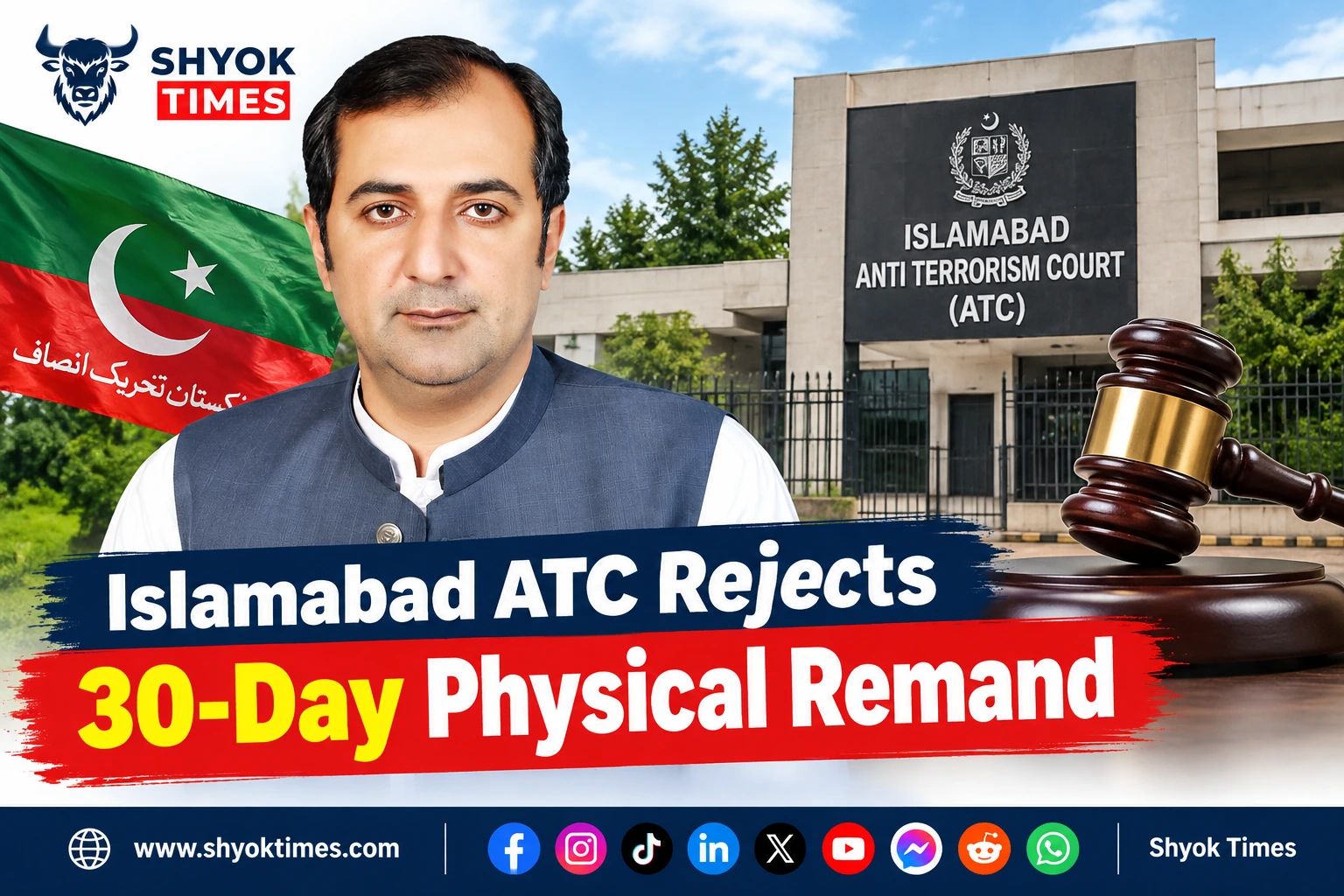
Khalid Khurshid judicial remand was ordered by an Islamabad anti-terrorism court on October 17, 2026, after the court rejected police's request for 30 days of physical remand of the former Gilgit-Baltistan chief minister in a case linked to Pakistan Tehreek-e-Insaf's November 26 protest.
The court directed that Khalid Khurshid be sent to jail on judicial remand for 14 days. The proceedings were conducted by Anti-Terrorism Court (ATC) Judge Abul Hasnat Muhammad Zulqarnain, who ordered that the former regional chief executive be produced before the court again on October 31.
The case was registered at Islamabad's Aabpara Police Station in connection with the November 26, 2024, protest. The court's decision means Khurshid will remain in judicial custody while the proceedings continue; it does not, by itself, determine his guilt or innocence in this particular case.
The ruling is a significant development in the legal cases involving the senior Pakistan Tehreek-e-Insaf (PTI) leader, whose political career in Gilgit-Baltistan has been marked by court proceedings, disqualification and criminal cases.
Islamabad ATC Rejects 30-Day Physical Remand
During the hearing, Islamabad Police presented Khurshid before the anti-terrorism court and requested 30 days of physical remand to investigate the allegations connected to the November 26 protest.
Physical remand allows investigators to retain an accused person in their custody for an authorised period while carrying out investigative steps. Judicial remand, by contrast, places the accused in court-authorised custody, generally in jail, rather than allowing continued police custody under the requested arrangement.
The court declined the police request and ordered judicial custody for 14 days. According to reports of the proceedings, the investigating officer was also directed to submit a report under Section 173 of the Code of Criminal Procedure within the stipulated period.
Section 173 concerns the police report submitted to a competent court following an investigation. The court's direction establishes a procedural requirement for the investigating officer; it should not be interpreted as a finding that the allegations have been proved.
The next production date was set for October 31, 2026. Further proceedings will help determine the next legal steps in the case.
The distinction between physical and judicial remand is important. Rejection of the police request does not automatically mean that the case has been dismissed, that the accused has been acquitted, or that all allegations against him have been withdrawn. It means the court did not grant the particular period of physical custody sought by the investigating agency.
What Is the November 26 Protest Case?
The case against Khurshid is linked to PTI's protest of November 26, 2024, in Islamabad. The party had called for demonstrations amid its political confrontation with the federal government and demands associated with its wider protest campaign.
The demonstrations brought large numbers of PTI supporters to the capital despite restrictions on public gatherings. Security personnel were deployed to prevent protesters from advancing into sensitive areas, and clashes occurred during the confrontation.
The protest ended with PTI leadership calling off its planned sit-in, while police registered cases against party leaders and other individuals in connection with the events. The cases reportedly invoked provisions of the Pakistan Penal Code and Section 7 of the Anti-Terrorism Act, depending on the allegations in each case.
Khurshid's current proceedings concern a case registered at Aabpara Police Station, identified in reports as FIR No. 1222/2024. The reported registration date is November 26, 2024.
An FIR records allegations that police are asked to investigate. Registration of a case does not, on its own, establish criminal responsibility. The evidence, applicable legal provisions and findings of the competent court remain central to determining the outcome.
The rejection of the requested remand therefore represents a development in the investigation and custody proceedings, rather than a final judgment on the November 26 protest allegations.
Khalid Khurshid's Arrest and Transfer to Islamabad
Reports surrounding Khurshid's detention describe his custody in Peshawar before he was produced before the Islamabad court. PTI-linked accounts reported that he was taken into custody at a government residence associated with the Khyber Pakhtunkhwa Assembly Speaker.
The precise distinction between the initial detention and the formal arrest in the Aabpara Police Station case matters. Reports indicate that police formally presented the arrest in connection with the November 26 protest case before producing him in court.
He was subsequently transferred to Islamabad for the proceedings. The ATC then considered the police request for physical remand and ordered judicial custody instead.
The arrest has drawn attention because Khurshid is a former chief minister and a prominent PTI figure from Gilgit-Baltistan. His case also illustrates how political demonstrations and their aftermath can lead to separate criminal proceedings in different jurisdictions.
Any further account of the circumstances of his arrest should distinguish official police statements, court records and claims made by political representatives. Where accounts differ, the distinction should be made clear rather than treating one party's version as an established judicial finding.
Who Is Khalid Khurshid?
Khalid Khurshid served as chief minister of Gilgit-Baltistan from 2020 until July 2023. He rose to regional prominence through PTI and became one of the party's key political figures in the mountainous region.
His tenure ended after the Gilgit-Baltistan Chief Court disqualified him over issues concerning his educational qualifications and law degree. The case involved a degree purportedly issued by the University of London, which was reported to have been found invalid following verification.
The disqualification was a major turning point in Gilgit-Baltistan politics. It removed a sitting chief minister from office and intensified the political and legal challenges surrounding the regional PTI leadership.
Khurshid subsequently remained a prominent figure in PTI's regional politics, even as he faced further proceedings in separate cases.
His legal circumstances must be understood on a case-by-case basis. A decision in one proceeding does not automatically decide the facts or legal questions in another. Similarly, the current judicial-remand order should not be confused with the earlier disqualification proceedings or any separate criminal judgment.
For readers following developments in the region, the latest case is important because it connects national political tensions with the legal position of a former head of government in Gilgit-Baltistan.
Earlier 34-Year Sentence in a Separate Case
Khurshid also faced a separate legal case in Gilgit-Baltistan. In December 2024, an anti-terrorism court in Gilgit sentenced him to 34 years in prison on charges related to remarks allegedly threatening security institutions and officials.
Reports at the time said the court imposed a fine of Rs600,000 in addition to the prison sentence. The case concerned allegations arising from a political rally and was separate from the Islamabad proceedings over the November 26 protest.
The earlier sentence is relevant background to Khurshid's legal situation, but it should not be presented as the outcome of the Aabpara Police Station case. The two matters involve different proceedings and allegations.
The October 17, 2026, order concerns the police request for physical remand in the Islamabad case. The court rejected that request and ordered 14 days of judicial custody. It did not issue a new 34-year sentence in this hearing.
Accurate reporting requires keeping these developments distinct, particularly when a public figure is facing multiple cases in different courts.
ATC Also Discharges PTI Workers in Separate Cases
In a separate development reported from the same court proceedings, the ATC discharged PTI workers arrested in connection with two cases linked to the party's recent long march.
The cases were registered at Shalimar and Secretariat police stations. During the proceedings, the investigating officer sought an adjournment to conduct an identification parade, a procedure used in certain investigations to establish whether witnesses can identify a suspect.
Defence lawyers opposed the request. They argued that the workers had already spent more than 40 days in custody and that the investigation had been delayed by repeated requests for adjournments.
The defence also maintained that the workers had been wrongly implicated and asked the court to implement its earlier direction. These were arguments advanced by the lawyers, rather than findings that should be attributed to the prosecution.
The court accepted the request for discharge and ordered the workers released from those cases, according to reports of the proceedings.
This development was separate from the remand order concerning Khurshid. The two matters involved different accused persons and separate police cases, even though both were connected to PTI-related demonstrations and legal proceedings.
The outcome highlights the importance of timely investigation and compliance with court directions in cases involving people held in custody. It also demonstrates why the legal status of each accused person must be reported separately.
What Happens Next in the Khalid Khurshid Case?
The immediate next step is the continuation of proceedings following the 14-day judicial-remand order. The court directed that Khurshid be produced again on October 31, 2026.
The investigating officer was also directed to submit the required report under Section 173 of the Code of Criminal Procedure within the stipulated period. The report is part of the legal process through which investigators place the results of their inquiry before the court.
The court may consider subsequent applications, reports and submissions in accordance with the applicable law. The precise course of the case will depend on the record and any further orders issued by the competent court.
For now, the principal confirmed development is that the court refused the police request for 30 days of physical remand and ordered 14 days of judicial custody.
The ruling should not be interpreted as a final acquittal, a dismissal of the FIR or a determination of the merits of the allegations. Those questions depend on the subsequent proceedings and any decisions issued by the relevant courts.
Why the Decision Matters for Gilgit-Baltistan Politics
Khurshid's case is being followed closely because of his former position as chief minister and his continuing political association with PTI. Developments involving senior regional leaders can influence political debate in Gilgit-Baltistan, where questions of representation, accountability, governance and relations with the federal government remain important public issues.
The case also draws attention to the relationship between political protest and criminal investigation. Authorities are responsible for investigating alleged offences, while courts must assess custody requests and proceedings under the law. Accused persons retain the right to due process, and allegations should not be treated as proven solely because a case has been registered.
For the public, the distinction between police custody, judicial custody, discharge, acquittal and conviction is essential to understanding court reporting. These terms describe different legal stages and outcomes, and using them accurately helps readers assess what a court has actually decided.
As proceedings continue, further developments may clarify the investigation and the legal position of the accused. Until then, the October 17 order remains a procedural decision on remand rather than a final verdict in the November 26 protest case.
Frequently Asked Questions
Why did the Islamabad ATC reject the police request for Khalid Khurshid's physical remand?
The court rejected the request for 30 days of physical remand and ordered judicial custody for 14 days. The reported order does not establish that the case itself was dismissed.
How long has Khalid Khurshid been sent to judicial remand?
The Islamabad ATC ordered 14 days of judicial remand on October 17, 2026, with the next court production scheduled for October 31.
Which police station registered the case?
The case related to the November 26, 2024, protest was registered at Aabpara Police Station in Islamabad. Reports identify it as FIR No. 1222/2024.
Who heard Khalid Khurshid's case?
The proceedings were heard by ATC Judge Abul Hasnat Muhammad Zulqarnain in Islamabad.
Is this the same case in which Khurshid received a 34-year sentence?
No. The 34-year sentence reported in December 2024 concerned a separate case in Gilgit-Baltistan. The October 2026 proceedings concern the Islamabad case related to the November 26 protest.
What happens after judicial remand?
The accused remains in court-authorised custody while the case proceeds. Investigators must comply with court directions, and the court will consider subsequent proceedings under the applicable law. Judicial remand is not itself a finding of guilt.
Conclusion
The Islamabad ATC's decision to reject the 30-day physical-remand request and send former Gilgit-Baltistan chief minister Khalid Khurshid to jail for 14 days marks a significant procedural development in the November 26 protest case.
With the next hearing scheduled for October 31, attention will turn to the investigation, the required police report and any further orders from the court. The outcome of the case remains subject to the judicial process.
Reporting note: This article reflects information available through October 17, 2026.
External Resources (DoFollow):
Read further at Tribune: Islamabad ATC sends former G-B CM Khalid Khurshid to jail
Keep reading via DAWN: Islamabad ATC rejects for physical remand of ex-GB CM Khalid Khurshid