
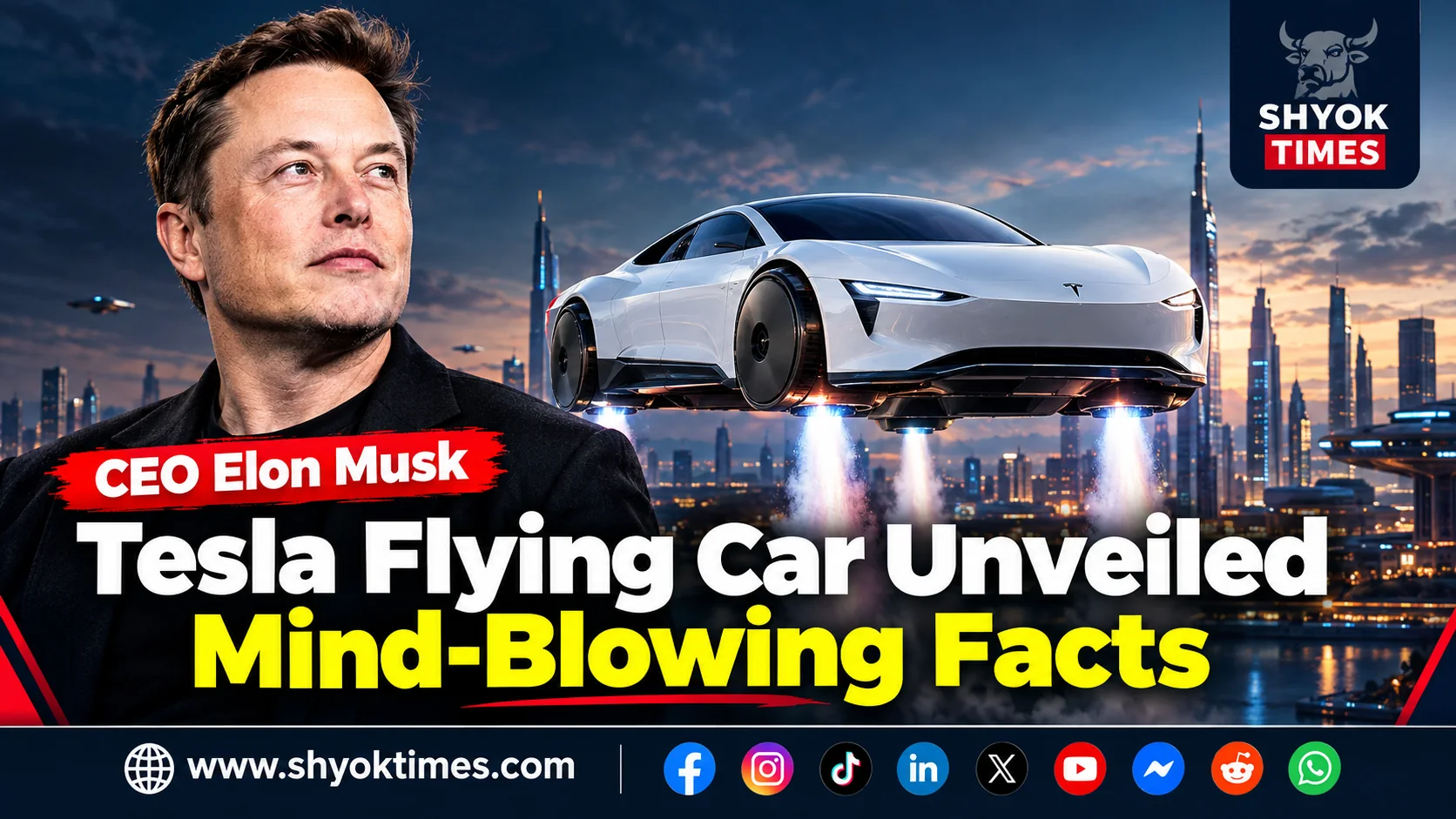
Tesla Flying Car Unveiled: Mind-Blowing Facts | Shyok Times
Elon Musk Unveils Tesla Flying Car
Elon Musk unveils Tesla flying car technology in a thrilling live-streamed demonstration that left tech enthusiasts and automotive experts stunned. During a high-octane product reveal at SpaceX’s rocket testing facility in McGregor, Texas, Tesla CEO Elon Musk showcased a redesigned next-generation Roadster equipped with ultra-high-pressure air thrusters. The long-delayed electric sports car demonstrated extreme aerial maneuvers, including vertical ramp climbs, mid-air flips, and hopping over parked vehicles.
This historical collaboration between Tesla and SpaceX marks an unprecedented shift in automotive engineering. Below are five mind-blowing facts you need to know about Tesla’s newly unveiled flying vehicle.
Powered by SpaceX Cold-Gas Rocket Thrusters
The new Roadster relies on advanced rocket propulsion technology developed alongside SpaceX engineers. The vehicle uses 10 strategically placed nozzles connected to ultra-high-pressure air tanks filled with compressed gas.
Turns out the future does have flying cars pic.twitter.com/6fexPp6SXI
— Elon Musk (@elonmusk) October 16, 2026
During the live demonstration in McGregor, Texas, the system delivered over 80 kilonewtons of force. This immense propulsion allowed the driverless prototype to:
- Ascend near-vertical ramps and hang briefly upside down via an underbody suction system.
- Perform mid-air barrel rolls and controlled turns using directional air jets.
- Leap cleanly over a line of parked Tesla vehicles—including the Cybertruck and Cybercab—before landing on its wheels.
"This is what happens when you have a collaboration with the world's best car company and the world's best rocket company," Musk told the crowd.
Record-Breaking Acceleration: 0 to 60 mph in Under 1 Second
By combining high-performance electric drive motors with rear-mounted SpaceX thrusters, the Roadster achieves speed metrics previously considered impossible for land vehicles.
Specification Performance Rating
0–60 mph Acceleration Under 0.81 seconds
Top Speed Over 230 mph
Air Thruster Output > 80 Kilonewtons
Aerodynamic System Multi-mode fan suction & active aero
Three Distinct Trim Variants Announced
Tesla updated its official reservation pages immediately following the event, establishing three separate trim levels for the new Roadster lineup:
- Performance Trim ($50,000 Reservation Deposit): A road-ready electric sports car equipped with active aerodynamics and a multi-mode underbody suction system for maximum cornering traction.
- Thrust Trim ($250,000 Reservation Deposit): A race-ready variant featuring active aerodynamics, suction fans, and rear acceleration thrusters for extreme track speed.
- Rocket Variant (Invitation-Only): The specialised, single-seat full flight system demonstrated on stage, designed for private track closed-course aerial demonstrations.
Production Slated for 2028 After Nearly a Decade of Delays
First announced in November 2017 with an initial target release of 2020, the second-generation Roadster has experienced over eight years of development delays.
Do a kickflip! pic.twitter.com/DJ1Bq1yu8m
— Tesla (@Tesla) October 16, 2026
Musk officially confirmed on stage that commercial production for the vehicle is now scheduled to begin in 2028. While initial reservation holders have waited nearly a decade, Tesla emphasizes that the extensive engineering required for the SpaceX thruster integration forced the timeline to shift outward.
Strict Regulatory and Public Road Limits
Despite the spectacular aerial flips demonstrated in Texas, Tesla clarified that the full flight system will not be certified for routine public road commuting or long-range airborne transportation.
Musk candidly addressed regulatory and safety concerns during his presentation:
"This is not necessarily a safety-optimized car, but it takes the fun meter to 11 out of 10," Musk noted, acknowledging that full flight capabilities face severe legal hurdles across various global jurisdictions.
Aviation safety approvals and noise restrictions—given the sheer volume of high-pressure air thrusters—mean the flying "Rocket" version will remain restricted to private tracks and controlled venues.
Key Takeaways for Readers
- Is it a true flying car? It provides short-burst hops, flips, and thruster-assisted jumps rather than long-distance flight.
- When can you buy one? Production begins in 2028, with reservation deposits currently open for select trims.
- Can you fly it on public highways? No. Flying maneuvers are strictly prohibited on public roads.
Stay tuned to Shyok Times News Desk for real-time updates on automotive innovation, electric vehicle developments, and global technology news. For full specifications on regulatory standards for experimental vehicles, visit the Federal Aviation Administration (FAA) and check official Tesla announcements on Tesla's Newsroom.
Frequently Asked Questions (PAA)
Q: Can the Tesla Roadster actually fly long distances?
A: No. The Tesla Roadster uses cold-gas thrusters to execute short airborne hops, flips, and maneuvers. It does not operate as a long-range aircraft or flying taxi.
Q: How fast is the Tesla Roadster 0 to 60 mph?
A: With the assistance of SpaceX rocket thrusters, Tesla claims the Roadster can accelerate from 0 to 60 mph in 0.81 seconds.
Q: Is the flying Tesla Roadster legal on public roads?
A: The standard electric sports car variants are road-legal, but the full flight "Rocket" trim equipped with air thrusters is restricted from public road flight due to safety and regulatory laws.
External Resources (DoFollow):
Follow more on CNN: Tesla unveils what it says is a flying car
Read further at Reuters: Tesla's new Roadster turns in air with SpaceX thrusters
Keep reading via DAWN: Elon Musk unveils Tesla's 'flying' car