
Saudi Arabia Houthi Attacks: Alarming Risks | Shyok Times
Saudi Arabia Houthi Attacks Intensify as Riyadh Airport Crisis Deepens
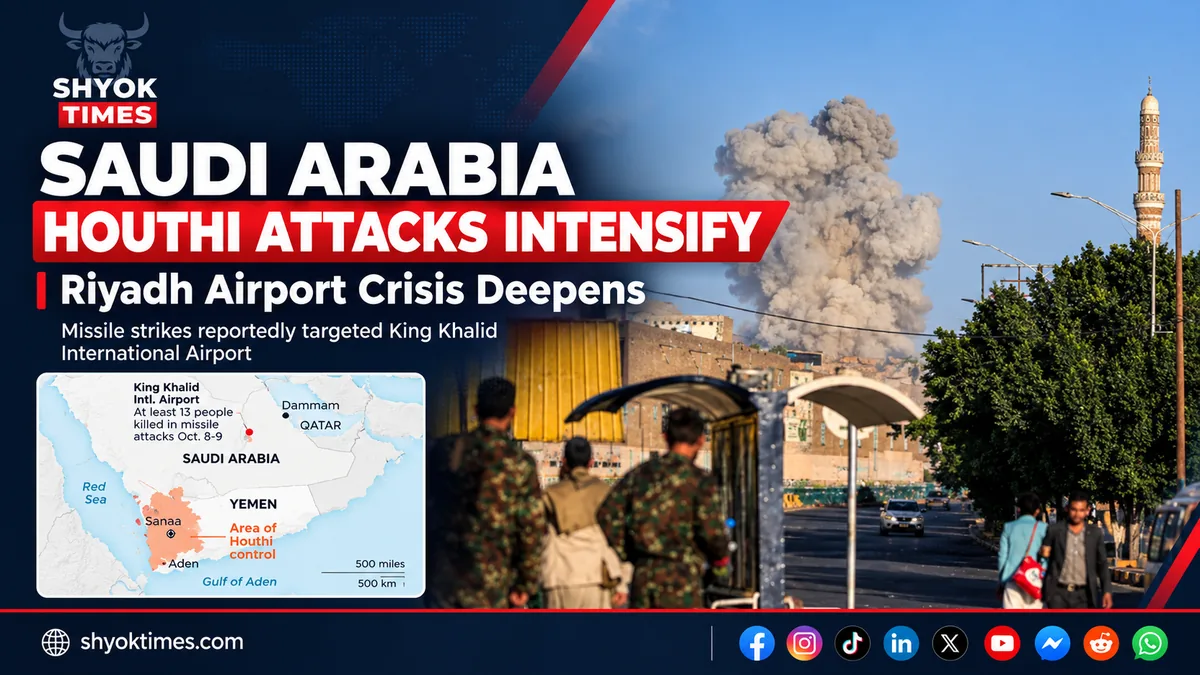
Saudi Arabia Houthi attacks have intensified, raising serious concerns about civilian safety, regional security and international air travel after a series of deadly missile strikes targeted King Khalid International Airport in Riyadh. The attacks have disrupted flights, triggered international travel warnings and increased pressure on Saudi Arabia to strengthen its defences and decide how to respond.
Saudi authorities reported that the October 10 attack killed 12 people and injured more than 300. A subsequent strike on October 11 killed another person, identified by Saudi authorities as a Pakistani resident, and injured 11 others. Reporting from Reuters and other international outlets has highlighted the growing risk of further escalation between Saudi Arabia and Yemen's Iran-backed Houthi movement.
The crisis comes amid renewed fighting in Yemen, Saudi-backed military operations and wider tensions involving Iran and the United States. With Riyadh's principal international airport facing repeated attacks and airlines suspending services, the consequences extend beyond the immediate conflict.
The central question is whether Saudi Arabia can protect its civilian infrastructure and deter further attacks without becoming embroiled in a costly, prolonged military campaign in Yemen.
What Happened at Riyadh's King Khalid International Airport?
King Khalid International Airport, one of Saudi Arabia's principal aviation hubs, has faced repeated attacks during a sharp escalation in hostilities involving the Houthis.
The October 10 strike was particularly deadly. Saudi aviation authorities reported 12 fatalities and more than 300 injuries. The victims included Saudi citizens and foreign nationals, illustrating the danger faced by civilians and international travellers at the airport.
Another projectile struck the airport on October 11. According to Saudi authorities, one Pakistani resident was killed and 11 people were injured. The successive attacks prompted further restrictions on airport operations and raised urgent questions about the safety of passengers, airline employees and airport staff.
The incidents followed other attacks on Saudi aviation facilities during the preceding week, including strikes that killed three people at Riyadh airport on October 8 and attacks affecting Abha International Airport in southwestern Saudi Arabia. These incidents demonstrate that the threat is not confined to a single location.
The Houthis have claimed responsibility for several of the attacks. Their military spokesman, Yahya Saree, has announced operations involving missiles and drones and threatened further strikes against Saudi targets.
The group has presented its campaign as retaliation for Saudi military involvement in Yemen and attacks against Houthi-controlled territory. Saudi Arabia, meanwhile, regards the strikes as a threat to its population, national security and essential infrastructure.
The competing explanations do not change the immediate concern: repeated attacks on an international passenger airport place civilians at substantial risk.
Riyadh Airport Closure Disrupts International Air Travel
The airport crisis has rapidly developed into a major aviation disruption.
Saudi authorities extended the suspension of operations at King Khalid International Airport to allow safety inspections and procedures intended to establish whether facilities could operate safely. A notice reported by The Indian Express indicated that the closure was scheduled to continue until 9 p.m. GMT on October 17, subject to further developments.
Airlines have cancelled or suspended services as the security situation deteriorates. Lufthansa and several Asian carriers have announced operational restrictions, while the US Federal Aviation Administration has warned American airlines to exercise caution when flying to or over Saudi Arabia.
For passengers, the consequences include missed connections, disrupted religious and business travel, unexpected accommodation expenses and uncertainty about when normal operations will resume.
Travellers connecting through Riyadh may also face disruption to onward journeys, depending on their airline, destination and ticket arrangements. Passengers should therefore confirm their individual flight status directly with their carrier rather than assume that a previously scheduled service will operate.
The suspension also affects Saudi Arabia's international commercial relationships. Riyadh has been positioning itself as a regional business centre, a destination for international conferences and an increasingly important tourism market. Extended airport disruption risks undermining these objectives.
The immediate priority remains passenger safety. Reopening an airport before security assessments are complete could expose travellers and aviation workers to additional danger.
Why Are the Houthis Targeting Saudi Arabia?
The current escalation is closely connected to Yemen's prolonged conflict and the struggle for influence across the Arabian Peninsula and the Red Sea.
The Houthis, formally known as Ansar Allah, emerged from Yemen's Zaydi Shia revivalist movement and became a major armed and political force. They seized Yemen's capital, Sanaa, in 2014 and subsequently fought against the internationally recognised Yemeni government and the Saudi-led coalition that intervened in 2015.
Iran has provided the movement with varying degrees of military and strategic support. However, the precise extent of Iranian involvement in individual attacks must be assessed using verified evidence rather than assumed from the group's political alignment.
Saudi Arabia supports Yemen's internationally recognised government and has carried out military operations against Houthi positions. The Houthis have repeatedly used missile and drone attacks to pressure Saudi Arabia and demonstrate their capacity to threaten important infrastructure.
The current fighting has intensified around strategically important areas, including sections of Yemen's Red Sea coast. Control of these areas matters because they influence access to shipping routes, coastal supply lines and military positions.
The renewed Saudi-backed counteroffensive has coincided with Houthi attacks against Saudi airports and other infrastructure. The group has framed its actions as retaliation, while Saudi Arabia and its partners have condemned the attacks and called for them to stop.
Attacking a major airport also has a strategic purpose beyond physical damage. It can interrupt commerce, discourage foreign visitors, create uncertainty among investors and force the targeted government to divert resources towards defence.
Nevertheless, such strategic calculations cannot justify attacks that endanger civilian passengers and airport workers.
How Have the Houthis Developed Their Missile and Drone Capabilities?
One of the most significant questions raised by the Saudi Arabia Houthi attacks is how the group has acquired the ability to threaten targets far beyond Yemen.
The Houthis have developed a varied arsenal that includes ballistic missiles, cruise missiles and unmanned aerial vehicles. These weapons differ in speed, range, flight profile and interception requirements, making the defence of a large country particularly challenging.
Iranian assistance, technical expertise and access to components have been widely cited by analysts as important factors in the development of Houthi capabilities. The extent of direct Iranian involvement in specific operations, however, requires separate verification.
The movement's weapons programme has evolved considerably since the early stages of the Yemen conflict. Its ability to threaten airports, military installations and energy infrastructure has made it an important factor in regional security calculations.
Why Saudi air defences face difficult challenges
Saudi Arabia has invested heavily in modern military equipment and air-defence systems. Yet even sophisticated defensive networks cannot guarantee that every incoming missile or drone will be intercepted.
Several factors can complicate interception:
- Geographical scale: Saudi Arabia has a large territory with numerous cities, military facilities, airports and energy installations requiring protection.
- Multiple threat types: Ballistic missiles, cruise missiles and drones can require different detection and interception approaches.
- Limited reaction time: Depending on a weapon's trajectory and speed, defenders may have only a short period to detect and respond to an incoming threat.
- Protection of critical infrastructure: Defending airports, oil facilities, military bases and densely populated areas simultaneously presents a demanding operational challenge.
- Cost and resources: Interceptors can be expensive, and sustained attacks may place pressure on ammunition supplies, maintenance and readiness.
The recent strikes have prompted renewed scrutiny of Saudi Arabia's defensive capabilities. Analysts have noted that some attacks have been intercepted while others have caused casualties and damage.
An interception failure does not necessarily mean an entire air-defence system has collapsed. Determining why a particular projectile reached its target requires information about the weapon, its trajectory, the defensive response and the circumstances of the incident.
Saudi Arabia's current challenge is to improve protection of civilian infrastructure while preparing for the possibility of additional attacks.
Will Saudi Arabia Launch a Major Military Response?
Saudi Arabia faces a difficult strategic decision: how to deter further attacks without escalating the conflict into a larger and more expensive war.
The kingdom has previously relied on air operations, regional partnerships and support for anti-Houthi Yemeni forces rather than committing to an extensive new ground invasion. The latest attacks, however, have increased domestic and international pressure for a stronger response.
A major military campaign could involve expanded airstrikes against Houthi military infrastructure, improved intelligence cooperation, additional defensive deployments or support for Yemeni government forces.
Each option carries risks.
Airstrikes could damage weapons facilities and disrupt launch capabilities, but they may not eliminate the movement's ability to conduct attacks. The Houthis have demonstrated resilience during years of conflict, and military pressure can also encourage retaliatory operations.
A large Saudi ground deployment in Yemen would present even greater challenges. Yemen's rugged terrain, complex political landscape and established armed networks could turn an intervention into a prolonged campaign with substantial financial and human costs.
Such a war could also undermine Saudi Arabia's economic transformation agenda, which seeks to attract foreign investment, expand tourism and diversify the economy beyond oil.
For Riyadh, therefore, the objective is not simply to retaliate. It is to restore deterrence, protect its population and reduce the likelihood of repeated attacks.
Pakistan and Other Countries Condemn the Attacks
The attacks have prompted regional diplomatic responses, with Pakistan among the countries condemning the violence.
On October 12, Reuters reported that Saudi Arabia, Pakistan, Turkey and Egypt issued a joint condemnation of the attacks, describing them as a dangerous escalation and demanding an immediate halt to hostilities. The countries also expressed support for Saudi Arabia's legitimate efforts to defend itself.
The involvement of Pakistan is particularly significant because Pakistani citizens live and work across Saudi Arabia, including in the aviation, construction, healthcare and service sectors. The death of a Pakistani resident in the October 11 airport strike has added a direct human dimension to the crisis for Pakistan.
For Pakistani families with relatives working in Saudi Arabia, the immediate concerns include personal safety, travel disruption and access to reliable information.
The situation also raises broader diplomatic questions. Regional governments must weigh their security partnerships against the risk of being drawn into a wider conflict.
International cooperation could help improve air-defence coordination, intelligence sharing, civilian warnings and the protection of critical infrastructure. Diplomatic pressure may also be needed to prevent further attacks and establish channels for de-escalation.
The effectiveness of these measures will depend on whether the parties can move beyond public condemnation towards practical steps that reduce the threat.
What the Crisis Means for Oil Prices and the Global Economy
Saudi Arabia is a major oil producer, making threats to its infrastructure a concern for energy markets and the wider global economy.
The latest attacks have occurred amid broader regional tensions and security concerns around important shipping routes, including the Red Sea and the Bab al-Mandab Strait. These waterways connect major trading regions and are important for international energy and merchandise transport.
The effect on oil prices depends on several factors, including the extent of physical damage, the duration of transport disruptions, the availability of alternative supply routes and expectations about future escalation.
Even when oil production remains operational, heightened security risks can increase transport costs, insurance premiums and market uncertainty.
For consumers, sustained increases in energy prices can contribute to higher transport expenses and inflation. Countries that import significant quantities of fuel may be particularly exposed to changes in international prices.
Businesses can also face higher freight costs, longer delivery times and uncertainty over supply chains.
However, it would be premature to attribute every movement in oil prices to the Riyadh airport attacks alone. Energy markets respond to multiple developments, including production decisions, global demand, shipping security and wider geopolitical tensions.
The longer-term economic consequences will depend on whether the violence spreads to oil facilities, export terminals or maritime routes, and whether the parties can prevent further disruption.
What Happens Next? Three Possible Scenarios
The immediate direction of the crisis remains uncertain. Three broad scenarios help explain the risks facing Saudi Arabia and its neighbours.
1. Stronger defences and limited retaliation
Saudi Arabia could prioritise air-defence improvements, intelligence sharing and targeted military operations while avoiding a major ground deployment.
This approach could reduce exposure to further attacks if defensive measures prove effective. However, it would not guarantee that all incoming threats could be stopped.
2. A wider regional military escalation
Repeated attacks and retaliatory strikes could expand the conflict, potentially drawing additional regional or international actors into military operations.
Such an outcome would increase the risk to civilians, complicate air travel and threaten economic activity. It could also intensify pressure on energy markets and regional shipping.
3. Renewed diplomatic engagement
Saudi Arabia and its partners could combine defensive measures with efforts to reduce hostilities through diplomatic channels.
Negotiations would face significant obstacles, including competing demands over Yemen's political future, security arrangements and control of strategic territory. Nevertheless, reducing attacks on civilian infrastructure would be an important starting point.
These scenarios are not mutually exclusive. Saudi Arabia could strengthen its defences and conduct limited military operations while pursuing diplomatic engagement.
The central test will be whether those measures can protect civilians and prevent the crisis from developing into a much wider conflict.
Frequently Asked Questions
Why is Saudi Arabia facing Houthi missile attacks?
The attacks are linked to the renewed Yemen conflict, Saudi support for Yemen's internationally recognised government and the Houthis' stated opposition to Saudi military operations. The group has also sought to pressure Riyadh by targeting strategically important infrastructure.
How many people were killed in the October 10 Riyadh airport attack?
Saudi aviation authorities reported 12 deaths and more than 300 injuries in the October 10 attack. A separate strike on October 11 killed one Pakistani resident and injured 11 others.
Is Riyadh airport open?
As of October 13, reports indicated that operations at King Khalid International Airport remained suspended, with the closure extended until October 17 at 9 p.m. GMT. Travellers should verify current arrangements with their airline and official airport or aviation authority updates because restrictions may change.
World News - The Indian Express
Are the Houthis backed by Iran?
Yes. The Houthis are widely described by international news organisations and analysts as an Iran-backed armed movement. The nature and extent of Iranian support vary by capability and period, and specific claims about Iranian direction of individual attacks require evidence.
Could the attacks affect global oil prices?
Yes. Further attacks on energy infrastructure or disruptions to major shipping routes could increase supply concerns and put upward pressure on oil prices. The actual impact will depend on the extent and duration of disruption and broader market conditions.
Will Saudi Arabia send troops into Yemen?
That remains uncertain. Saudi Arabia could intensify air operations, strengthen its defences, support Yemeni government forces or pursue diplomatic engagement. A major ground deployment would carry substantial military, financial and political risks.
Conclusion: A Critical Test for Saudi Security
The Saudi Arabia Houthi attacks represent a serious challenge to the kingdom's civilian safety, aviation network and regional security strategy. Repeated strikes on Riyadh's airport have caused deaths and injuries, disrupted international travel and raised questions about how Saudi Arabia can protect vital infrastructure against sustained missile and drone threats.The consequences extend beyond Saudi Arabia. Pakistan and other countries have citizens living in the kingdom, airlines face operational uncertainty, and international markets remain sensitive to developments affecting energy infrastructure and regional shipping.
Saudi Arabia now faces the difficult task of restoring security without allowing retaliation to trigger an even wider war. Strengthened defences, coordinated international support and credible diplomatic engagement may all play a role.
For now, the most urgent priorities are protecting civilians, ensuring reliable information for travellers and preventing further attacks on civilian infrastructure. Whether the crisis leads to a limited military response or a broader regional confrontation will depend on the decisions made in the coming days.
Reporting note: This article reflects information available through October 13, 2026. Casualty figures and operational restrictions may change as authorities issue updated statements.
External Resources (DoFollow):
Follow more on BBC: Houthi strike on Riyadh airport in two days
Read further at CNBC: Saudi Arabia says drones and missiles still targeting kingdom
Keep reading via GULF NEWS: Saudi Arabia boosts readiness after Houthi attacks