Khalpu Hospital Gynecologist Crisis | Shyok Times
Khalpu Hospital Gynecologist Shortage Raises Serious Health Concerns
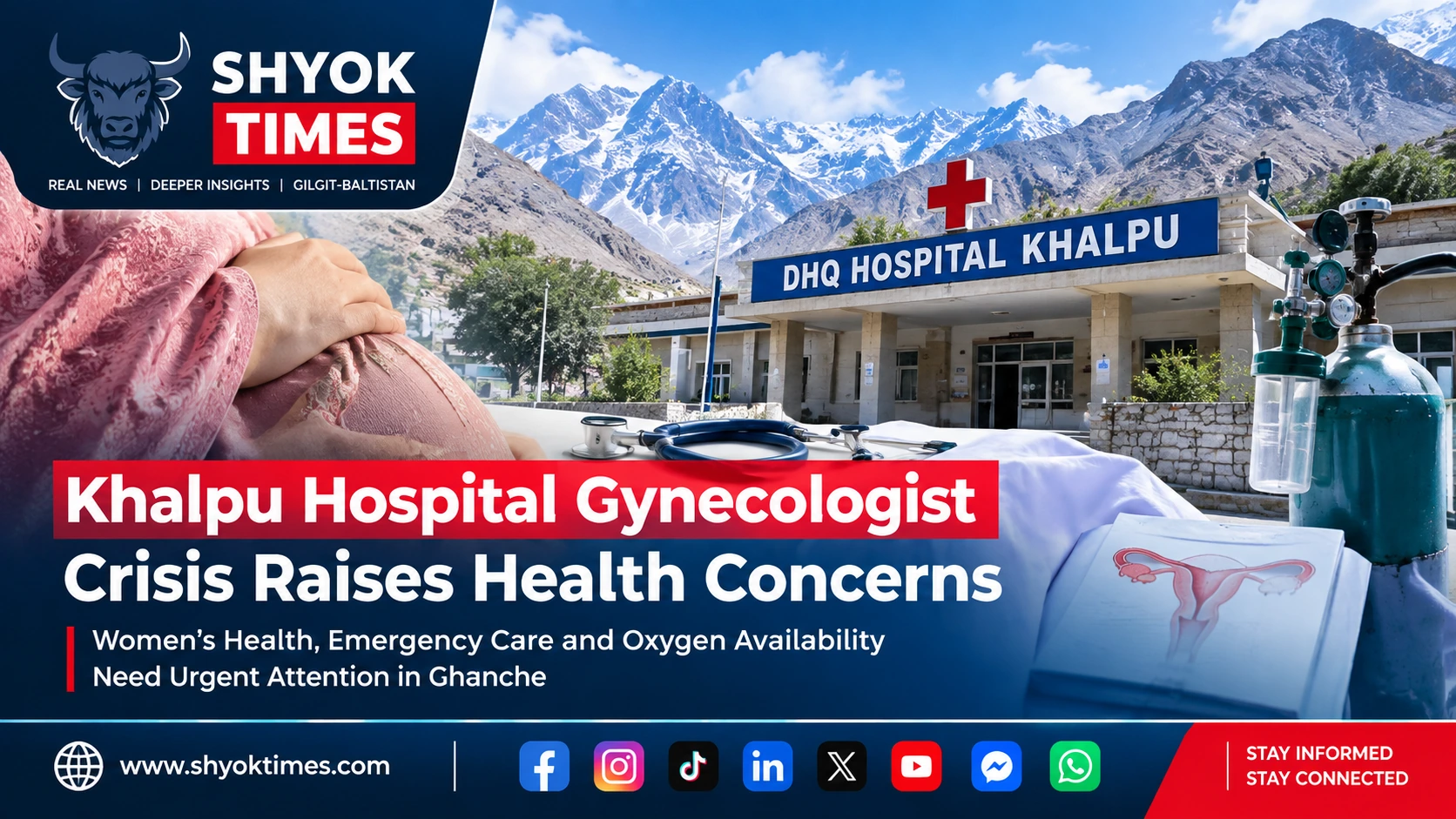
The Khalpu Hospital gynecologist shortage has raised fresh concerns about access to essential healthcare for women in Ghanche, Gilgit-Baltistan, particularly pregnant women and patients requiring urgent specialist care.
According to concerns raised by residents and highlighted by Engineer Imtiaz Baltistani, the District Headquarters Hospital (DHQ) in Khalpu has repeatedly faced a lack of a permanently available gynecologist. The issue, according to the account, has persisted intermittently for several years and continues to create uncertainty for women who need specialist medical attention.
A separate concern has also been raised regarding the reported availability of oxygen cylinders at the hospital. According to the same account, patients requiring oxygen have allegedly been referred from Khalpu to Skardu.
These claims require clarification and verification from the relevant health authorities. However, if confirmed, they would raise important questions about the continuity and reliability of essential emergency and maternal healthcare services at the district's main hospital.
Why a Permanent Gynecologist Matters in Khalpu
Pregnancy and childbirth can involve unexpected complications. Access to qualified obstetric and gynecological care can therefore be critical, particularly in remote and mountainous communities where travelling to another city can take considerable time.
For women in Khalpu and surrounding areas, the absence of a permanent specialist can mean that patients may have to wait for visiting doctors, seek treatment elsewhere, or travel to Skardu when specialist intervention is required.
That distance matters.
Gilgit-Baltistan's mountainous geography can make emergency medical transfers particularly challenging. Weather, road conditions, travel time and availability of transportation can all affect how quickly a patient reaches a higher-level medical facility.
For a pregnant woman experiencing complications, delays can become particularly concerning.
The question, therefore, is not simply whether a specialist is present on a particular day. It is whether women can depend on a consistent, predictable and adequately staffed maternal healthcare service when they need it.
Residents Want a Permanent Solution
The concern raised by local residents is not about targeting an individual doctor or government employee.
It is fundamentally about continuity of healthcare.
If the shortage has occurred repeatedly over several years, residents reasonably want to know why a long-term staffing arrangement has not been established.
They also want answers to basic questions:
- Why has the hospital struggled to maintain permanent gynecological coverage
- How frequently has the position remained vacant?
- What temporary arrangements are used when a specialist is unavailable?
- How are emergency maternity cases handled?
- How many patients have been referred outside the district because specialist care was unavailable?
- What is the government's timeline for ensuring permanent coverage?
These questions can only be properly answered by the relevant health department and hospital administration.
Reported Oxygen Shortage Adds Another Concern
The gynecologist issue is not the only healthcare concern being raised.
According to the account provided to Shyok Times, the hospital was also reportedly facing a shortage of oxygen cylinders, with some patients requiring oxygen allegedly being referred to Skardu.
This claim has not been independently verified by Shyok Times and should be addressed publicly by the hospital administration and relevant health authorities.
Nevertheless, oxygen availability is an important hospital-readiness issue.
Oxygen is routinely used in emergency medicine and may be required by patients suffering from serious respiratory conditions, severe infections, trauma, certain cardiac conditions and other medical emergencies. It may also be required during surgery and other procedures.
The important issue is therefore whether a district-level hospital has sufficient oxygen supplies, functional equipment and reliable backup arrangements to respond to emergencies at all times.
Why Oxygen Availability Matters in an Emergency
A patient requiring supplemental oxygen may be medically unstable. In such cases, transferring the patient to another city is not necessarily a substitute for having basic emergency capabilities at the referring hospital.
This is particularly important in mountainous regions.
If a patient must travel from Khalpu to Skardu, the transfer itself requires adequate preparation. The patient may need oxygen during transportation, qualified medical supervision, an appropriate ambulance and communication between the referring and receiving facilities.
Without those arrangements, a referral can become more complicated than simply moving a patient from one hospital to another.
That is why residents are asking whether DHQ Khalpu has adequate emergency resources and whether its referral system is capable of handling serious cases safely.
A District Hospital Must Be Prepared for Emergencies
A district headquarters hospital is expected to provide essential healthcare services to the population it serves.
The exact services and staffing requirements depend on government policy, hospital classification and available resources. But from a public-health perspective, continuity of emergency care, maternal services, essential medicines, oxygen and referral arrangements are fundamental components of a functioning healthcare system.
For Khalpu, the issue is especially important because residents cannot simply rely on nearby major urban medical centres.
Geography is a major part of the healthcare equation in Gilgit-Baltistan.
A service that might be considered relatively accessible in a major city can become difficult to reach in a remote mountainous district.
That makes local preparedness even more important.
The Real Question: What Happens When the Specialist Is Not There?
The most important question for residents may not be whether a doctor is absent on a particular day.
It is what happens when an emergency occurs while the specialist is unavailable.
A pregnant woman experiencing complications cannot always wait for a visiting specialist.
A patient suffering from respiratory distress cannot necessarily wait for oxygen supplies to arrive.
An accident victim may require immediate stabilization before transfer.
The health system therefore needs contingency arrangements that operate before, during and after an emergency.
These should include appropriate staffing, emergency equipment, oxygen availability, trained personnel, ambulance support and a clear referral pathway.
What Residents Are Asking Authorities to Do
Residents and community voices have called for several measures to address the concerns surrounding healthcare services at Khalpu Hospital.
1. Ensure Permanent Gynecological Coverage
The relevant health authorities should clarify the staffing position and take steps to ensure reliable gynecological and maternal healthcare coverage at DHQ Khalpu.
2. Provide a Reliable Interim Arrangement
Until permanent staffing is secured, authorities should ensure that women are not left without specialist access when the position is vacant.
Any temporary arrangement should be predictable and publicly communicated.
3. Clarify the Oxygen Situation
Hospital authorities should clarify whether an oxygen shortage occurred, what caused it, how long it lasted and what measures have been taken to prevent a recurrence.
4. Strengthen Emergency Referrals
Patients who require transfer to Skardu or another higher-level facility should have access to properly equipped ambulances, oxygen support where medically necessary and coordinated referrals.
5. Publish a Clear Staffing and Service Plan
Residents deserve to know what services are currently available, which positions are vacant and what steps are being taken to fill critical posts.
6. Ensure Accountability Through Information
Public confidence improves when authorities communicate clearly about healthcare shortages, staffing challenges and corrective measures.
Silence can create uncertainty and distrust.
Five Years Is Too Long for Uncertainty
The central concern raised by residents is simple: essential healthcare services should not depend indefinitely on temporary arrangements.
If the gynecologist position has repeatedly become unavailable over a period of years, then the problem deserves a structural solution rather than another short-term arrangement.
Similarly, if oxygen availability has been disrupted, the solution should include a dependable supply and backup system rather than waiting until the next emergency.
Healthcare planning in remote regions requires anticipation.
Authorities must consider not only normal circumstances but also emergencies, weather disruptions, road closures, equipment failures and sudden increases in patient demand.
This Is About Healthcare, Not Politics
The concerns surrounding Khalpu Hospital should not be reduced to political confrontation.
The underlying issue is access to healthcare.
Residents are asking for a functioning system in which women can obtain specialist maternal care, emergency patients can receive basic stabilization and hospitals have the equipment necessary to respond when lives are at risk.
That is a reasonable public-interest demand.
At the same time, allegations concerning shortages should be investigated and answered with facts.
The appropriate response is not accusation without evidence, but transparent verification, corrective action and public accountability.
What Authorities Owe the People of Ghanche
The people of Ghanche deserve clarity about the condition and capacity of their main public hospital.
The relevant authorities should publicly address:
Is there currently a permanently available gynecologist at DHQ Khalpu?
If not, what is the interim arrangement?
Has the hospital experienced an oxygen shortage, and if so, why?
Are emergency patients being referred to Skardu because essential services are unavailable locally?
What is the timeline for resolving these issues permanently?
These are not unreasonable questions.
They are questions about the safety and dignity of patients.
A Call for a Sustainable Healthcare Solution
The concerns emerging from Khalpu should serve as an opportunity for authorities to examine the broader healthcare needs of Ghanche.
Residents do not need sympathy alone.
They need dependable services.
They need to know that when a pregnant woman requires specialist care, there is a qualified professional available or a reliable system capable of responding immediately.
They need to know that when a critically ill patient requires oxygen, the hospital has adequate supplies and functioning equipment.
And they need to know that when a patient must be transferred to Skardu, the referral system is prepared to move that patient safely and quickly.
A remote community should not be forced to choose between dangerous delays and expensive emergency travel simply because essential services are not consistently available.
The concerns raised about Khalpu Hospital therefore deserve a transparent response from the relevant health authorities.
The objective should not be to blame individuals.
It should be to build a healthcare system that residents can trust.
For the mothers, sisters, daughters and families of Ghanche, reliable healthcare is not a luxury.
It is a necessity.
Shyok Times | News Desk
Public-interest reporting on Gilgit-Baltistan