
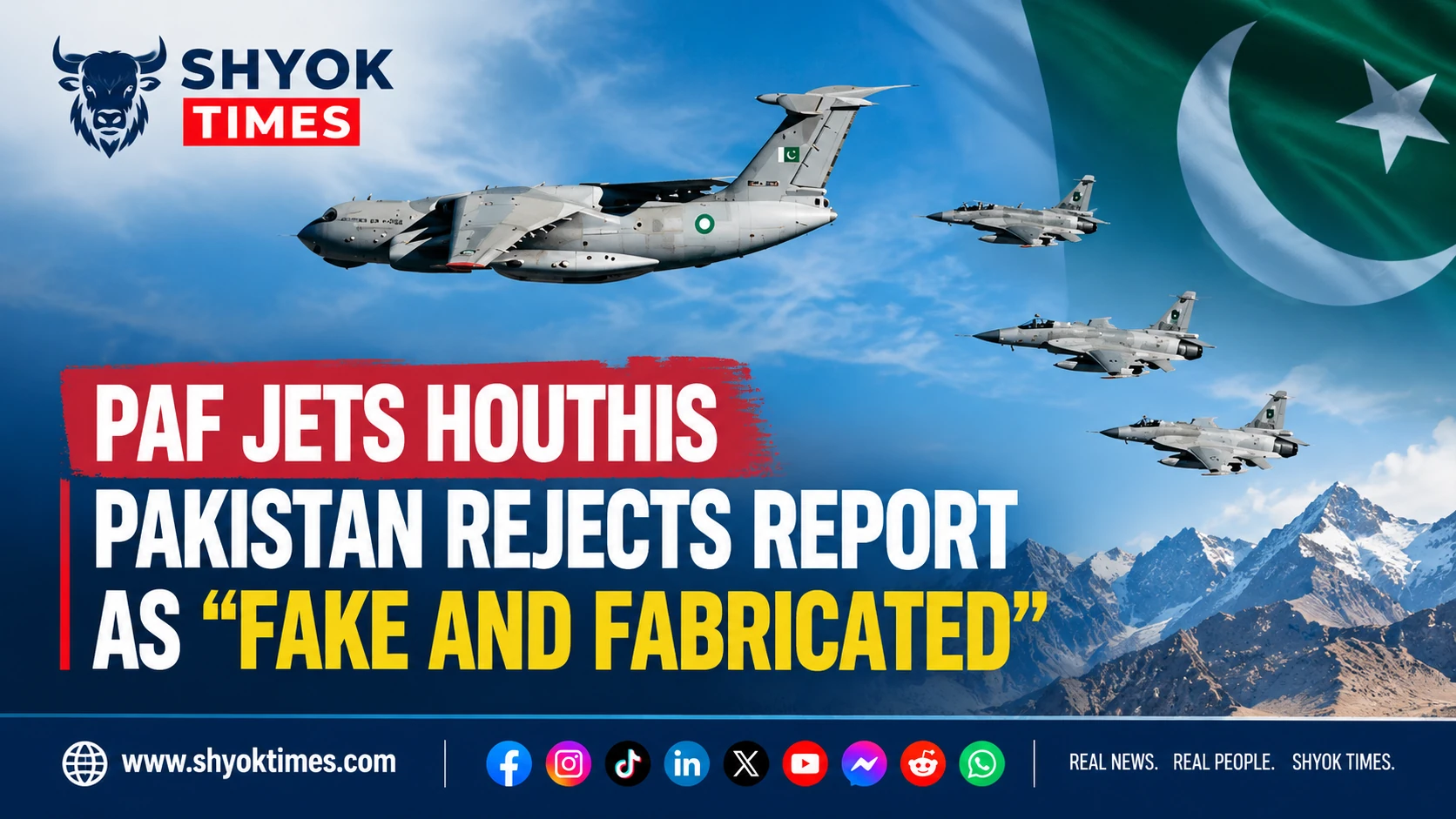
PAF Jets Houthis: 1 False Report Rejected | Shyok Times
PAF Jets Houthis: Pakistan Rejects Report as “Fake and Fabricated”
PAF Jets Houthis claims have triggered fresh controversy over Pakistan’s military role in the escalating Saudi-Houthi conflict, after Pakistan’s Ministry of Information and Broadcasting rejected a report alleging that Pakistan Air Force aircraft were being used in operations against Yemen’s Houthis.
The ministry described the report as “fake and fabricated” and urged international media organisations to avoid speculative reporting about the employment of Pakistani military forces under the Makkah Joint Defence Agreement. The original report, published by The New York Times on October 7, cited an unnamed source as claiming that PAF fighter jets were being employed against the Houthis.
𝐅𝐚𝐜𝐭 𝐂𝐡𝐞𝐜𝐤 | 𝐌𝐢𝐧𝐢𝐬𝐭𝐫𝐲 𝐨𝐟 𝐈𝐧𝐟𝐨𝐫𝐦𝐚𝐭𝐢𝐨𝐧 & 𝐁𝐫𝐨𝐚𝐝𝐜𝐚𝐬𝐭𝐢𝐧𝐠
— Fact Checker MoIB (@FactCheckerMoIB) October 8, 2026
▪️ NYT above referred story attributing employment of PAF aircraft against Houthis is fake and fabricated. International Media houses are again asked to avoid speculative reporting… pic.twitter.com/tqSZPNL01X
The Pakistani government’s rejection comes at a particularly sensitive moment. Pakistan, Saudi Arabia and Türkiye have moved to implement their newly established Makkah Joint Defence Agreement, while Saudi Arabia faces renewed attacks and military pressure linked to Yemen’s Houthi movement.
However, the official Pakistani position is that the claim about PAF aircraft participating in combat operations against the Houthis is false.
Pakistan Rejects PAF Jets Houthis Claim
Pakistan’s Ministry of Information and Broadcasting directly rejected the claim that Pakistan Air Force aircraft were being employed against Yemen’s Houthis.
In its response, the ministry said the report attributing the employment of PAF aircraft against the Houthis was “fake and fabricated.” It also warned international media organisations against relying on speculative reports concerning Pakistan’s military deployments under the Makkah defence framework.
The ministry said that any information concerning the employment of Pakistani military assets, if necessary, would be released by the relevant authorities.
This distinction is important because Pakistan has acknowledged a military presence in Saudi Arabia, but acknowledging troops in the kingdom does not establish that PAF fighter aircraft are conducting combat missions in Yemen.
Pakistan’s official clarification therefore challenges the specific allegation involving PAF jets rather than denying the broader defence relationship between Islamabad and Riyadh.
What Did the Report Claim?
The disputed report was published by The New York Times on October 7 and, according to Pakistan’s information ministry and Pakistani media reports, cited an unnamed source claiming that Pakistani fighter aircraft were being used against the Houthis.
The allegation emerged as Saudi Arabia and the Houthis face renewed military tensions.
The timing also coincides with the activation of practical measures under the Makkah Joint Defence Agreement, creating an environment in which speculation about Pakistan’s military role has intensified.
Pakistan has repeatedly stated that operational details concerning its armed forces are sensitive and that official authorities will announce relevant deployments when appropriate.
A separate Reuters report had previously claimed that Pakistan had deployed between 30,000 and 40,000 troops to Saudi Arabia. Pakistan’s Information Ministry also rejected that reporting as speculative, saying operational details of the defence arrangement were confidential.
𝐅𝐚𝐜𝐭 𝐂𝐡𝐞𝐜𝐤 | 𝐌𝐢𝐧𝐢𝐬𝐭𝐫𝐲 𝐨𝐟 𝐈𝐧𝐟𝐨𝐫𝐦𝐚𝐭𝐢𝐨𝐧 & 𝐁𝐫𝐨𝐚𝐝𝐜𝐚𝐬𝐭𝐢𝐧𝐠
— Fact Checker MoIB (@FactCheckerMoIB) October 6, 2026
▪️Having taken note of speculative reports by Reuters on Makkah Joint Defense Agreement, it is reiterated that Pakistan has already made Pakistan’s commitment to security of Haramain… pic.twitter.com/8AYC3m7yuL
Consequently, the latest dispute over PAF aircraft is part of a wider information battle surrounding the actual scale and nature of Pakistan’s military involvement in Saudi Arabia.
What Is the Makkah Joint Defence Agreement?
The Makkah Joint Defence Agreement was signed by Pakistan, Saudi Arabia and Türkiye in Makkah on August 7, 2026.
According to Pakistan’s Foreign Office, the agreement is designed to strengthen collective deterrence and defence cooperation among the three countries. It states that an armed attack against any one of the three states will be regarded as an attack against all three.
Pakistan has consistently described the agreement as defensive in nature.
The Foreign Office has stressed that the pact is intended to strengthen regional security, collective deterrence and the ability of the three countries to respond to external aggression. Pakistani officials have also said that the agreement is not directed against any particular country.
The agreement therefore creates an important framework for Pakistan’s security relationship with Saudi Arabia and Türkiye, but its existence alone does not prove that Pakistani fighter jets are conducting offensive operations in Yemen.
Makkah Pact Moves Into Practical Implementation
The defence agreement has moved beyond its initial signing stage.
On October 5, Pakistan, Saudi Arabia and Türkiye held an emergency meeting of the Strategic Political and Defence Committee of the Makkah Alliance for Defence in Riyadh.
The three countries agreed to move immediately toward the practical implementation of their collective defence commitments and to take measures to provide agreed military forces and capabilities for rapid deployment in Saudi Arabia, subject to approved arrangements and the national legislation of the participating countries.
The meeting also condemned attacks targeting Saudi territory, including threats against civilian and economic infrastructure.
The official statement said the three countries viewed the security of each member as part of their collective security and described the implementation process as a demonstration of their commitment to collective defence.
That development helps explain why questions about the precise role of Pakistani forces have become increasingly important.
At the same time, the official documents do not establish that PAF fighter aircraft have been deployed for combat against the Houthis.
Pakistan Confirms Troops Are Already in Saudi Arabia
Pakistan has not denied that Pakistani military personnel are present in Saudi Arabia.
Inter-Services Public Relations Director General Lieutenant General Ahmed Sharif Chaudhry said Pakistani troops have been stationed in the kingdom for decades and operate in multiple capacities.
This longstanding military cooperation predates the Makkah Joint Defence Agreement.
Pakistan and Saudi Arabia have maintained defence cooperation for decades, including training and other military activities. The new trilateral agreement adds another layer to that relationship by formalising collective defence cooperation with Türkiye.
The presence of Pakistani personnel in Saudi Arabia, therefore, should not automatically be interpreted as evidence that Pakistani combat aircraft are conducting operations inside Yemen.
That distinction is central to understanding the latest controversy.
What Pakistan Has Said About Its Possible Military Role
Pakistan’s position has evolved alongside the development of the Makkah agreement.
In September, Pakistan’s Foreign Office said operational questions concerning when, how, where and what force might be used remained subject to operational confidentiality.
The Foreign Office also explained that the Makkah agreement is primarily intended to strengthen regional peace and stability, defence cooperation, training, capacity-building, technology cooperation and collective deterrence.
This leaves a clear distinction between:
- Pakistan’s commitment to Saudi Arabia’s security;
- Pakistani military personnel already stationed in Saudi Arabia;
- future military capabilities made available under the Makkah agreement; and
- the specific allegation that PAF fighter jets are actively conducting combat operations against the Houthis.
The fourth claim is the one Pakistan has explicitly rejected.
Defence Minister Says Saudi Forces Are Conducting Combat Operations
The government’s position is also supported by comments attributed to Defence Minister Khawaja Asif.
According to the supplied report, Asif said Pakistan and Türkiye had a “presence in theatre” but clarified that Saudi forces were involved in combat operations.
That statement provides important context.
It suggests that Pakistan’s military presence in the region should not automatically be equated with direct participation in Saudi combat operations against Houthi forces.
The distinction is particularly significant because the Makkah agreement allows for collective defence cooperation while individual countries retain authority over the deployment and use of their forces under their own national laws and approved arrangements.
Why the Houthis Are at the Centre of the Crisis
The controversy surrounding PAF aircraft comes amid a significant escalation involving the Houthis and Saudi Arabia.
The Houthis have claimed attacks against Saudi targets, including missile and drone operations. Saudi authorities and Saudi-led forces have reported intercepting or destroying incoming threats and targeting Houthi military infrastructure.
Reuters reported this week that Saudi Arabia was preparing for a military offensive against Houthi forces in Yemen, with Yemeni forces expected to play a major role and Saudi Arabia providing air and intelligence support. Reuters also reported that Pakistan and Türkiye were providing military equipment and advisers but were not expected to engage directly in combat.
That reporting is significant because it independently indicates a distinction between support, military cooperation and direct combat involvement.
The situation nevertheless remains fluid.
Claims made by opposing sides in Yemen can be difficult to independently verify, particularly during rapidly changing military operations.
Rising Threats to Saudi Arabia
The security situation has intensified in recent weeks.
Saudi Arabia has faced reported missile and drone threats linked to the Houthi movement, while fighting has continued in Yemen between Houthi forces and Saudi-backed forces.
Shyok Times previously reported on Houthi attacks and threats around Riyadh, including claims involving missiles and drones targeting Saudi territory. Those earlier developments provide important background to the current debate over regional defence cooperation.
The renewed instability has also raised concerns about the security of the Red Sea and the Bab el-Mandeb Strait, one of the world's most strategically important maritime chokepoints.
For readers following the wider regional picture, Shyok Times has also reported on the reported Houthi advance around Yemen's Red Sea coastline and the potential implications for global shipping.
Why the PAF Jets Claim Matters
The allegation concerning PAF aircraft is significant because direct Pakistani air operations against Houthi forces would represent a major escalation in Pakistan’s military involvement in Yemen.
Pakistan has historically had to balance several strategic relationships in the region, including its close ties with Saudi Arabia, its relations with Türkiye and its broader diplomatic interests concerning Iran and Yemen.
A direct Pakistani air role could therefore have implications far beyond the battlefield.
It could affect Pakistan’s relations with regional states, increase the risk of retaliation against Pakistani interests, and potentially transform perceptions of the Makkah Joint Defence Agreement from a defensive framework into an active military coalition.
That is why the Pakistani government’s categorical rejection is important.
Fact-Check: What Is Confirmed?
Based on official statements and available reporting, several points can be separated from the disputed allegation.
Confirmed: Pakistan, Saudi Arabia and Türkiye signed the Makkah Joint Defence Agreement on August 7, 2026.
Confirmed: The agreement provides for collective defence and treats an armed attack against one member as an attack against all.
Confirmed: Pakistani military personnel are present in Saudi Arabia and have been there for decades in different capacities.
Confirmed: The three countries agreed on October 5 to move toward practical implementation of collective defence commitments and rapid deployment of agreed military capabilities.
Confirmed: Pakistan has repeatedly expressed support for Saudi Arabia's sovereignty, territorial integrity and security.
Rejected by Pakistan: The claim that PAF aircraft are being employed against Yemen’s Houthis. Pakistan’s Information Ministry called that report “fake and fabricated.”
Not independently established: The exact operational role, numbers and capabilities of Pakistani forces that may be involved under the Makkah framework. Pakistan has indicated that some operational information remains confidential.
What Happens Next?
The immediate question is whether the Makkah Joint Defence Agreement will lead to a larger and more visible military role for Pakistan and Türkiye in Saudi Arabia.
The October 5 decision confirms that the agreement is entering a more practical phase. However, the precise deployment and employment of military capabilities remain matters for the governments and military authorities involved.
For Pakistan, the challenge will be balancing its commitment to Saudi Arabia’s security with its stated preference for regional stability, diplomacy and defensive cooperation.
For Saudi Arabia, the priority is countering missile, drone and other security threats while maintaining the security of its territory and critical infrastructure.
For Türkiye, the agreement provides another mechanism for strengthening its regional defence partnerships.
For the broader region, the development could mark an important shift toward greater regional coordination in response to emerging security threats.
Bottom Line
The PAF Jets Houthis claim has been firmly rejected by Pakistan’s Ministry of Information and Broadcasting, which described the report alleging Pakistani fighter aircraft were being used against Yemen’s Houthis as “fake and fabricated.”
Pakistan’s military presence in Saudi Arabia is real and longstanding, and the Makkah Joint Defence Agreement is now moving into practical implementation. But those facts do not establish that PAF fighter jets are conducting combat operations against the Houthis.
The most reliable position at present is therefore to distinguish between confirmed Pakistani defence cooperation and unverified claims about direct PAF combat operations.
As tensions between Saudi Arabia and the Houthis continue, further official statements will be important in determining the exact role of Pakistani forces.
Until Pakistan’s competent authorities announce otherwise, the specific claim that PAF aircraft are being used against the Houthis remains officially rejected by Islamabad.
Shyok Times News Desk will continue to monitor developments and update readers as verified information becomes available.
External Resources (DoFollow):
Read further at Business Recorder: Pakistan rejects NYT report on PAF jets in Saudi operation against Houthis
Follow more on Pakistan Today: Pakistan rejects report claiming PAF aircraft used against Houthis
Keep reading via DAWN: Info ministry rejects NYT report claiming PAF jets being used against Yemen's Houthis